.png)
The Soft Play Market in 2026: A Data-Driven Guide for Equipment Buyers
The soft play equipment industry is not a niche corner of the toy world. It is a multi-billion-dollar global market undergoing structural transformation. If you are sourcing equipment for a daycare chain, launching an indoor playground, stocking an e-commerce store, or bidding on a school district contract, the numbers behind this market are not background trivia. They are the logic that shapes your supplier options, your pricing power, and your competitive position over the next three to five years.
This guide combines market intelligence with a practical supplier evaluation framework. Understanding the market is only half the equation. Knowing how to act on that understanding is what separates buyers who find reliable partners from those who learn expensive lessons.
How Big Is the Soft Play Equipment Market?
Before diving into segments and trends, let’s anchor on the numbers. The global soft play equipment market is big enough to demand attention, and growing fast enough to reward early movers.
Global Market Size — How Big Is “Big”?
Depending on how you define the category, the global soft play equipment market was valued between $3.2 billion and $5.1 billion in 2024. The lower figure (WiseGuy Reports) focuses narrowly on foam-based soft play structures: climbing frames, ball pits, modular play systems, and padded mats. The higher estimate (DataIntelo) includes a broader scope — indoor playground installations, themed play zones, and integrated commercial play spaces. Both numbers are credible; the gap simply reflects where you draw the category boundary.
For context: even the conservative $3.2 billion figure makes soft play equipment a meaningful segment within the broader $100+ billion global toy and playground industry. It is larger than the global puzzle market and roughly comparable in scale to the commercial trampoline park equipment sector.
Growth Trajectory — How Fast Is It Moving?
The market is not just large — it is accelerating. Most research firms project a compound annual growth rate (CAGR) between 3.9% and 8.5% through the early 2030s. The conservative end (WiseGuy Reports) forecasts the market reaching approximately $5.0 billion by 2035. The more bullish projection (MarketIntelo) sees nearly $9.6 billion by 2033.
The Asia-Pacific region is the standout growth engine, with a projected CAGR of approximately 11.2% — nearly triple the rate of mature North American and European markets. This regional divergence has practical implications: as Asian demand scales, manufacturing capacity in China will face increasing competition between export and domestic orders. China is where the majority of global soft play production is concentrated. Buyers who secure supplier relationships now are effectively locking in capacity before the demand curve steepens further.
What’s Driving the Growth?
Four structural forces are pushing the market forward. None of them are short-term fads.
Urbanization and shrinking outdoor space. The UN projects that 68% of the global population will live in cities by 2050, up from 57% in 2023. As backyards shrink and outdoor playgrounds face space constraints, indoor soft play becomes the substitute. Shopping malls, residential complexes, and community centers are installing play zones not as amenities but as traffic drivers.
Early childhood development awareness. Parents and educators increasingly understand that structured physical play is foundational to motor skill development, social learning, and cognitive growth — not optional. This has shifted soft play equipment from a “nice-to-have” to a “must-have” in daycare licensing requirements across multiple U.S. states and European countries.
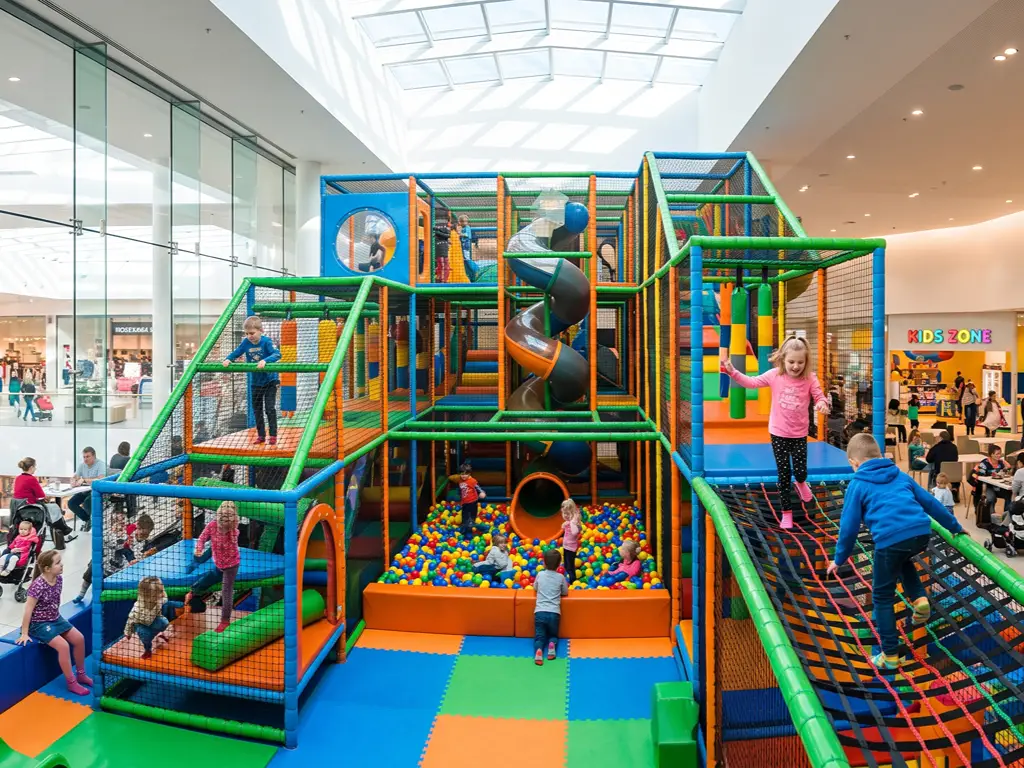
Commercial real estate’s experience pivot. Brick-and-mortar retail is losing to e-commerce on product selection and price, so it competes on experience. A shopping mall with a soft play zone keeps families on-site 45–90 minutes longer, directly increasing food court and retail spend. Family entertainment centers (FECs), hotels, and even airports are following the same playbook.
Emerging market middle-class expansion. Rising disposable incomes in India, Southeast Asia, Latin America, and Africa are creating millions of first-time buyers of structured play experiences. These markets are price-sensitive but volume-hungry. They represent a different procurement profile than the certification-heavy Western markets, but a demand pool too large to ignore.
Understanding Market Segments — Who’s Buying What?
“Soft play equipment” is not one product sold to one type of buyer. The market splits across four dimensions, and each split changes who your competitors are and what your supplier needs to deliver.
By Product Type
| Product Category | Approx. Revenue Share | Growth Heat | Typical Buyer |
|---|---|---|---|
| Climbing structures & frames | ~35% | High | Indoor playgrounds, FECs |
| Ball pits & slides | ~25% | Medium-High | Daycare centers, kindergartens |
| Modular soft play systems | ~20% | High | Shopping malls, hotels, multi-use venues |
| Soft play mats & foam blocks | ~10% | Medium | Early learning centers, home use |
| Tunnels, balance beams & other | ~10% | Medium | Therapy centers, schools |
By End User
Different end users have fundamentally different procurement behaviors. The supplier that excels for one may fail for another.
| End User | Purchase Characteristics | Decision Cycle | Typical Budget Range |
|---|---|---|---|
| Indoor playgrounds / FECs | Large volume, theme-driven, design-intensive | 2–6 months | $40,000–$200,000+ |
| Daycare centers / preschools | Safety-compliance priority, medium volume | 1–3 months | $10,000–$50,000 |
| Shopping malls / hotels | Aesthetics + safety, small-to-medium footprint | 1–2 months | $15,000–$60,000 |
| Schools / school districts | Tender-based procurement, heavy documentation | 3–12 months | $20,000–$100,000+ |
| Amazon / e-commerce sellers | Small-batch testing, patent protection priority | 2–4 weeks | $5,000–$30,000 |
By Material Type
| Material | Share | Strengths | Typical Application |
|---|---|---|---|
| High-density foam (EPE/EPP) | ~60% | Lightweight, impact-absorbing, cost-effective | Core structural bodies |
| Plastic (PE/PP) | ~20% | Durable, easy to sanitize | Connectors, slides, shells |
| Fabric / PVC covering | ~15% | Soft-touch, customizable colors/patterns | Outer upholstery |
| Rubber | ~5% | Anti-slip, shock-absorbing | Floor mats, base pads |
Quality note: Commercial-grade EPE foam should register at least 40 kg/m³ in density. Anything below 25 kg/m³ is household-grade — it compresses within months, loses impact absorption, and creates a safety hazard. PVC covers under 0.35 mm thickness will fade, tear, and delaminate within one to two years of commercial use. These are not cosmetic differences; they are the line between a three-year asset and an eight-year asset.
By Age Group
| Age Group | Product Characteristics | Safety Requirement Level |
|---|---|---|
| Toddlers (1–3 years) | Low height, fully rounded edges, all-soft surfaces | Highest |
| Preschoolers (3–6 years) | Moderate height, climbing elements introduced | High |
| School-age (6–12 years) | Greater challenge, complex structures, mixed materials | Medium-High |
Key Trends Reshaping the Soft Play Industry
Trends in this industry are not abstractions. Each one rewrites part of your supplier evaluation checklist.
Technology integration. Augmented reality overlays, interactive projection floors, and sensor-triggered sound/light effects are moving from trade-show demos to commercial installations. The AR-in-play segment alone is projected to reach approximately $350 million globally by 2025. For buyers, this means asking a new question during supplier evaluation: does the manufacturer have in-house electronic integration capability, or is it outsourcing? The difference shows up in lead times, warranty coverage, and long-term maintenance complexity.
Sustainable and non-toxic materials. European buyers in particular are facing tightening requirements under the EU Green Deal and related circular-economy regulations. Recyclable foam formulations, water-based adhesives, and FSC-certified wood components are shifting from “nice-to-have” to “procurement requirement.” Even in North America, large institutional buyers — school districts, municipal contracts — are adding sustainability criteria to RFPs. If your supplier cannot document material provenance, you may win the bid on price and lose it on compliance.
Modular and reconfigurable design. Fixed play structures lock operators into a single layout for the equipment’s entire lifespan. Modular systems let components be rearranged, expanded, or repurposed. This reduces long-term cost by extending the equipment’s perceived freshness. For buyers, the math is simple: a higher return on the initial investment and a stronger negotiating position with the supplier. You are buying a platform, not a one-time installation.
Inclusive play for children with special needs. Sensory-friendly equipment — muted colors, varied textures, reduced noise profiles, wheelchair-accessible routes — is one of the fastest-growing sub-segments. This is not just an ethical imperative; it is a market opportunity. An indoor playground that advertises “sensory-friendly sessions” can access a customer segment that most competitors ignore entirely. For equipment buyers, specifying inclusive design features at the RFP stage can differentiate a bid in a crowded tender process.
Regional Market Dynamics — Where Is the Opportunity?
The soft play market is global, but the rules of engagement vary sharply by region.
North America holds the largest single share at approximately 38% of global revenue, roughly $1.2 billion in 2024. The U.S. market is defined by its safety enforcement infrastructure. ASTM F1918 governs soft contained play equipment specifically. The Consumer Product Safety Improvement Act (CPSIA) mandates third-party testing for children’s products. Liability insurance carriers often impose additional requirements beyond the legal minimum. For any buyer targeting the U.S. market, a supplier without current, in-scope ASTM and CPC documentation is not a viable option. Period.
Europe is a similarly mature market with its own regulatory framework. EN 1176 (Parts 1–11) covers playground equipment safety, and EN 1177 governs impact-attenuating surfacing. The European market places higher weight on environmental compliance than any other region. A supplier’s ability to document material composition and recyclability is often a gatekeeping requirement for institutional contracts.
Asia-Pacific is the growth story. With a projected CAGR of approximately 11.2%, the region is adding demand faster than any other. China alone accounts for a significant share of both production and consumption. The same factories that export to Walmart and Target are increasingly filling domestic orders for China’s own expanding network of indoor play centers. India and Southeast Asia are following, driven by urbanization and the rapid expansion of organized retail. Price sensitivity is higher in these markets, but volume growth creates opportunities for suppliers who can deliver compliance at competitive price points.
Latin America, the Middle East, and Africa are emerging markets with strong demographic tailwinds. Government investment in child recreation infrastructure — particularly in Gulf states and major Latin American cities — is driving tender-based procurement. These markets reward suppliers who can produce comprehensive documentation packages: certificates, material test reports, installation guides, and maintenance schedules that satisfy institutional purchasing protocols.
How to Evaluate Soft Play Equipment Suppliers — A Practical Framework
Here is where most online content lets you down. Search for “soft play market” and you will find plenty of market sizing reports. Search for “how to choose a soft play supplier” and you will find manufacturer blogs that all conclude with “choose us.” What follows is a neutral, dimensional framework for evaluating any supplier, no matter where they are located or how they market themselves.
The core principle: certificates prove the floor; systems prove the ceiling. Most buyers check whether a supplier has certificates. Far fewer check whether the compliance system behind those certificates is actively maintained, whether materials are traceable to specific production batches, whether design capability is in-house, or whether post-sales support has documented response times. The five dimensions below are your evaluation checklist — and your negotiation leverage.
Certification & Compliance — Beyond the Certificates
A supplier’s certificate wall can be misleading. Certificates expire. Scopes change. A CE mark issued for plastic slides does not cover foam climbing structures. A CPC certificate from three years ago does not prove the factory passed its most recent audit.
For soft play equipment, the essential certifications by market are:
- ASTM F1918 — U.S. safety standard for soft contained play equipment. Covers structural integrity, entrapment hazards, and impact attenuation specific to foam-and-fabric play structures.
- EN 1176 / EN 1177 — European playground equipment and surfacing standards. EN 1176 Part 1 covers general safety; subsequent parts address specific equipment types.
- CPC (Children’s Product Certificate) — Required under U.S. CPSIA for all children’s products. Must be based on third-party lab testing, not self-declaration.
- CE marking — Required for products sold in the European Economic Area. Indicates conformity with applicable EU health, safety, and environmental requirements.
- BSCI (Business Social Compliance Initiative) — A factory-level social audit covering labor practices, working conditions, and environmental management. Not a product safety certificate, but increasingly requested by institutional buyers as part of ESG procurement policies.
When you ask a supplier for certifications, go beyond “do you have it?” Ask four verification questions:
- Is the certificate currently valid? Request the issue date and expiry date. A certificate expired six months ago is not a certificate — it is a liability.
- Does the scope cover your specific product type? A valid ASTM F1487 (general playground) certificate does not cover soft contained play equipment, which falls under ASTM F1918. Confirm scope, not just presence.
- Can the supplier provide a third-party audit report from the last 12 months? A certificate is a point-in-time document. A recent audit report shows the compliance system is alive, not dormant.
- Are material test reports independent of finished-product certificates? Ask for SGS, Intertek, or equivalent lab reports on raw foam density, PVC phthalate content, and fabric flame retardancy — not just the final assembly certificate.
These four questions separate suppliers who maintain compliance as an ongoing discipline from those who obtained certificates once and let the system decay. Consider this example: a manufacturer with an independently BSCI-audited facility, current CPC, CE, and ASTM documentation, and a verifiable 10-year safety record demonstrates the kind of compliance infrastructure that institutional buyers should look for (Startinal). The certificates themselves are table stakes. The system behind them is the differentiator.
- Certificate issue/expiry dates confirmed
- Product scope matches your order category
- Third-party audit report ≤12 months old
- Independent material test reports (foam density, PVC, flame retardancy)
Material & Manufacturing Quality — What’s Behind the Foam
Materials are the single largest determinant of equipment lifespan. And cost-cutting in materials is the hardest thing to detect from a product photo.
Foam density and type. Commercial-grade EPE (Expanded Polyethylene) foam should measure 40–45 kg/m³. At this density, foam maintains its shape and impact-absorption properties through years of daily use. Below 25 kg/m³ — common in budget-tier products — foam compresses within months. The result is not just an ugly product; it is a safety failure. Compressed foam no longer meets the impact attenuation requirements it was certified for. The replacement cost of low-density foam over a six-to-eight-year ownership period often exceeds the upfront savings.
PVC covering. The outer upholstery on soft play equipment takes the brunt of daily wear. Commercial-grade PVC covers should measure at least 0.45 mm in thickness, with UV-stabilization for colorfastness and antimicrobial treatment for hygiene. Thinner covers (under 0.35 mm) develop cracks at stress points — corners, seams, and climbing holds — within 12–18 months of commercial use. When the cover fails, moisture penetrates the foam core, and the entire unit becomes a mold risk.
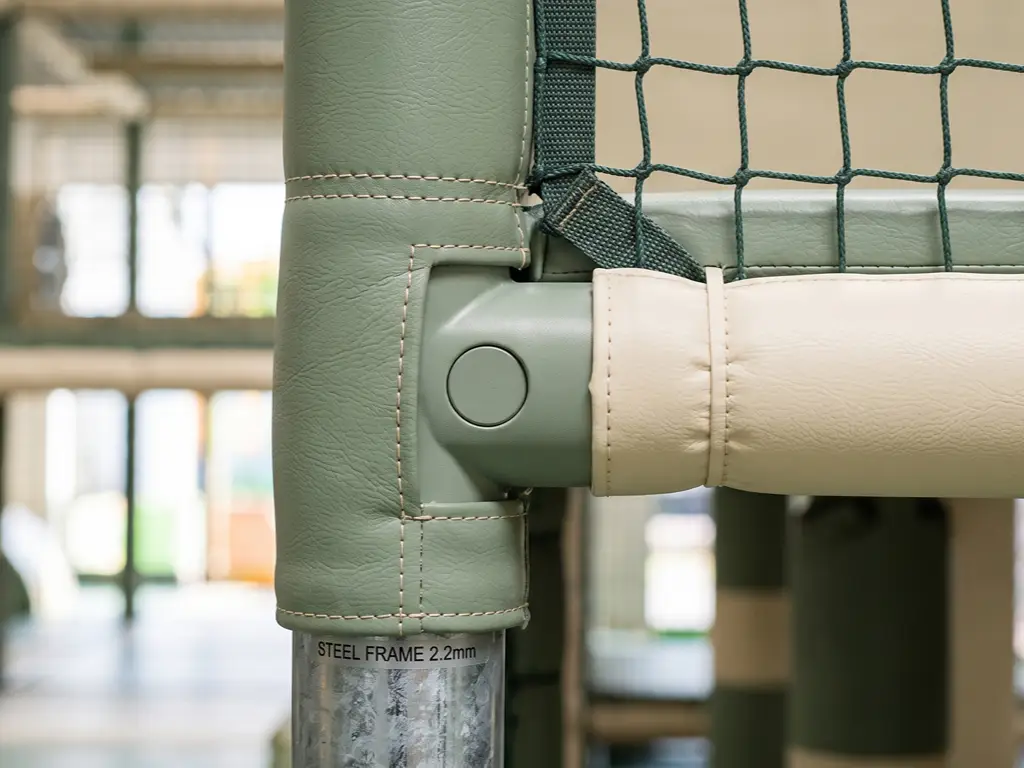
Structural components. Steel pipes used in soft play frames should measure Φ48 mm outer diameter with 2.0–2.5 mm wall thickness. Thinner tubing (1.2–1.5 mm) is common in low-cost production and visibly flexes under load. Weld quality at connection points is equally important. Cold or incomplete welds are the most common point of structural failure in budget equipment.
Factory-floor checklist for material verification:
- Request the foam density test certificate for your specific production batch (not a sample from a different run)
- Ask for PVC thickness measurement data with batch traceability
- Verify that flame retardancy certification (BS 5852 or CAL 117) covers the specific fabric lot being used
- Confirm that colorfastness is tested to at least Grade 4 on the blue-wool scale
- Check whether the factory maintains incoming material inspection (IQC) records. If they cannot show you batch-level receiving inspection data, assume materials are accepted on trust.
Design & Engineering Capability — Not Just “Can You Make It,” but “Can You Think?”
The difference between a contract manufacturer and a design partner is the difference between receiving what you asked for and receiving what your business actually needs.
A supplier with in-house design and engineering capability can:
- Produce 2D CAD layout plans showing equipment placement, safety clearances, and traffic flow — critical for space-constrained venues
- Generate 3D renderings for stakeholder approval before production begins
- Propose product combinations based on your target age group, space dimensions, and throughput goals — not just sell you a catalog item
- Hold design patents that protect your product from copycat competition — especially important for private-label and e-commerce sellers
Four signals of genuine design capability:
- R&D team size and location. A supplier with a dedicated design team co-located with the factory can turn concept sketches into prototypes in days, not weeks. When design is outsourced to a third-party studio, every revision cycles through external communication. This adds time and introduces translation errors.
- New product introduction cadence. A manufacturer launching 100+ new styles per quarter has an active R&D engine, not a stagnant catalog. Market trends in children’s products move fast. A supplier that only refreshes its catalog annually is asking you to bet your inventory on last year’s trends.
- Patent portfolio. Patents — particularly utility and design patents filed in your target market (U.S., EU, China) — protect your product’s exclusivity. Without patent protection, a successful product will be copied within one trade show cycle.
- Customization depth. Can the supplier adjust dimensions, colors, logos, packaging, and structural modifications — or only the surface graphics? The deeper the customization capability, the more the supplier functions as your manufacturing partner rather than a fulfillment vendor.
Quality Assurance — The System Behind Every Shipment
Quality is not inspected into a product at the end of the line. It is built in at every stage. Or it is not there at all.
A credible QA system has four layers:
Incoming Quality Control (IQC). Raw materials — foam sheets, PVC rolls, steel pipes, plastic pellets — are tested upon arrival against specification before they enter the production floor. If a supplier cannot show you IQC records organized by supplier batch, the factory is accepting materials on faith.
In-Process Quality Control (IPQC). Inspection points are embedded at key production stages: foam cutting accuracy, welding integrity, cover stitching seam strength, assembly fit. The frequency and documentation of these checks determine whether defects are caught during production or discovered by your customer.
Outgoing Quality Control (OQC). Pre-shipment inspection (PSI) follows AQL (Acceptable Quality Limit) sampling standards — typically AQL 2.5 for major defects, AQL 4.0 for minor defects. A supplier who resists third-party or buyer-nominated inspection is a supplier with something to hide.
Internal laboratory capability. Does the supplier have in-house testing equipment — foam density meters, tensile testers, colorfastness chambers — or does every test require an external lab? The difference is not just cost; it is lead time. An external lab adds five to seven days to every quality check cycle. An internal lab produces same-day results, keeping production and shipping on schedule.
| QA Dimension | Green Light | Red Flag |
|---|---|---|
| IQC | Batch-level receiving inspection records | “We trust our suppliers” |
| IPQC | Documented checkpoints with frequency | No inspection between start and finish |
| OQC | AQL-based PSI, third-party welcome | “Quality speaks for itself” |
| Internal Lab | In-house calibrated equipment | All outsourced, 1-week turnaround |
Post-Sales Support — The Relationship After the Invoice
The lowest price on a purchase order means nothing if a broken component takes three weeks to replace during peak season.
Evaluate post-sales support across five dimensions:
Installation support. Does the supplier provide installation manuals with exploded-view diagrams? Video walkthroughs? Remote support via video call? On-site installation teams? The right level depends on your operation. A daycare owner assembling a small soft play corner needs different support than a mall operator installing a 400 m² themed play zone.
Spare parts availability. Commonly worn parts — foam blocks, PVC covers, connectors, netting — should be available from stock with short lead times (under seven days). A supplier that needs to set up a production run for every spare part order runs a business model that does not include post-sales service.
Warranty terms. Standard industry warranty for commercial soft play equipment ranges from one to three years on structural components and six to twelve months on wear items (covers, foam). Read the exclusions carefully. Some warranties exclude commercial use entirely — useless for business buyers.
Response time. A 48-hour initial response window is the B2B industry benchmark. Beyond that, the supplier should commit to a resolution timeline: replacement parts shipped within X days, technical assessment completed within Y days. If these commitments are not in the contract, they do not exist.
Value-added services. Some suppliers provide marketing asset kits — professional product photography, spec sheets, and short promotional videos — that save buyers thousands in content production costs. Others share market trend intelligence to help buyers stay ahead of category shifts. These services do not replace core quality, but they separate suppliers who see themselves as long-term partners from those optimizing for single transactions.
What This Means for Buyers in 2026 and Beyond
The soft play equipment market is at an inflection point. Demand is rising across all major regions. Safety standards are tightening, not loosening. The supplier base is consolidating at the quality end while fragmenting at the budget end. In this environment, three conclusions matter:
First, the supplier selection window is narrowing. As demand grows — particularly from Asia-Pacific and institutional buyers — the most capable manufacturers will fill their production capacity. Buyers who establish relationships now will have priority when lead times stretch. Buyers who wait will compete for residual capacity.
Second, compliance is becoming the cost of entry, not a differentiator. Five years ago, a supplier with ASTM and CE certification stood out. Today, those certificates are baseline expectations. The new differentiators are compliance-system integrity, material traceability, and in-house design capability — the dimensions that separate suppliers who check boxes from suppliers who build partnerships.
Third, the evaluation framework in this guide is your competitive advantage. Most buyers evaluate suppliers on two dimensions: price and certificates. You now have a five-dimensional framework. Use it. When you receive a quote, ask the IQC question. When you see a certificate, ask for the batch-level material test report. When you hear “we can customize,” ask about the R&D team’s size and patent portfolio.
Action checklist for buyers sourcing in 2026:
- Shortlist two to three candidate suppliers and run each through the five-dimension framework above
- Request batch-level material test reports — not just finished-product certificates — from every candidate
- Confirm certification currency (expiry dates) and scope (does it cover your specific product type?) for your target market
- Factor post-sales response commitments into the total cost of ownership, not just the unit price
- Consider locking in supplier relationships and pricing now, while capacity is more available than it will be in 12–24 months
The soft play market is growing. So is the sophistication of the buyers who succeed in it. The question is not whether the market will reward good sourcing decisions. The question is whether your sourcing process is built to make them.
The soft play equipment market is projected to grow from $3.2–5.1 billion (2024) to $5.0–9.6 billion by the early 2030s. Buyers who adopt a structured supplier evaluation framework — covering certifications, materials, design capability, QA systems, and post-sales support — will secure better pricing, more reliable quality, and stronger long-term partnerships than those who compare on price and certificates alone.
References
- WiseGuy Reports. “Global Soft Play Equipment Market Research Report: Forecast to 2035.” 2025. wiseguyreports.com
- DataIntelo. “Soft Play Equipment Market Research Report 2033.” 2025. dataintelo.com
- QY Research. “Global Soft Play Equipment Market Research Report 2025.” 2025. qyresearch.com
- MarketIntelo. “Soft Play Equipment Market Research Report 2033.” 2025. marketintelo.com
- Bailu Toy. “2026 Global Indoor Playground Equipment Market Trends.” 2026. bailutoy.com
- United Nations Department of Economic and Social Affairs. “World Urbanization Prospects.” 2018 Revision. population.un.org
- Startinal. “About Us.” startinal.com
- Startinal. “Why Startinal.” startinal.com
- Startinal. Homepage. startinal.com
- Startinal. “Contact Us.” startinal.com