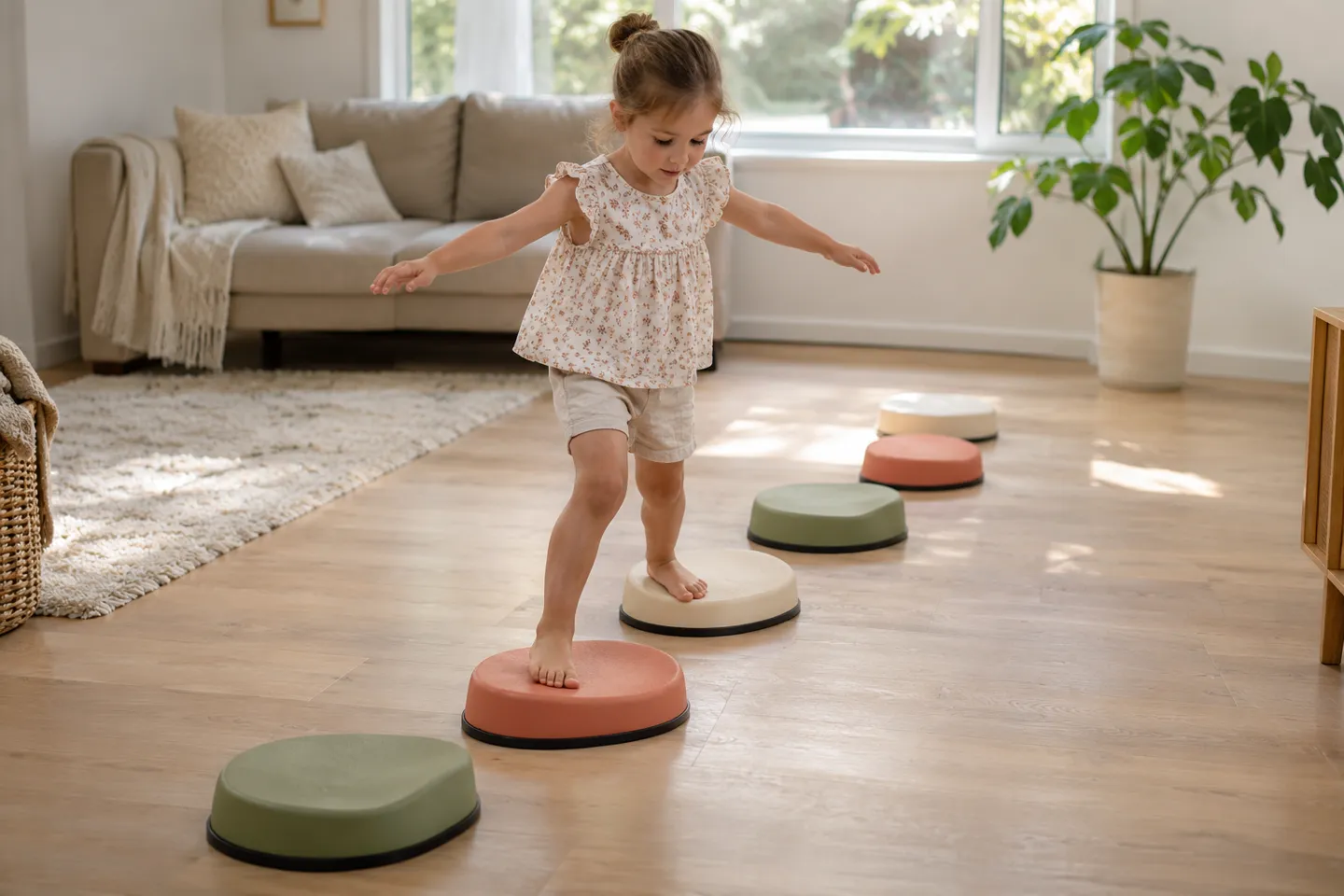
A plastic balance beam set with a handful of stepping stones costs $19.99 on a Target shelf (Target, 2026). A competition beam bolted down in a gymnastics facility lists at $5,630 (Spieth America, 2026). Both products answer to the same name, and both show up when someone checks balance beam prices. The gap between them is not a pricing accident. It is four separate costs stacked on top of each other, and most price guides never separate them.
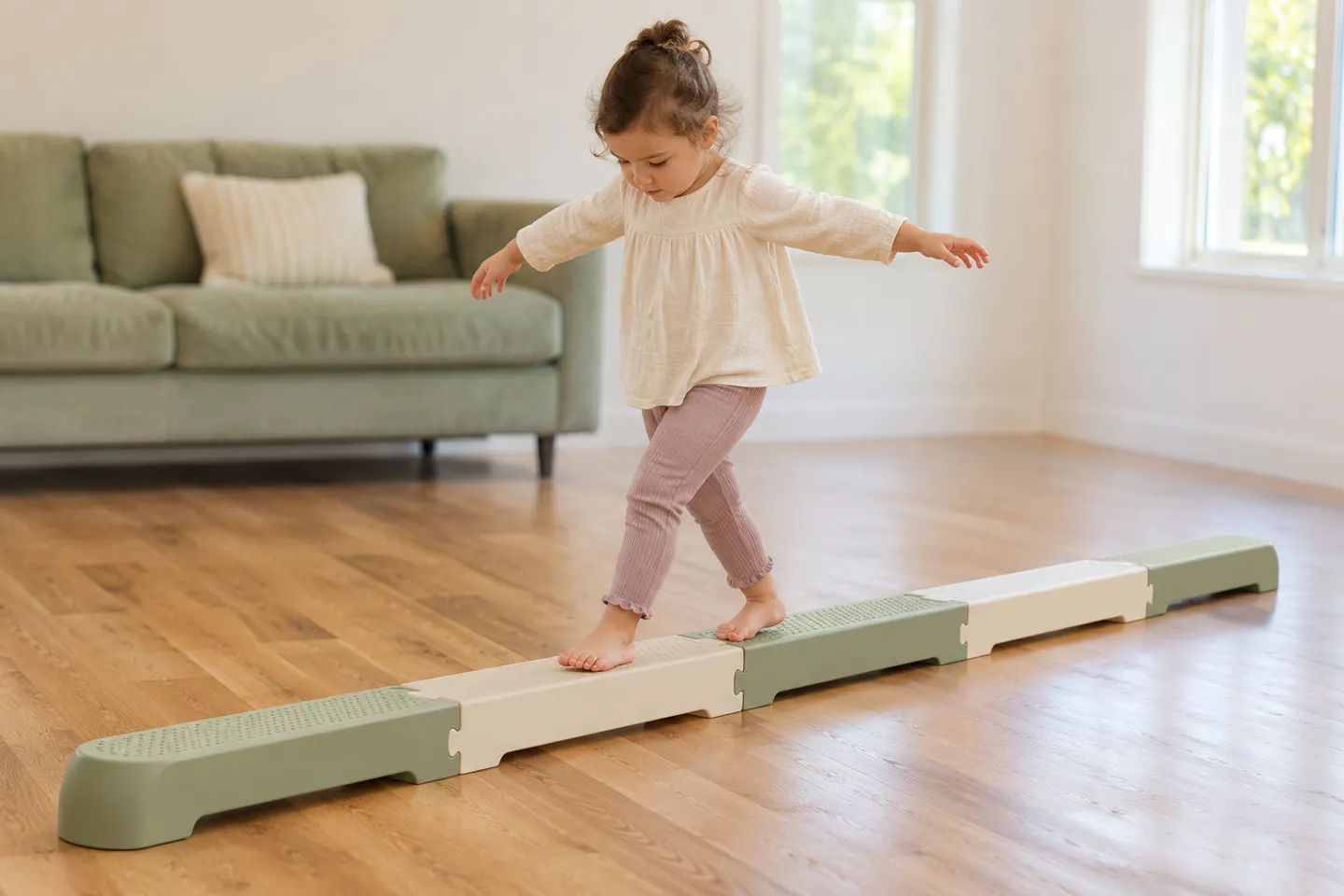
Quick spelling first, because the word collides with two other products. This article is about the beam you walk on, the one toddlers wobble across and gymnasts train on. It is not the steel I-beam that holds up buildings, and it is not the beam balance in a laboratory. If that is what you came for, the numbers below will not help you.
For everyone else, the whole market fits in one table.
| Product tier | Example | Price | Who buys it |
|---|---|---|---|
| Sensory play set (beam sections + stones) | B. toys Balance & Build at Target | $19.99 | Parents of toddlers |
| Folding foam floor beam | Marfula, Amazon’s best-selling beam line | around $46 | Families with young kids |
| Low-profile training beam, 4 to 8 ft | The Beam Store, wood core | $174.99 to $274.99 | Gymnastics families |
| Raised training beam with legs | The Beam Store, 12 to 30 in legs | $349.99 to $519.99 | Serious home practice |
| Long sectional beams, 10 ft and up | The Beam Store, freight shipped | $999.99 | Home gyms, small clubs |
| Specialty series beams | Midwest Gym Supply 100 Series | $1,400 | Programs and studios |
| Competition beams | Spieth America Soft Touch | $5,630 | Gymnastics facilities |
Same category, roughly 280 times the price from the cheapest entry to the most expensive one. No other piece of children’s play equipment spreads that wide. Once you can read why, every quote you see, retail or wholesale, becomes legible. The rest of this article walks the four layers in order: structure, material, compliance, and channel.
One category, one product name
The spread is four cost layers stacked, not one product with random markups.
The Structure Layer: Height Sets the Price
Ask what a balance beam costs and the honest answer starts with a second question: how far off the floor? Height drives structure, structure drives cost, and every rung on that ladder fails in its own way.
The five rungs, and what each one costs
The floor line comes first, and it is free. A strip of painter’s tape on the floor gives a one-year-old a visible path with zero fall risk. Most child development advice agrees this is where balance training actually starts, raised beams included.
The low wooden beam is the first rung that costs money. A 4×4 post laid on flat ground gives a real edge under small feet, and the lumber runs about ten dollars. A padded version with legs, fabric and finished edges lands between $31 and $38 in materials, plus an afternoon of build time. Parents keep publishing these builds every year because the math keeps working.
The folding foam beam is where retail starts. The best-selling folding line on Amazon (Marfula, 6 to 9 ft, suede cover, anti-slip base) sells in the $46 range (Amazon best sellers, 2026). You are paying for portability and storage, not for feel. The beam sits 3 inches high and folds flat under a bed.
The low-profile training beam is the entry point of “real” gymnastics feel. The Beam Store’s 8 ft low-profile beam lists at $274.99, down from $399.99 (The Beam Store, 2026). Its work surface is 4 inches wide, the same as a competition beam, with a 7 inch profile and a 250 lb weight limit. Add metal legs at 12, 18, 24 or an adjustable 30 inches and the price moves to $349.99 and up. Go longer and the price curve bends sharply. The Beam Store’s 10 ft sectional costs $999.99, weighs 140 lb, and ships by freight in a wooden crate. A longer span between legs needs stronger construction, more material, and freight handling.
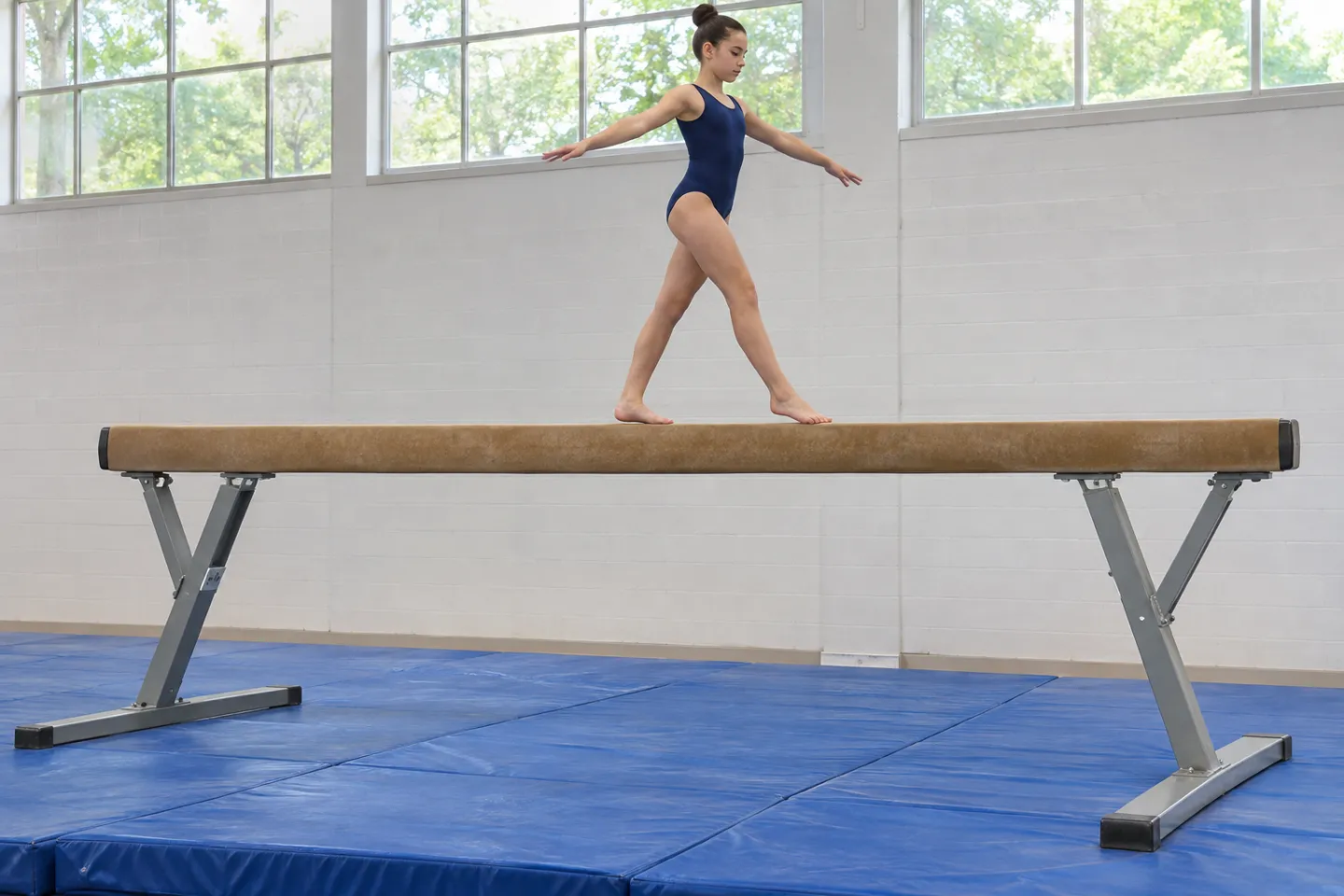
The competition beam sits at the top, and its three numbers never change. The apparatus is 10 cm (4 in) wide, 5 meters (16.4 ft) long, and raised 125 cm (4.1 ft) (Encyclopaedia Britannica, 2026). At that height, padding density, spring response and anchoring become engineering problems, which is why facilities pay $2,000 to $5,630 for apparatus from AAI, Spieth or GMR.
Why cheap beams wobble, and stable ones don’t
Sideways tipping is a base-width problem, not a luck problem. The folding beams that don’t tip put a 6 inch base under a 4 inch work surface. The raised training beams go further, mounting on steel support braces 12 inches wide or wider (The Beam Store, 2026). The wider the footprint relative to the height, the more sideways force it takes to roll the whole thing over.
Connection quality is the other half. A leg attached with one screw per joint rocks no matter how tight it feels. Through-bolted joints with glue hold their geometry for years. And the floor matters more than buyers expect: hard flooring shows every wobble, thick carpet can rock a tall narrow base, and a slick floor defeats a thin anti-slip pad.
Regulators read the same geometry through fall height. The CPSC’s Public Playground Safety Handbook defines a balance beam’s fall height as the distance from the top of the walking surface to the protective surfacing below it (U.S. Consumer Product Safety Commission, 2025). The higher the beam, the more the ground under it matters.
The DIY boundary: four situations where building stops making sense
A DIY beam is a fine tool right up until one of four things happens. Each one has a quick self-check.
Four tripwires that end the DIY math
- 1Skills go airborne. Jumps and dismounts multiply landing force, and homemade joints have no tested rating for that.
- 2Users go over 100 lb. A span solid under a 40 lb child flexes differently under an adult.
- 3Traffic goes institutional. A beam serving dozens of daily users needs a fatigue rating no homemade build has.
- 4The setting gets licensed. Inspectors ask for documentation a homemade beam cannot show.
If none of those tripwires fire, build freely and keep it low. If one fires, the buying question changes. It is no longer “which one” but “what do I require”: a stated load rating, a base wider than the work surface, and certification for your market.
Every rung also fails in its own predictable way, which is what the price steps are actually buying down.
Balance beam types: fit, failure and upgrade signals
| Type | Best for | Main failure mode | Signal to move up |
|---|---|---|---|
| Floor line (tape, chalk) | Toddlers 1-3, first balance play | Slides on hard floors; too easy past age 4 | Child crosses without looking down; wants a real edge |
| Low wooden beam (2×4/4×4) | Ages 3-6, defined-edge practice | Splinters, narrow-base wobble, floor scuffs | Skills add jumps, turns, dismounts |
| Folding foam beam | Ages 4-8, portability and storage | Foam compresses, cover shifts, slides on slick floors | Practice gets regular (3+ sessions a week) |
| Low-profile training beam | Ages 6+, real gymnastics feel | Cover wear at ends; needs floor space | Coach confirms beam skills in training plans |
| Raised beam with legs | Home rehearsal at height | Falls now need mats; joints need checking | Any airborne skill, or adult use |
| Sectional / long beams | Garage gyms, small clubs | Freight cost, floor loading, assembly | Program outgrows 8 ft length |
| Competition beam | Facilities only | Cost, anchoring and mats are mandatory | Not applicable, this is the ceiling |
The Material Layer: What the Money Buys in Durability
At the same height, the material decides how long the beam lives, how it handles cleaning, and what it will be worth used. Four families cover the market.
| Material | Feel and handling | Durability | Hygiene | Typical band | Best fit |
|---|---|---|---|---|---|
| Wood core + suede cover | Competition-like, firm, grippy | Strong; quality builds carry 250 to 350 lb limits and 2-year warranties | Suede wipes down; no soaked foam | $174.99 to $1,330 | Home training, clubs |
| Folding foam | Soft, light (about 16 lb), portable | Foam compresses with hard use; cover seams shift first | Cover wipes; foam inside stays vulnerable | $46 to $120 | Young kids, small spaces |
| Hard plastic (PP body, TPE base) | Textured tops, modular pieces | Weatherproof, stackable, survives outdoors | Rinse-safe, whole piece | $19.99 to $150 | Toddlers through primary, classrooms, outdoor |
| Soft vinyl over foam | Cushioned, quiet | Dense foam holds shape; seams and zippers wear | Wipe-clean and disinfectable | $119.99 to $179.99 | Therapy rooms, preschools, special education |
Two of these cells deserve a closer look.
The plastic modular family is the one most first-time buyers actually meet, because it owns the $20 to $150 shelf at Target and Amazon. Its whole safety story lives in one component: the base. A textured TPE (thermoplastic elastomer) base grips hard flooring and stays quiet; a thin hard-plastic base slides. Base thickness is also the cost lever, thicker compounds cost more, so the cheapest sets cut exactly there. Before buying, ask one question: can this piece be rinsed, and is the base a real TPE pad?
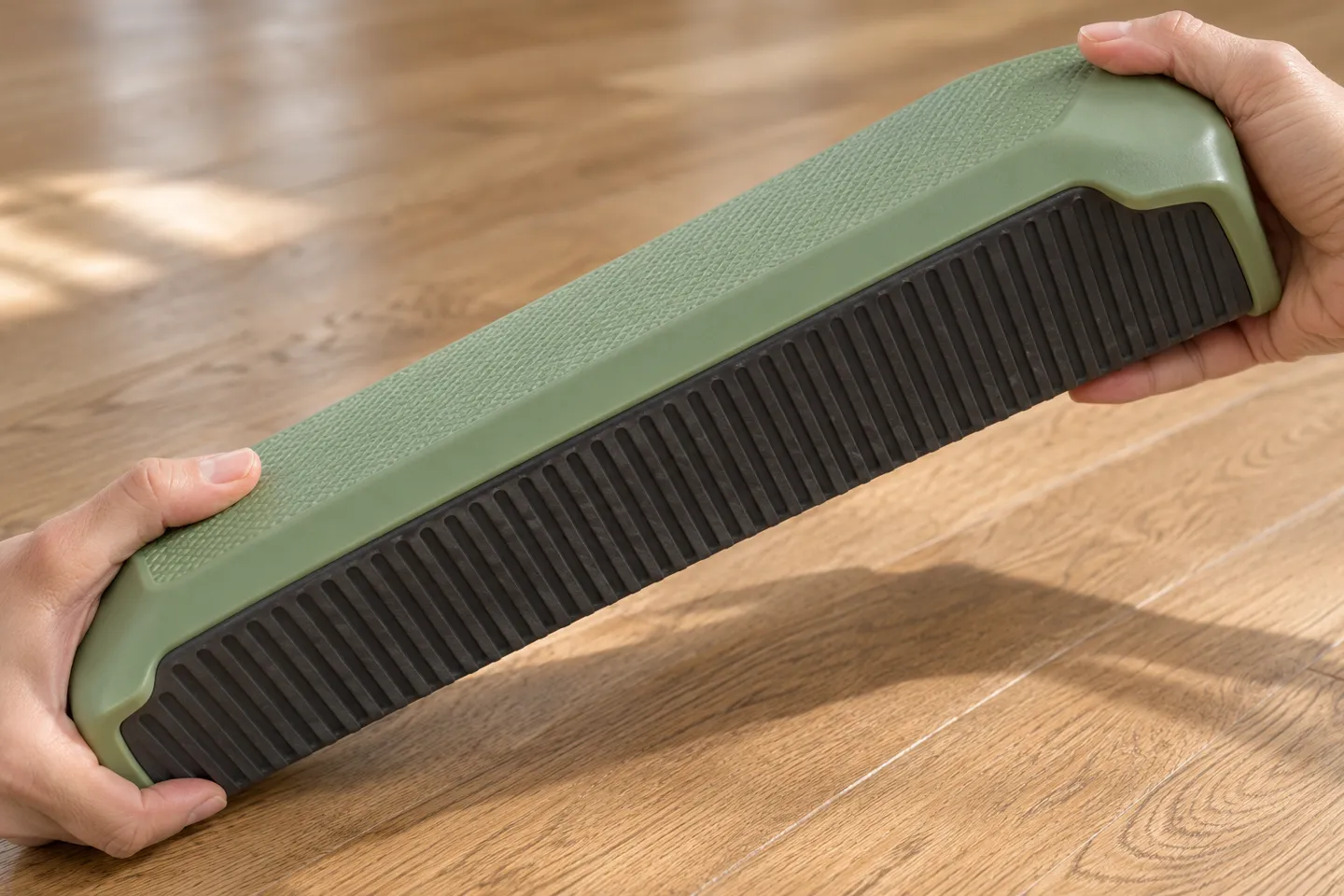
The soft vinyl family is the institutional answer. Vegan leather over certified dense foam wipes clean between users. That is why therapy clinics and preschools pay $179.99 for a single soft beam (Discount School Supply, 2026). A plastic modular set with 20 pieces runs $119.99 in the same therapy channel (Rehabmart, 2026). The premium is mostly covering workmanship and certifiable foam, not the beam function.
Wood-core suede beams hold value best, and the used market proves it: classified listings for quality used beams still ask half or more of retail. Foam beams are the opposite, because compressed foam cannot be inspected from a photo. Buying used? Check three things in person. Push the beam sideways for joint wobble. Press your thumb deep in the walking line for foam compression. Lift the end caps to inspect cover edges for lifted seams or exposed staples.
Sampling beats guessing: request a sample of any beam on the ladder and feel the material before you commit.
Request a SampleThe Compliance Layer: Paperwork Is Part of the Price
A balance beam for children is a regulated toy in every major market, and the paperwork is real cost baked into the retail price. Testing fees, batch records and liability all live inside that number.
| Market | What to ask for | What it covers |
|---|---|---|
| United States | CPC (Children’s Product Certificate) | CPSIA compliance, with testing to ASTM F963 toy standard |
| European Union | CE mark, EN71 test report | EU Toy Safety Directive, mechanical and chemical safety |
| Canada | CCPSA compliance | Canada Consumer Product Safety Act, children’s toys |
| Anywhere, institutional | Test reports matching the product name and batch | Proof the certificate belongs to the goods you receive |
For a home buyer, the practical version is one line: buy beams that state their certification for your market, and be suspicious of any listing that cannot.
For an institution, the price ladder has three extra steps. Wipe-clean surfaces, so the beam can be disinfected between classes. Batch consistency, so a room of ten sets matches in color and size. Replacement parts, so one cracked connector does not scrap a whole set. Those three requirements, plus liability coverage, are why the same functional category spans $19.99 on a mass retail shelf and $119.99 to $179.99 through education suppliers. You are not paying more for the balancing. You are paying for the beam to survive your procurement office.
The licensed setting is the hard boundary. A daycare or clinic that answers to inspectors needs documentation: what the beam is, what it is made of, and what its fall height requires underneath it. A homemade beam has no file to show. Ask before you build, not after.
A four-point check covers any institutional purchase.
Institutional beam purchase, four checks
- Certificate copy that matches the product name and batch.
- Surface wipes clean with your disinfectant.
- Batch consistency in writing (color and size across all sets).
- Replacement parts available from the supplier.
The Channel Layer: Where the Markup Lives
The first four rungs of the ladder explain costs. This layer explains prices, because the same category of goods changes price depending on who sells it and what the buyer needs on the invoice.
Four channels, four price logics
Mass retail ($19.99 to $60) sells turnover. The shelf winner is the set that ships flat, photographs bright and returns rarely. Brand marketing and platform fees are inside the price, and the product itself is a commodity.
Specialty gymnastics retail ($174.99 to $1,330) sells trust. The Beam Store explains its 10 ft beam’s price openly. The 10 ft model weighs 140 lb against 42 lb for the 8 ft beam (The Beam Store, 2026). It needs heavier construction for the longer span, and it ships by freight in a crate. The buyer is paying for stated specs, a 2-year transferable warranty, and no exposed staples on a beam their daughter flips off every week.
Institutional supply ($119.99 to $179.99 and beyond) sells compliance and service. Certificates, invoices that pass procurement, wipe-clean surfaces, batch consistency, replacement parts. The distributor earns the margin by carrying all of that.
Wholesale and factory-direct is the ladder with the channel layer removed. This is where importers and e-commerce sellers buy. Pricing is quoted, not listed, and it moves with volume. Custom work carries minimum order quantities, often none on stock items. Sampling comes before production, and lead times run in weeks. The factory’s margin lives in the material and process layers. Everything above it on the price ladder is channel money.
Where the margin sits, channel by channel
| Channel | Price band | What it sells |
|---|---|---|
| Mass retail | $19.99 to $60 | Turnover: ships flat, photographs bright, returns rarely |
| Specialty gymnastics retail | $174.99 to $1,330 | Trust: stated specs, warranty, no exposed staples |
| Institutional supply | $119.99 to $179.99 and beyond | Compliance and service: certificates, procurement-ready invoices, wipe-clean surfaces, replacement parts |
| Wholesale and factory-direct | Quoted, moves with volume | The factory margin: material and process layers |
The commodity floor has no room left
The $19.99 set and the $46 folding beam form the floor of the market, and that floor is crowded from every direction. Retail giants own the shelf. Patented brand designs own the premium shelf above it. And the DIY community siphons off the price-sensitive end. A padded wooden build costs $10 to $38 in materials, close enough to $46 that the decision comes down to one afternoon.
Enter that floor band on price alone and the math has nowhere to go. The check before any floor-band listing: study the head listings’ price band and review counts first. If thousands of reviews already anchor the price, a new commodity entry competes against an installed base it cannot see.
What does change the math
Three things reliably move a beam out of commodity pricing.
Function stacking: modular beams that connect with stones, hinges and connectors sell as “courses”, not “toys”. The mass retail version of that idea, a $19.99 beam-plus-stones set, already carries 2,170 ratings at 4.8 stars at Target (Target, 2026). The format has real demand volume at retail.
Protected design: original shapes and connection systems covered by patents cannot be cloned at the floor price. The design premium is the buyer’s answer to “why this one over the $19.99 set”, and it holds up in listings, not just in ads.
Certified institutional build: the wipe-clean, documented, batch-consistent version of a plastic modular set sits in a channel with a sixth of the competition and a defensible price. Very few factory brands work that channel properly, because it requires files, not just goods.
One tier above everything sits competition apparatus, $1,970 to $5,630, sold through specialist distribution to facilities. That tier prices on FIG compliance, brand trust and service contracts. It is a different business, and its prices are best read as the ceiling reference for the rest of the ladder.
Reading the Price Ladder as a Buyer or a Seller
The four layers compress into two checklists, depending on which side of the invoice you stand.
If you are buying for a home, a classroom or a facility, the ladder tells you what to demand at your price point. Under $60, demand a real anti-slip base and nothing sharper than a rounded edge. Around $175 to $280, demand a stated weight limit (250 lb is the floor for teen use) and a base wider than the work surface. Over $1,000, demand freight-grade packaging, spare parts availability and a written warranty. At any tier above $100, demand the certificate for your market.
Demands by price point
- Under $60: real anti-slip base, rounded edges only.
- $175-280: stated 250 lb limit, base wider than the top.
- $1,000+: freight-grade packing, spare parts, written warranty.
- Any tier above $100: certificate for your market.
If you are selling into this category, the ladder is your margin map, and the layers tell you where the money sits. The structure and material layers set your landed cost. The compliance layer is an entry ticket you either pay or route around. The channel layer is where every dollar of retail markup lives. Three moves follow from that reading.
First, skip the commodity floor. The $19.99 to $46 band is a race against retail giants on one side and DIY parents on the other. Second, look for layer-four space in two places. One is certified institutional builds. The other is modular sets with protected designs. In both segments the price holds because the product answers objections the cheap versions cannot. Third, quote by the layers. When you ask a factory for pricing, ask in their language. Ask for load rating and base material, which is the structure layer. Ask for material grades and thickness, the material layer. Ask for certification files for your market, the compliance layer. Ask for packing volume and carton config too, because freight is part of your margin. Then put the compliance cost into your landed cost before you celebrate the quote.
The factory side runs on a few standard parameters. Any supplier worth sampling will state them plainly. The four to ask: minimum order on stock items, stock ship window, sample turnaround, and the lead time that light customization adds. Color, logo and packaging are the usual custom work. In this category those numbers typically run from same-week stock shipping to a few weeks for custom work. A supplier who cannot state them is a supplier who will surprise you later.
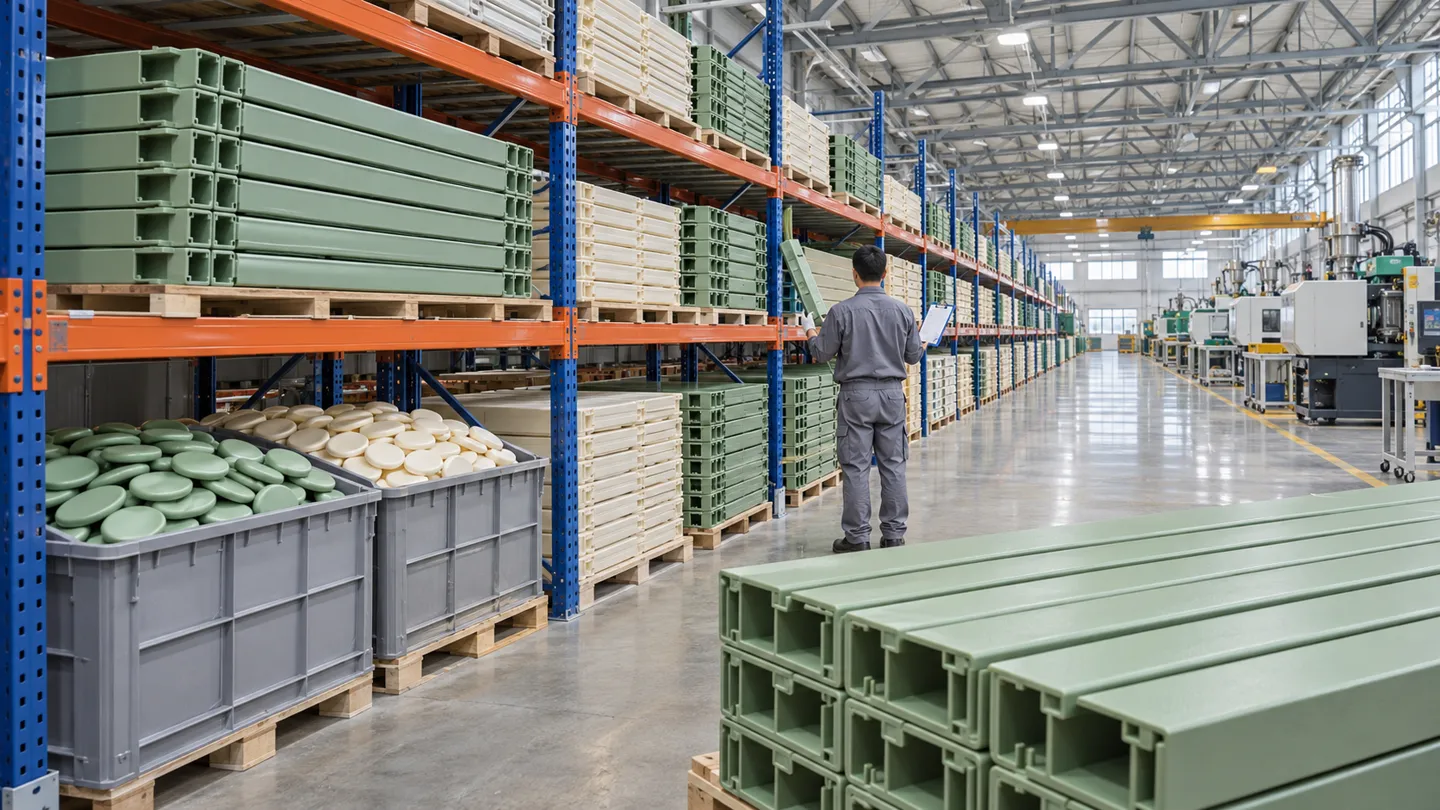
That quoting conversation is exactly where we can close this out. STARTINAL builds a balance walking series of modular beams, stepping stones and balance boards. Everything comes out of our own 10,000 square meter facility, with 60+ patents across the US, EU and China behind the designs. Stock items ship in 1 to 7 days with no minimum order, samples go out in 3 to 5 days, and light customization runs 15 to 25 days. Bring us your target price band from the ladder above, and we will tell you which layer is realistic at that number.
Put the four layers to work on your quote
Send your price band and your market, and get factory-side numbers on structure, material, compliance and channel.
Start a Wholesale InquiryReferences
- Target. “B. toys Interlocking Balancing Beams Balance & Build Set.” 2026. target.com
- Amazon. “Best Sellers: Gymnastics Balance Beams & Bases.” 2026. amazon.com
- Encyclopaedia Britannica. “Balance Beam.” 2026. britannica.com
- U.S. Consumer Product Safety Commission. “Public Playground Safety Handbook.” 2025. cpsc.gov