.png)
How to Start a Soft Play Business: The Complete Guide From Plan to Grand Opening
Is a Soft Play Business Right for You?
Before you sign a lease or browse equipment catalogs, take an honest look at whether this industry fits your goals and risk tolerance.
Parents are spending more on structured play experiences than they did a decade ago — and indoor play centers are capturing a growing share of that budget. A soft play business, whether a fixed-location center, a mobile rental service, or a franchise, can pull steady revenue from admission fees, birthday parties, memberships, and café sales. But it is not passive income, and it is not for everyone.
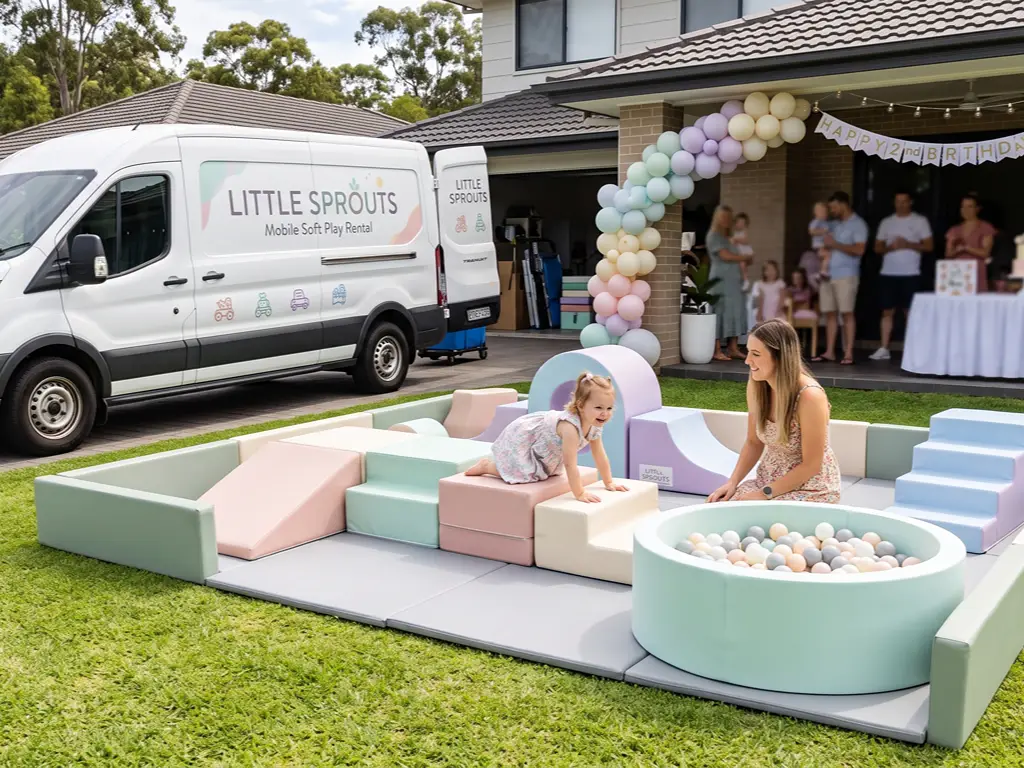
Three common business models call for very different levels of commitment. A mobile soft play rental service can launch with as little as $5,000 to $15,000 — you buy a curated set of foam equipment, pack it into a van, and set up at events and homes. A fixed-location indoor play center is the full version: a leased commercial space with walk-in play, party rooms, and often a café, with startup costs starting around $50,000. A franchise buys you a proven brand and operating system but takes a percentage of revenue and limits your creative control.
Before you go further, ask yourself three questions. First: how many competing play centers sit within a 30-minute drive of your target area, and are they consistently busy? Second: can you personally afford six to twelve months without profit while the business builds a customer base? Third: are you comfortable being legally responsible for the safety of other people’s children every single day? If any answer gives you pause, research longer before committing capital.
The industry benchmark for a well-run fixed location is an 18- to 36-month payback period, with a healthy weekend traffic baseline of 80 to 150 visitors per day. These numbers are achievable — but they are earned, not guaranteed.
What It Really Costs to Launch a Soft Play Business
The total startup cost for a soft play business is not one number. It is a stack of decisions, each with its own price range. The table below breaks down what you are actually paying for.
| Cost Category | Typical Range | Notes |
|---|---|---|
| Lease deposit + first month | $5,000–$15,000 | Based on 2,000–4,000 sqft at $15–25/sqft/year |
| Build-out and renovations | $10,000–$40,000 | Flooring, lighting, partitions, restroom upgrades |
| Soft play equipment | $30,000–$80,000 | At roughly $100–$180 per square meter for mid-range custom equipment |
| First-year insurance | $3,000–$8,000 | General liability + property coverage |
| Licenses and permits | $1,000–$5,000 | Varies by state and municipality |
| Pre-opening marketing | $2,000–$8,000 | Website, social ads, grand opening event |
| 6-month operating reserve | $15,000–$30,000 | Payroll, utilities, supplies before revenue stabilizes |
| Total | $66,000–$186,000 |
Equipment typically accounts for 45 to 55 percent of the total startup budget. It is the single largest line item — and the one that most directly shapes your customer experience. Spend too little and you will replace foam and fabric within two years. Spend wisely and a quality set can last five to eight.
Insurance costs vary sharply by state. California and New York workers’ compensation premiums can run two to three times higher than those in Texas or Florida. Factor this into your location decision early.
One practical rule: keep at least six months of operating expenses in reserve. The business that fails in month four is rarely defeated by a bad concept. It simply runs out of runway before word-of-mouth kicks in.
Legal Requirements, Licenses, and Insurance Checklist
Compliance is not the exciting part of starting a soft play business. It is the part that keeps you in business after your first incident report. Here is what you need, in order.
Business structure. Form an LLC or S Corporation to separate your personal assets from business liability. Register your business name (DBA) with your county clerk, and obtain a federal Employer Identification Number (EIN) from the IRS — it is free and takes 15 minutes online.
Licenses and permits. At minimum, you will need a general business license from your city or county, a certificate of occupancy confirming the space is zoned for public assembly, and a fire department inspection verifying maximum capacity, exit count, and sprinkler coverage. If you sell food or drinks, add a health department permit. If you play recorded music, add a music license from BMI or ASCAP.
Insurance. Three policies are non-negotiable. General liability insurance should cover at least $1 million per occurrence and $2 million aggregate — most landlords will require this before you sign a lease. Property insurance covers your equipment against fire, flood, and theft. Workers’ compensation is mandatory in nearly every state once you have employees. For additional guidance on permits and business registration, refer to the Small Business Administration’s licensing guide (SBA.gov).
Choosing Your Location and Planning Your Layout
Location is the single most consequential decision you will make. The right space can compensate for modest marketing; the wrong space will suffocate a great concept.
Evaluate every candidate on four dimensions. Demographics: how many households with children under 10 live within a five-mile radius? This is your core catchment area. Visibility: is the space on a road parents drive daily, or tucked into an industrial park where nobody sees it? Accessibility: count the parking spots, check for stroller-friendly entrances, and note whether the restroom has a changing station. Competition: map every play center within a 30-minute drive. If three of them are well-reviewed and busy, the market may already be saturated.
Inside, think in three zones. The active zone — climbing structures, slides, and ball pits — should occupy 40 to 50 percent of your play area. The toddler zone for children under three needs a dedicated soft-padded enclosure, about 15 to 20 percent of floor space. The parent zone — comfortable seating, reliable Wi-Fi, clean sightlines to the play area — is not a luxury. It is the reason parents choose your center over the one 10 minutes closer.
Space requirements: you need at least 1,500 square feet of play area for a viable setup. If you plan to host birthday parties and serve coffee, budget 2,500 square feet or more. Ceiling height should be a minimum of 12 feet; if your equipment includes multi-level climbing structures, you need 16 to 20 feet.
How to Source Soft Play Equipment Without Getting Burned
Here is a fact that most “how to start a play center” guides skip: the global supply chain for soft play equipment is concentrated in one place. An estimated 40 to 70 percent of the world’s indoor play equipment is manufactured in and around Wenzhou, a city in China’s Zhejiang province. Whether you buy from a domestic distributor in Dallas or a website that looks local, the equipment itself probably started its journey in the same cluster of factories.
This is not a warning. It is an opportunity. Buying factory-direct can reduce your equipment costs by 30 to 50 percent — but only if you can tell a real factory from a trading company that adds a margin and calls itself a manufacturer.
Factory-Direct vs. Trading Companies — Understanding the Supply Chain
A genuine factory has a fixed product line, its own molds, and a shop floor where you can see people cutting foam and welding steel. A trading company has a website, a catalog of everything, and no production facility of its own. Both can supply equipment. Only one lets you control quality at the source.
Three signals help you tell them apart. First, can they give you a live video tour of their production floor right now — not a polished company video, but a real-time walkthrough showing molds, assembly lines, and raw material storage? Second, do they hold factory-level certifications like BSCI (a social compliance audit conducted on-site) or ISO 9001 (a quality management system certification tied to a physical production facility)? Trading companies cannot obtain these — they are issued to the factory address. Third, is their product range focused on two or three categories, or do they claim to make everything from carousels to trampolines to VR rides? Focus signals manufacturing depth; breadth signals reselling.
Red flags worth taking seriously: a supplier that refuses video verification, provides certification documents without serial numbers you can cross-check, or quotes a price 30 percent below the market average. That last one is not a deal — it is a signal that materials or workmanship are being cut somewhere you cannot see.
How to Vet a Supplier Before You Send a Dollar
Once you have a shortlist, verify before you pay. Four steps, in order of importance.
Step one: the video factory tour. Ask the supplier to walk through their facility on a video call — not a pre-recorded tour. Look for mold storage racks (real factories have dozens or hundreds of molds), active production lines (are workers actually assembling equipment, or does the floor look staged?), and raw material inventory (visible quantities of foam rolls, steel tubing, and fabric bolts signal real throughput). A factory that cannot accommodate this within 48 hours is hiding something or does not exist.
Step two: certificate cross-verification. A PDF of a TÜV or SGS test report is not evidence — it is a claim until you verify it. Every legitimate certification body maintains an online database where you can enter the certificate number and confirm it is active, matches the factory name, and covers the product categories you are buying. If the supplier hesitates to share the certificate number so you can look it up yourself, walk away.
Step three: the physical sample test. Order a sample piece and inspect it yourself. Press firmly into the foam and release — high-density EPE foam with a density of at least 30 kilograms per cubic meter should rebound to its original shape within three seconds. Smell the PVC covering from 30 centimeters away — a sharp chemical odor indicates excess plasticizers, a red flag for children’s products. Run your fingers along every edge — the minimum safe rounding radius is 5 millimeters, about three times the thickness of a dime. Any edge that feels sharp to the fingertip will not pass a safety inspection.
Step four: structure the payment to protect yourself. The industry-standard payment schedule is 30 percent deposit to start production, 60 percent before shipment (after you review photos or video of the finished order), and 10 percent after delivery and inspection. Never accept a demand for 100 percent upfront payment. It eliminates your only leverage.
By way of example, a supplier that meets all four of these verification steps — live video tour, cross-checkable certifications including BSCI, CPC, CE, and ASTM, sample quality that passes the foam-rebound and edge-radius tests, and a standard staggered payment schedule — is a credible candidate regardless of which company it is. The point of this framework is that it works for evaluating any supplier, not a specific one.
Safety Certifications and Quality Standards — What Actually Matters
Most guides tell you to “buy equipment that meets safety standards.” Few explain what those standards actually test, how they differ, or how to verify that a certificate is real. This section fills that gap.
Key Certifications Explained — What Each One Actually Tests
The table below covers the four certifications you are most likely to encounter when sourcing soft play equipment. Understanding what each one verifies puts you in control of supplier conversations — you stop nodding at acronyms and start asking the right questions.
| Certification | Region | What It Actually Tests | How to Verify |
|---|---|---|---|
| ASTM F1918 | United States | Structural integrity of soft contained play equipment; head and neck entrapment (openings between 89 mm and 230 mm are the critical danger zone); impact absorption; material flammability | Request the test report from an ASTM-accredited lab (SGS, TÜV) and confirm the manufacturer name matches the supplier |
| EN 1176 | European Union | Overall playground equipment safety — structural strength, entrapment gaps, guardrail heights (≥600 mm for platforms serving children over age 3), ground impact attenuation | The CE technical file must include an EN 1176 test report from an EU Notified Body; ask to see it |
| CE Marking | European Union | A manufacturer’s self-declaration that the product meets all applicable EU directives — CE is a declaration, not a test result; its legitimacy depends on the test reports backing it | A valid CE mark must be accompanied by a Declaration of Conformity listing which standards were tested and by which laboratory |
| CPC | United States | Mandated by the Consumer Product Safety Commission; verifies lead content, phthalate limits, and mechanical/physical safety based on third-party laboratory testing | A valid CPC certificate must name the CPSC-accepted third-party lab and the test date; required for US Customs clearance |
Third-party lab tests structure, entrapment, flammability
EU Notified Body verifies structural & impact safety
Self-declaration — valid only with underlying lab reports
Mandatory US Customs doc — requires CPSC-accepted lab
The critical distinction: ASTM F1918 and EN 1176 require testing by independent laboratories. CE marking and CPC certificates are documents that cite those test results. When a supplier says “we have CE,” the correct response is “show me the EN 1176 test report it references.” A supplier that can produce both the declaration and the underlying lab report is demonstrating the transparency you should expect.
Your Pre-Delivery Quality Inspection Checklist
When your equipment arrives, spend 30 minutes with this checklist before signing the delivery acceptance. It will not replace a professional third-party inspection, but it will catch the most common problems at the stage where they are easiest to resolve.
- Foam density. Press firmly into any foam surface with your full palm and release. It should return to its original shape within three seconds. Slow rebound or permanent indentation signals low-density foam that will degrade within a year or two.
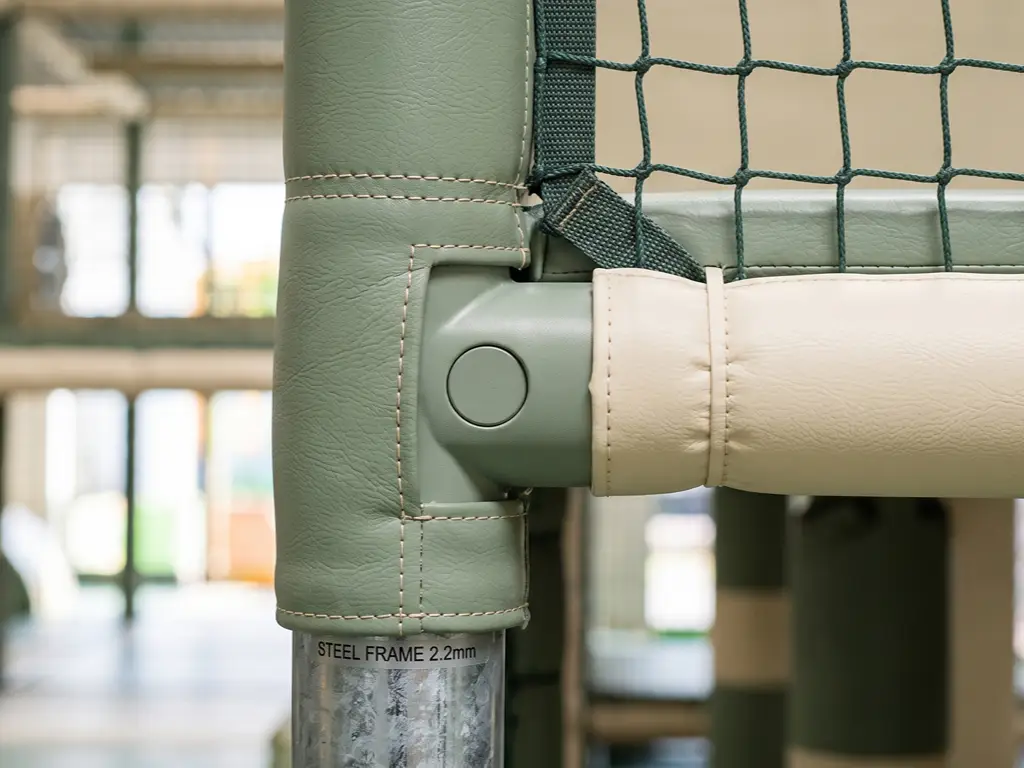
- Steel frame. Use a magnet on any exposed metal. Galvanized steel (standard and acceptable) is magnetic. 304 stainless steel (premium, used in high-humidity environments) is non-magnetic or weakly magnetic. Frame tubing should measure at least 2.5 millimeters thick with a caliper.
- PVC odor. Open the packaging and smell the vinyl covering from arm’s length. A sharp, chemical smell indicates excess phthalate plasticizers — unacceptable for children’s products and likely to fail a CPC test.
- Edge rounding. Slide your fingertip along every accessible edge. Any sensation of sharpness is a fail. The minimum radius should be visibly larger than the thickness of a dime.
- Gap hazards. Try to insert a smartphone (approximately 8 millimeters thick) into any gap between panels, nets, or structural elements. If it fits, a child’s finger could become trapped. This is a fail.
- Seams and bonding. Pull gently on every stitched seam and bonded joint. No threads should be loose, and no adhesive bond should show gaps or cracking.
- Color fastness. Wipe a damp white cloth firmly across any brightly colored surface 10 times. If the cloth picks up visible color, the dye is not properly fixed and will stain children’s clothing — and eventually, their skin.
The industry benchmark for an acceptable defect rate is 2 percent. More than two visibly flawed pieces per 100 items in your shipment warrants a formal complaint and corrective action — ideally backed by your retained 10 percent final payment.
Marketing, Staffing, and Your Grand Opening
You have planned the business, secured the location, sourced the equipment, and verified the safety compliance. Now you need customers.
Marketing before you open. Four weeks out, build a simple website with online booking and party inquiry forms. Claim your Google Business Profile — this is how local parents will find you when they search “indoor playground near me.” Create an Instagram and Facebook page and post behind-the-scenes content of your space coming together. Contact local parenting groups, daycares, and elementary schools and offer them a free preview session in exchange for word-of-mouth. The goal of pre-opening marketing is not to sell — it is to build a list of families who are waiting for your door to open.
Staffing. The minimum viable team is one full-time manager plus two to four part-time play supervisors. Every staff member who interacts with children needs CPR and first aid certification, a background check, and training on your specific emergency procedures — including a written lost-child protocol. The industry standard for staff-to-child supervision is roughly one staff member per eight to ten children. Err on the side of more supervision during your first month.
Grand opening strategy. Consider a soft opening first: invite friends, family, and community partners for two weekends of free or discounted sessions. Use this time to debug your check-in process, test your café workflow, and train your team under real conditions with low stakes. Once the operation runs smoothly, launch your public grand opening with a weekend event — face painting, a raffle for a free birthday party, and a “founding member” discount for annual passes sold in the first 30 days.
The number to watch in your first month is not revenue. It is return rate. If more than 30 percent of families who visit in week one come back in week four, you have a product parents trust. Everything else — pricing optimization, party packages, membership tiers — builds on that foundation.
From your first market research query to the moment you cut the ribbon, you have now walked through the full sequence of launching a soft play business. The industry rewards operators who take equipment quality and child safety as seriously as they take marketing and customer experience. Do that, and the families in your community will fill your calendar.
The play industry rewards operators who get the fundamentals right. Start with quality equipment, build a safety-first reputation, and treat every visiting family like they are your only customer.
References
- ASTM International. “ASTM F1918-21: Standard Safety Performance Specification for Soft Contained Play Equipment.” 2021. store.astm.org/f1918-21.html
- U.S. Small Business Administration. “Apply for Licenses and Permits.” sba.gov
- U.S. Consumer Product Safety Commission. “Children’s Product Certificate (CPC).” cpsc.gov
- Kids Soft Play. “Cost to Install Soft Indoor Playground Equipment — Budget Guide.” kidssoftplay.com
- Startinal. “Why Startinal.” startinal.com/why-startinal/
- Startinal. “Contact Us.” startinal.com/contact-us/
- Startinal. startinal.com