.png)
Indoor Playground Structure Buying Guide: Engineering Quality, Real Costs, and a Framework for Choosing Manufacturers
You are about to spend serious money on an indoor playground structure. You have probably received quotes from three or five factories already — numbers ranging from fifty thousand to four hundred thousand dollars. Every one of them says the same thing: “high quality, fully certified, fast delivery.” And you do not know whom to trust.
That is the real problem. You are not picking a supplier off a list. You are making an engineering decision. Structural steel mechanics. Flame-retardant foam density. International safety certification systems. Volumetric freight calculations. A minimum eight-year service life. Get one variable wrong and the cost is not a few thousand dollars. It is equipment that fails in year three. A safety incident your insurance refuses to cover. Two months of lost revenue while you wait for replacement parts nobody stocks locally.
Here is the harder problem: nearly every “buying guide” you can find online was written by a factory that sells these products. Every single one tells you “choose us.” Not one of them tells you how to figure out what “good” actually looks like.
This article does exactly one thing. It gives you a verification framework. Testable. Quantifiable. Something you can email to any factory and ask them to fill out. When you finish reading, you will evaluate quotes the way an engineer would. You will know the steel tube wall thickness below which you walk away. You will know how to check foam density with your bare hands. You will know which three pieces of information on an SGS test report matter more than the certificate number itself. And you will understand, down to the dollar, why the cheapest option is almost certainly the most expensive thing you will ever buy.
Three Types of Indoor Playground Structures: Soft Play, Adventure, and Hybrid Systems
Before discussing how to choose, understand what you are buying. Indoor playground structures fall into three categories based on safety profile and stimulation level. Your ceiling height and target age group determine which category you can use. This is not a matter of preference. It is physics.
| Type | Age Range | Min. Ceiling Height | Cost per sqm (FOB) | Key Characteristics |
|---|---|---|---|---|
| Soft Play | 1-6 years | 3.0-3.8m | $50-150/sqm | Steel frame + high-density foam wrapping + EVA floor mats; lowest fall risk; daycare/early learning/mall family zones |
| Adventure Multi-Level | 5-12 years | 4.0-5.5m (ideal 6.0m+) | $160-400/sqm | Multi-tier steel frame + climbing nets + spiral slides + obstacle courses; traffic engine; FECs/standalone playgrounds/mall atriums |
| Hybrid Themed | All ages | 4.0m+ | $200/sqm+ (+ design fee) | Soft play + adventure + digital interactive + IP theme wrap; differentiation weapon; destination venues/branded chains |
Soft Play Structures: The Safety Baseline for Younger Children
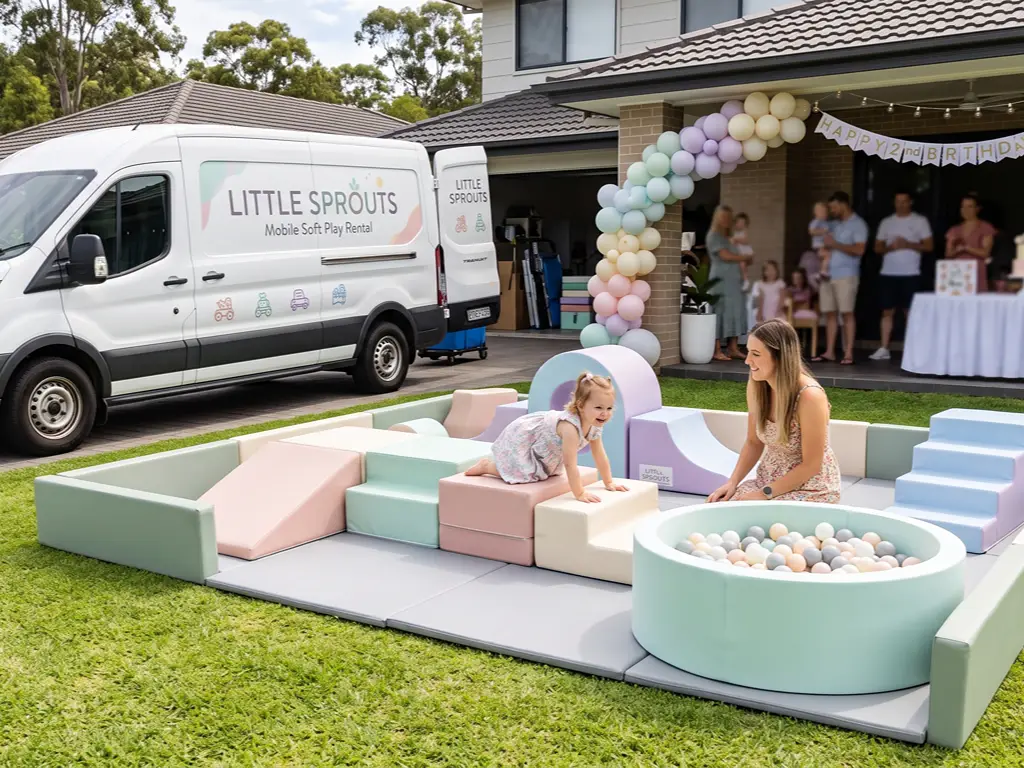
Soft play is the only compliant option for children aged one to six. The construction is straightforward: galvanized steel tube frames wrapped in high-density foam, EVA mat flooring throughout. Every hard edge and sharp corner gets swallowed by padding. Maximum free-fall height is clamped firmly below every relevant safety threshold.
But the business logic of soft play is not excitement. It is not even fun, strictly speaking. It is parental peace of mind. A mother walks into your facility. She sees soft flooring everywhere. She sees that every corner is rounded. She sees that she can spot her child from any position in the room. Only then does she sit down in the café area and order a second coffee.
Remember one number: foam density below 22 kg/m³ undergoes irreversible collapse within six months of commercial use. The analogy is simple. When you buy a sofa, foam density decides whether it lasts three years or collapses in three months. A playground’s foam absorbs the impact of dozens of children running and jumping every single day. Low-density foam fails faster than you think. And when it fails, it is not a comfort problem. A child falls, and the foam that was supposed to cushion the impact is gone.
Adventure Multi-Level Structures: The Traffic Engine for Older Kids
Adventure structures are the main course for ages five through twelve. Multi-tier steel frames, climbing nets, spiral slides, rope bridges — the greater the vertical challenge, the harder it is to get children to leave. Children who refuse to leave means parents who come back. Parents who come back means membership cards that sell themselves.
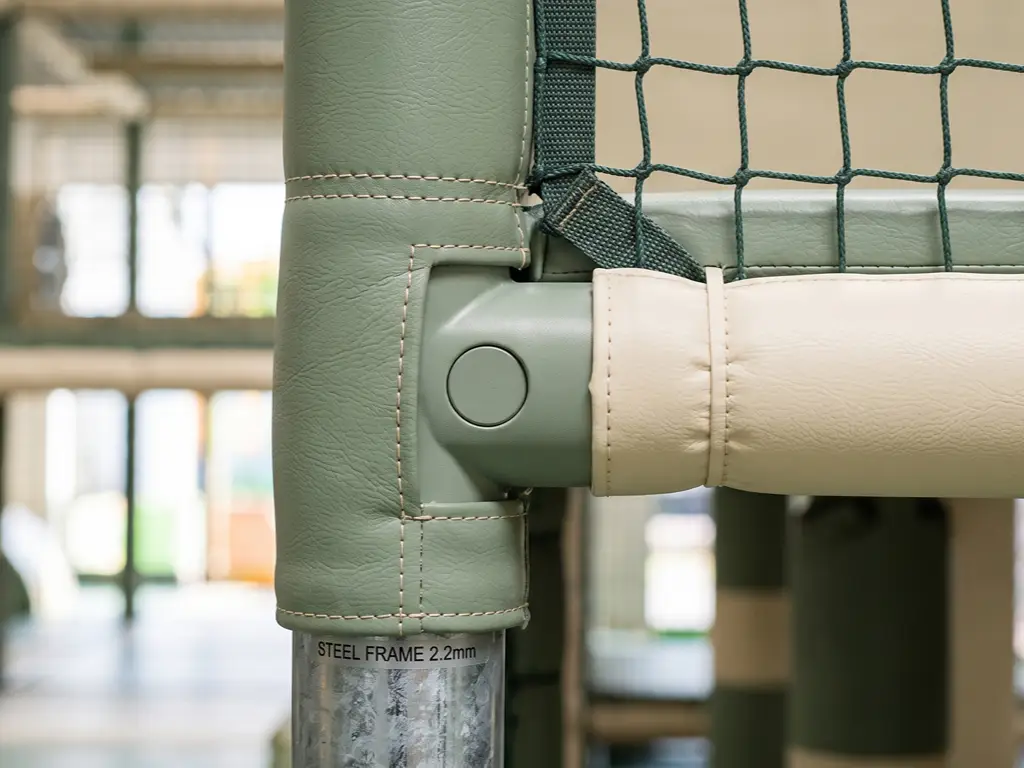
But the engineering requirements rise fast. Structural steel tube wall thickness must be ≥2.0 mm. Thin-walled tubes develop stress micro-cracks at weld points after two to three years of commercial use. Connectors must be concealed anti-loosening locking bolts. Never exposed self-tapping screws. This is not the gap between “better” and “adequate.” It is the gap between a decade of reliable service and a major structural overhaul in year three. Next time you visit any indoor playground, reach out and feel a steel frame joint. Exposed screw heads equal low-end product. It is the most honest quality inspection you can perform. No tools required.
Adventure structures have one more hard threshold: ceiling height. Four meters is the starting line. Below that, you cut climbing levels. Every level you lose reduces revenue per square meter by roughly twenty-five percent.
Hybrid and Themed Playgrounds: The Ultimate Differentiation Weapon
When three indoor playgrounds open on the same street, only the one with a space exploration or underwater world theme gets photographed for Instagram. Hybrid themed structures integrate soft-play safety, adventure thrills, and digital interactivity — AR projection walls, interactive LED floors — into a single narrative environment.
The underlying logic: themed customization is not “more expensive equipment.” It is higher per-visit revenue. Longer dwell times. Completely free social media exposure. A themed birthday party commands two to three times the price of a standard session. Parents do not pay for the equipment. They pay for their child’s memory.
Engineering Quality: How to Assess Materials and Construction with Quantifiable Criteria
This is the most important section of this article. Most buyers evaluate equipment by appearance — whether the colors look appealing, whether the shapes look cute. But what determines whether an indoor playground structure lasts five years or fifteen is three things you will not notice on a first look: the skeleton (steel frame), the flesh (foam), and the skin (plastic components). Compromise any one of these three dimensions, and the entire safety and service-life chain collapses.
Most factories are betting you will not check any of them. Because they themselves would not pass.
Steel Frame Engineering: The Skeleton That Carries Everything
The steel frame is the final line of defense. Foam can be replaced. Plastic panels can be refurbished. Once the steel frame develops structural rust or weld cracks, the entire unit is scrap. You do not repair it. You haul it out and start over.
Evaluate steel frame quality across four indicators:
Wall thickness. Commercial-grade indoor playground steel tubes should be ≥2.0 mm. This number is not whatever the factory claims. A caliper does not lie. Tubes below 2.0 mm, after three or more years of repeated dynamic loading — children jumping, running, colliding, every single day — develop micro-cracks at weld nodes. Micro-cracks do not heal. They propagate. Slowly. Until one day they become structural failure, and nobody saw it coming.
Surface treatment. Hot-dip galvanizing and spray painting are not variations on the same thing. They are two entirely different things. Hot-dip galvanized coating thickness is ≥60 μm, with a corrosion-protection lifespan of fifteen to twenty years. Cold galvanizing or spray paint begins rusting within two to three years. If your facility is in a humid city or a coastal area, this difference alone determines whether you replace the entire steel frame in five years.
Connection method. Concealed anti-loosening locking bolts — each node torqued to design specification — this is the industry standard. Exposed self-tapping screws are cost control. Exposed screws rust faster, yes. But worse: the screw heads gradually back out under daily equipment vibration. By the time they back out far enough, that connection node is loose. And you will never notice. Until something fails.
Tube sourcing. Does the factory run its own steel tube processing line? Or does it buy finished tubes from outside and assemble them? The first option gives you closed-loop quality control. The second introduces a third-party supplier you will never see — whose material choices the factory itself may not fully control.
Foam and Safety Padding: Impact Protection That Degrades Silently
Foam is the single most dangerous quality blind spot in the entire structure. Its degradation is silent. The surface looks fine. The color has not changed. It still feels soft when you press it. But the internal closed-cell structure has collapsed. Impact absorption capacity is zero. And you cannot tell by looking.
Three core indicators:
Density. Commercial-grade foam density should be ≥22 kg/m³. Field test: press firmly into the foam for five seconds and release. Quality foam recovers its shape within two seconds. Low-density foam leaves a depression that takes its time rebounding. That depression is the impact-attenuation failure you will be dealing with later. Except later, there is a child on the receiving end.
Flame retardancy rating. Non-negotiable for commercial premises. Foam must pass BS 5852 (British standard) or CAL 117 (California standard) flame retardancy testing. A supplier that cannot produce a flame retardancy test report does not advance to the next round.
Resilience and closed-cell ratio. EVA foam resilience should be ≥40%. Indoor environments must use closed-cell foam. Open-cell foam absorbs moisture and cleaning agents like a sponge. Within six months, the interior becomes a bacterial growth medium. You do not want to know what a moldy ball pit smells like. Your customers will tell you anyway.
Plastic Components and Surface Finishes: Everything Your Customers Actually Touch
Slide surfaces. Climbing grips. Interactive panels. These are the parts that children’s and parents’ hands touch directly. Low-quality plastic commits three sins: yellowing (UV degradation), scratching (insufficient hardness), and burrs (low mold precision, or skipped de-burring entirely).
The judgment standard: HDPE virgin material versus recycled material. You can see the difference. Recycled-material injection-molded parts contain visible black specks. Those are contaminants from the recycling process. They cannot be washed out. They are in the material.
Pigment quality matters too. A slide that shifts from bright yellow to gray-yellow in two years of sunlight drags the perceived quality of your entire facility down with it. Imported pigments carry a colorfastness rating of ≥Grade 4 under the AATCC standard. That is the hard number. Ask for it.
Safety Standards and Certifications: Seeing Through the Paper
Most buyers fall into the same trap. They see a CE mark and feel reassured. They obtain an ASTM test report and consider the job done. Here is the reality: CE marks come in two varieties — self-declaration and third-party testing — with a gulf in credibility between them. ASTM F1487 governs structural safety only, not material safety. CPSC is not a “certification” at all. It is a free public handbook you can download right now.
| Standard | Region | Scope | How to Verify |
|---|---|---|---|
| ASTM F1487 | USA | Public playground structural safety (ages 2-12); entrapment, fall protection, structural strength | Request original report from SGS/TÜV/BV. Verify factory name and address match the supplier. |
| EN 1176 | EU | Playground equipment safety (legally mandatory) incl. installation + maintenance | Same as above. Note: EN 1176 (equipment) and EN 1177 (surfacing) are separate standards. |
| ASTM F1918 | USA | Soft Contained Play Equipment — the more specific standard for soft-play | If purchasing soft-play, this is the more relevant standard than F1487 alone. |
| CPSC Handbook | USA | Public Playground Safety Handbook — free guidance document | Any factory claiming “CPSC certification” reveals a lack of professional knowledge. |
| EN 71 | EU | Toy safety (components entering a child’s mouth); chemical safety (heavy metals, phthalates) | Complements EN 1176 — chemical and structural safety are separate dimensions. |
The three-step certificate verification method:
1. Request the original third-party report — not a factory self-inspection report. A credible test report is issued by an ISO/IEC 17025 accredited laboratory: SGS, TÜV, or Bureau Veritas. The report must carry the laboratory’s logo, a report number, and a signature. If any of these is missing, you are done reading.
2. Verify the factory name and address on the report. This is the most common trap. The factory shows you a report that was done for its subcontractor. Or borrowed from another supplier entirely. The factory name and address must match the supplier’s business license, character for character.
3. Validate the report number on the issuing body’s website. SGS, TÜV, and similar bodies all have online report verification portals. Enter the report number. If nothing comes back, it is not a “system delay.” The report does not exist. Walk away.
One principle to remember: a single certificate is not trustworthy. A full set is. No single standard covers all risk dimensions of an indoor playground structure. You need ASTM + CPSC (or EN 1176 + EN 1177) + EN 71 for chemical safety + a flame retardancy test report (BS 5852 or CAL 117) + a factory BSCI audit report. Five documents. No exceptions. That is what “safety compliant” actually means.
Space Planning Essentials: Ceiling Height, Layout, and Capacity
You have verified the certificates. You understand the materials. Now: what can your space actually accommodate? Space parameters must be understood before you select equipment. Doing it the other way around is the most common procurement mistake in this industry.
Ceiling height sets the ceiling on equipment type. A venue with 3.0–3.8 m ceiling height accommodates only soft play structures. This is physics, not a budget question. At 4.0–5.5 m, you can do light adventure — two to three climbing levels. Only at 6.0 m and above can you build a full-scale multi-level adventure park. You rented a space with a 3.5-meter ceiling and want a “stunning adventure park”? That is buying a sedan chassis and trying to convert it into an off-road vehicle. Physics does not negotiate.
Capacity planning from a safety perspective. Commercial operations calculate at 1–1.5 sqm per child — a 100 sqm space accommodates roughly sixty to eighty children at once. But you cannot optimize this number for revenue alone. You must reserve ≥1.5 m safety buffer zones around equipment. Emergency egress routes must comply with local fire codes — most jurisdictions require ≥1.4 m.
Three principles of circulation design: ① A parent must see their child from any position in the facility. Visual transparency equals trust. Trust equals dwell time and secondary spending. ② Toddler zones and older-child adventure zones must be physically separated. A two-year-old struck by an older child beneath a climbing frame is the most common and most preventable indoor playground accident. ③ Traffic flows must not cross. Entry → ticketing → storage → play → food and beverage → exit. One direction. Any crossing point is a congestion point. Any congestion point is where the experience falls apart.
The Real Cost of Indoor Playground Structures: What Your Money Actually Buys
Cost is the single most frequently asked question in this space. And the single most evasively answered question in competitor content. Most “buying guides” reduce this section to one sentence: “It depends — contact us.” This article does not do that.
Price Tiers by Structure Type
| Structure Type | Price per sqm (USD) | Typical 100sqm Total | Key Cost Drivers |
|---|---|---|---|
| Soft Play | $50-150/sqm | $5,000-15,000 | Foam density, cover material grade (PVC vs PU), steel frame spec |
| Light Adventure | $160-260/sqm | $16,000-26,000 | Number of climbing levels, slide quantity/type, safety netting spec |
| Full-Scale Adventure | $280-400/sqm | $28,000-40,000+ | Steel tonnage (multi-level = steel-intensive), degree of customization |
| Themed Custom | $200/sqm+ (+ design $2K-50K) | $20,000+ | IP licensing, 3D modeling, immersion-scene construction complexity |
One fact to internalize: the same design drawing, quoted by three factories, can produce a forty percent price spread. The core of the spread is never the design. It is the material specification. The factory quoting forty percent less has almost certainly downgraded steel tube wall thickness, foam density, and plastic material grade. The two structures will look identical on delivery day. Two years later, you will know exactly who was swimming naked.
Hidden Costs Your Equipment Quote Does Not Include
The equipment quote is one-third of the iceberg above the waterline. For a 100 sqm soft-play project, a realistic total landed cost:
- Equipment: 60%
- Ocean freight (volumetric weight; playground equipment is volumetric cargo; volumetric weight can reach 3-5× actual weight): 10-15%
- Import duties and VAT: 5-10%
- Flooring installation (EVA mats or rubber flooring): 6-10%
- Installation labor (more complex = more expensive; factor in whether the factory sends an engineer): 5-10%
- First-year maintenance spares + insurance: 3-5%
Multiply the equipment quote you see by 1.5 to 1.7. That gets you close to the real number you will pay.
The Cheapest Option Is Almost Always the Most Expensive
Do not decide based on unit price. Use total cost of ownership. Elementary arithmetic:
Choosing a Manufacturing Partner: An Independent Evaluation Framework
This section is the easiest one in the entire article to turn into an advertisement. That is exactly why I wrote it as a framework you can use on any factory — including ours. The best sales pitch is not “I am the best.” It is “Here is a ruler. You measure.”
| Dimension | Questions to Ask | Red Flags | Positive Signals |
|---|---|---|---|
| Factory Floor | Can you do a video factory tour? Are production zones rationally separated? | Refuses video tour. Chaotic floor — raw materials mixed with finished goods. | Proactively provides factory video. Zones clearly separated. |
| Certificate Credibility | Can you provide original SGS/TÜV/BV test reports? Does the factory name match the license? | Only self-inspection reports. Factory name on report ≠ supplier name (subcontract). | BSCI audit + ASTM/EN third-party reports. All verifiable online. |
| Sample-to-Production | Do samples and production use the same line? Is there a retained-sample system? | Samples immaculate, production rough — no retained-sample benchmarking. | First Article Inspection before production. Batch sampling during production. |
| Reorder Rate | What is your repeat customer rate? Can you provide redacted PO history? | Reorder rate is opaque. Displayed logos cannot be traced to ongoing cooperation. | Reorder rate ≥30%. Willing to provide redacted long-term client records. |
| Communication | Does your sales staff understand engineering? Do they answer specs directly? | Cannot answer technical questions. Pushes for deposit. Vague quotes. | Answers technical parameters directly. Helps with space planning and recommendations. |
The golden rule for your first cooperation: place a trial order — three to five standard products. If a factory cannot maintain consistent quality even on standard products, do not consider custom orders. The purpose of a trial order is not to save money. It is to verify quality consistency at the smallest possible cost — to avoid spending tens of thousands of dollars on a lesson you did not need to learn the hard way.
Run through this framework once, and roughly eighty percent of suppliers on the market get eliminated. Not because they are “bad.” Because they cannot survive the ruler you are now holding. The few that remain — verify them item by item with the same checklist. Take “certificate credibility.” Factories that can simultaneously produce a BSCI audit report alongside CE, CPC, ASTM, and EN71 full third-party testing — with every report verifiable online on the issuing body’s website — are genuinely rare. Those that survive the filter earn their place.
If you need a factory audit checklist you can send directly to a supplier, or want to use this framework to evaluate your existing shortlist, Startinal’s compliance documentation and factory qualification materials are available here: verified compliance documentation | request a factory qualification pack.
References
- ASTM International. “ASTM F1487-21.” 2021. astm.org/f1487-21
- ASTM International. “ASTM F1918-21.” 2021. astm.org/f1918-21
- European Committee for Standardization. “EN 1176.” cen.eu
- U.S. CPSC. “Public Playground Safety Handbook.” cpsc.gov
- IPEMA. “Product Certification Program.” ipema.org/certification
- Startinal. “Why Startinal.” startinal.com/why-startinal
- Startinal. “Contact Us.” startinal.com/contact-us
- Startinal. Homepage. startinal.com