.png)
The Parent’s Guide to Balance Toys for Kids: From First Steps to Sport-Ready Skills
Why Balance Development Matters for Kids
If you’ve ever watched a toddler wobble across a room — arms out, face locked in absolute concentration — you’ve witnessed something remarkable. That wobbly walk isn’t just cute. It’s your child’s brain and body running one of the most complex coordination programs in human development.
Balance is not a single skill. It’s the result of three sensory systems working together in real time: your child’s vestibular system (the inner ear’s gyroscope), their proprioceptive system (the muscles’ and joints’ built-in GPS), and their visual system (the eyes’ navigation feed). When these three systems sync up, your child can walk, run, climb, and eventually ride a bike without thinking about it. When they don’t — well, that’s when you see the spills, the hesitations, and the “I can’t do it” frustration.
Here’s what most parents don’t realize: balance toys don’t build these systems by themselves. What they do is create the right kind of challenge — a situation where your child’s brain has no choice but to integrate sensory information in real time. The toy provides the opportunity. Your child’s movement does the work.
That distinction matters because it changes how you shop. You stop asking “which toy is best?” and start asking “which toy gives my child the right level of challenge right now?”
The Vestibular System — Your Child’s Internal Gyroscope
Imagine closing your eyes on a swing. You still know you’re moving — forward, back, higher, lower. That’s your vestibular system at work. Located deep in the inner ear, it consists of three semicircular canals (which detect rotation in every direction) and two otolith organs — the utricle and saccule — which sense linear acceleration and gravity.
Every time your child spins, swings, tilts their head, or tips sideways on a wobble board, fluid moves through these canals, sending signals to the brain at millisecond speed. The brain responds by adjusting muscle tension throughout the body to keep your child upright. This is the vestibulo-ocular reflex (VOR) in action — the same mechanism that lets you read a street sign while walking, because your eyes automatically compensate for head movement.
A study published in PLOS ONE by Tortella and colleagues (2016) put this to the test with 71 preschool children. Those who spent just one hour per week on a playground designed for balance and mobility — structured activities plus free play — showed significant improvements in balance beam walking, platform balance, and single-leg standing after ten weeks, compared to a control group that didn’t (Tortella et al., 2016).
Think of the vestibular system like your phone’s gyroscope chip. The phone uses it to know whether the screen should be portrait or landscape. Your child uses it to know whether they need to lean left or right to stay on their feet. And just like any sensor, it gets more accurate with use.
Proprioception — How Your Child Knows Where Their Body Is
Close your eyes and touch your nose with your index finger. You just used proprioception — your body’s ability to sense its own position and movement without looking.
Proprioception relies on specialized sensors inside your muscles (muscle spindles, which detect stretch and rate of change) and tendons (Golgi tendon organs, which detect tension). These sensors fire constantly during any active movement, creating a real-time map of where every limb is in space. When your child steps from one balance stone to another, pressure receptors in the soles of their feet and proprioceptors in their ankles fire simultaneously — “center of mass is shifting three centimeters to the right, adjust left leg tension now.”
The critical thing to understand is that proprioception only improves through active movement. Sitting still doesn’t train it. Watching a screen doesn’t train it. This is why children who spend more time in active, full-body play tend to develop better coordination — and why children who lack sufficient proprioceptive input often appear clumsy, bumping into doorframes, pressing too hard or too soft with a pencil, or struggling to stand on one leg with their eyes closed for more than a few seconds.
If proprioception is your child’s GPS, balance toys are the terrain that gives the GPS something to navigate.
Types of Balance Toys and What They Develop
Now that you understand the why, let’s map out the what. Balance toys come in many forms, but they all serve one of three purposes: training static balance (holding still), dynamic balance (staying stable while moving), or reactive balance (recovering from unexpected shifts). Different toys emphasize different combinations.
Here’s a comparison to help you see the landscape at a glance:
| Toy Type | Primary Balance Dimension | Best For Ages | Space Needed | Key Advantage | Examples |
|---|---|---|---|---|---|
| Balance Beams & Stepping Stones | Dynamic + Reactive | 2–6 years | Medium (2–3m) | Open-ended play, adjustable difficulty | Modular beams, textured stepping stones |
| Wobble Boards / Balance Boards | Static + Core Strength | 2–5+ years | Small | Most versatile — stand, sit, rock, slide | Curved wooden boards, rocker boards |
| Stacking & Balancing Games | Fine Motor + Hand-Eye | 2–6 years | Minimal (tabletop) | Quiet, focused play; portable | Animal stacking towers, block scales |
| Sensory Stepping Pods / Stones | Reactive + Sensory Integration | 1.5–5 years | Medium | Varied textures; ultra-lightweight | EPP foam pods, silicone mats |
| Scooter Boards & Ride-Ons | Dynamic + Upper Body | 3–6 years | Medium-Large | Speed adds engagement | Scooter boards, 3-in-1 riders |
If you have limited space and budget, start with one wobble board and one set of stepping stones. That single pair covers static and dynamic balance for years of developmental range. If your child is under two, sensory stepping pods with wide, low-profile bases are the gentler starting point.
Choosing Balance Toys by Age and Developmental Stage
You know the types. Now the question every parent actually wants answered: What should I get for my child, specifically?
Don’t just read the age label on the box. Age labels are starting points — they don’t account for your child’s individual motor development, confidence level, or the space you have at home. Instead, ask three questions: (1) Is my child physically ready for this movement? (2) Does this toy allow open-ended, self-paced exploration — or does it demand a specific “correct” way to play? (3) Does our living space support this kind of activity?
Use the breakdown below to match your child’s current stage, not their birthday.
Ages 1–2: First Steps and Standing Balance
At this stage, your child is mastering the fundamentals: pulling up to stand, cruising along furniture, taking those first independent steps, and — a milestone many parents overlook — squatting to pick something up and standing back up without holding on. This last skill is a pure balance test, and it’s harder than it looks.
What to look for: balance toys for this age should have wide, stable bases and low heights. The goal isn’t challenge — it’s confidence. Start with 3–5 wide-based stepping stones placed close together (15–20cm gaps), a push walker (not a baby walker with a seat — those have been banned in Canada since 2004 due to safety risks, and for good reason), or a low, gentle rocker.
Your child doesn’t need to “do it right.” If an 18-month-old can step across three stones while holding your hand, that’s a win. The milestone data backs this up: at this age, a child’s foot length averages 12–14cm, and they need a stepping surface at least 8–10cm wide — about 1.5 times their foot width — to walk across it with any stability.
Ages 2–3: Walking, Climbing, and Dynamic Balance
This is the golden window. Between two and three, balance development accelerates dramatically. Your child goes from toddling to running, jumping with both feet leaving the ground, kicking a ball without falling over, and standing on tiptoes. They’re no longer just maintaining balance — they’re actively testing its limits.
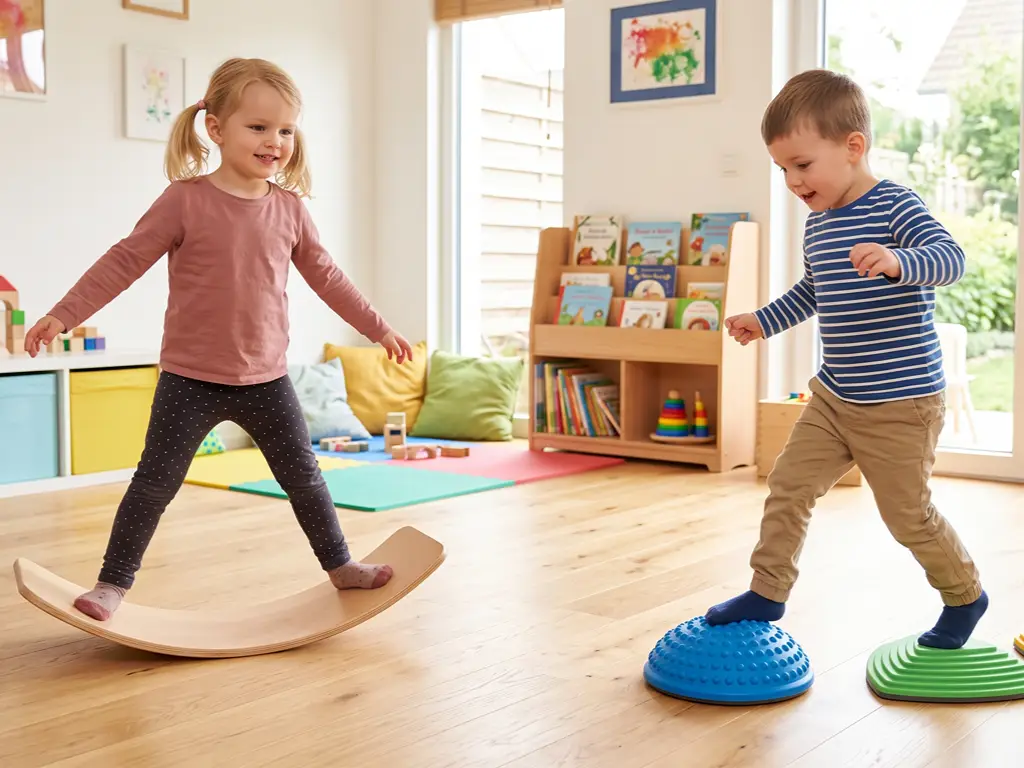
What to look for: stepping stones with larger gaps (20–25cm), a curved balance board they can rock while standing, and their first stacking balance game for tabletop play. The board serves multiple purposes — a bridge for toy cars, a slide for stuffed animals, a rocking boat — which matters because two-year-olds learn through self-directed play, not instruction.
The Tortella et al. (2016) playground study offers an encouraging data point: just 20 minutes of balance-focused play, twice a week, for eight weeks produced measurable improvements in preschool balance skills. In parent terms: fifteen minutes of stepping-stone play after daycare, a few times a week, and you’ll see progress within a month.
Ages 3–4: Running, Jumping, and Complex Coordination
By three, your child wants harder, faster, higher. They’re hopping on one foot, walking along a curb without stepping off, and starting to catch a bounced ball. If you’ve ever worried that your child seems clumsier than their peers, this is the age when those comparisons start creeping in. Here’s the truth: balance ability varies enormously between individual children at this stage — it’s influenced by genetics, prior movement experience, and personality (cautious kids practice less). Most “delays” at this age are just differences in practice time.
What to look for: stepping stones with greater height variation, an advanced balance board with a roller base for an extra instability challenge, and a scooter board for floor-level dynamic movement. This is also the age when social play kicks in — siblings or friends can race through obstacle courses or take turns on the balance beam.
CDC developmental monitoring guidelines note that by age four, most children can hop on one foot for two seconds and catch a bounced ball. Walking heel-to-toe on a narrow beam (10cm wide) typically emerges closer to age five — so don’t panic if your four-year-old can’t do it yet.
Ages 4–6: Refined Control and Sport-Ready Skills
This is the graduation window. Your child’s balance system is approaching adult-level capability. They can stand on one foot for ten seconds or more, jump rope, and — the big one — ride a bike without training wheels. The dynamic balance skills built on wobble boards and stepping stones over the previous years transfer directly to cycling, skating, and ball sports.
What to look for: large climbing structures, balance beams with curves and elevation changes, and entry-level board sports equipment if your child shows interest. But here’s the signal to watch for: when your child starts losing interest in balance toys, that’s not failure — that’s completion. Their body is telling you it’s ready for real sports. The toys did their job.
If your child at age six still struggles significantly with balance — can’t stand on one foot for five seconds, can’t walk heel-to-toe for five meters without stepping off — it’s worth mentioning to your pediatrician.
What Makes a Quality Balance Toy: Materials, Safety, and Durability
Most buying guides skip this section. They assume you just want a list of products. But if you’ve ever bought a toy that cracked after three uses or smelled like a chemical factory, you know that how something is made matters as much as what it does.
Here’s what to look for — and what to avoid — when evaluating any balance toy.
Materials
Wood: Solid wood balance toys feel great and look beautiful. But they’re heavy, they don’t like water, and they need periodic inspection for splinters. Look for FSC certification if environmental sourcing matters to you. Water-based finishes are safer than solvent-based ones.
EPP Foam: Expanded polypropylene is the professional-grade material used in quality stepping stones. It has a rebound rate above 85% — compared to EVA foam (budget products) at 60–70% that can permanently compress within months. EPP is waterproof, lightweight, and free of chemical smells.
PP/PE Plastic: Virgin PP produces consistent color and predictable durability. Recycled blends vary wildly. The sniff test works: if a plastic toy has a noticeable chemical smell out of the box, return it.
Safety Certifications
You don’t need to become a regulatory expert. You just need to know which marks actually mean something:
1. ASTM F963 (U.S.): Sets limits on eight heavy metals (lead ≤90 ppm), sharp edges, small parts, and flammability. Real compliance means traceable documentation, not just a logo.
2. CPC (Children’s Product Certificate) (U.S.): Required by law. A CPC means the product has been tested by a CPSC-accepted third-party laboratory.
3. CE + EN71 (EU): The European equivalent — mandatory for toys sold in the EU.
For factory-level quality assurance, look for BSCI certification. A BSCI-certified factory has passed third-party inspection of its entire production process — quality control systems are far more robust than at uncertified facilities.
What to Check When the Box Arrives
Three thirty-second tests that tell you more than any product description:
1. The edge test: Run your finger along every edge and seam. Sharp? Return it. Smooth? Keep it.
2. The adult weight test: Stand on it. Quality products support 100kg+. Creaking or flexing = return it.
3. The floor-slide test: Push it sideways on a smooth floor. Zero movement = good. Slides = inadequate anti-slip base.
One final point worth knowing: the best balance toys come from manufacturers who treat safety as a production system, not a checklist. Factories that source food-grade raw materials, use high-purity color pigments for batch-to-batch consistency, and maintain a documented safety record over years of operation are operating at a fundamentally different level from those that simply slap a certification logo on the box. When you find a manufacturer like Startinal — one that combines BSCI-audited production with virgin Sino-Korean PP materials, third-party lab testing against ASTM and EN71, and a ten-year track record of zero safety incidents — you’re looking at a fundamentally different product than what comes out of price-driven commodity factories.
Setting Up Balance Play in Any Space
“I’d love to get these, but we don’t have the room.”
If that thought crossed your mind, this section is for you. Balance play doesn’t require a dedicated playroom or a suburban backyard. It requires creativity, not square footage.
Small Apartment / Living Room (under 5m²): “Set up, play, pack away.” One wobble board (stores upright: 40cm × 10cm) plus stackable stepping stones (stacked: 45cm × 45cm) gives you a complete balance gym that disappears into a corner. A strip of colored masking tape on the floor becomes a permanent “balance beam.”
Balcony or Small Yard (5–15m²): Create a permanent mini-course with tape or chalk lines, rotating toys daily. EPP foam toys can stay outdoors without degrading.
Dedicated Playroom (15m²+): Build a multi-station circuit: stepping stones → balance beam → jump targets → crash mat. The circuit format keeps kids moving and scales naturally.
Backyard / Garden: Nature already built your balance playground. Tree roots, garden walls, uneven grass — balance toys become supplementary, not the main event.
A standard curved balance board takes up less space than a floor lamp when stored. Don’t let space anxiety keep you from giving your child what their developing balance system needs.
How to Build a Balance Toy Collection That Grows With Your Child
The question that keeps parents up at night: If I buy this, will my child actually use it — and for how long?
The answer depends less on the toy and more on how you build the collection. Think of it like adding to a Lego set — each new piece expands what’s possible.
Stage 1 — Entry (1.5–2.5 years): One set of wide-based stepping stones (3–5 pieces) and a push walker. Budget $40–80. Goal: “I can stand on this. I can step to that one. I did it.”
Stage 2 — Exploration (2.5–4 years): Add one wobble board, expand stones to 6–8 pieces, add a stacking game. Budget +$50–100. Stage 1 stones don’t retire — “walk across” becomes “jump from stone to stone.”
Stage 3 — Challenge (4–6 years): Scooter board or balance bike, balance beams with elevation changes, team relay games. Budget +$60–120. The wobble board becomes a “surfboard.”
Three principles to carry with you:
1. Fewer, better toys beat more, worse toys. Three high-quality pieces deliver more value than ten bargain-bin toys that break.
2. Open-ended toys outlast single-purpose toys. A balance board that can be a rocker, bridge, slide, and boat stays relevant for years.
3. Safety certifications and material quality are your first filter. If a toy can’t pass the safety bar, cross it off — no matter how fun it looks.
If you’re buying balance toys for a classroom, therapy clinic, or retail business, the quality bar rises even higher. Institutional use demands commercial-grade materials, documented safety certifications, and supply chain reliability that consumer-grade products rarely provide. Manufacturers who build to BSCI-audited standards with food-grade materials, anti-slip engineering, and a documented multi-year safety record — like Startinal — offer a reference point for what institutional-grade balance equipment looks like. For parents, the same principle applies in miniature: a well-made balance toy from a manufacturer that treats safety as a production system, not an afterthought, is worth every dollar.