.png)
Best Sensory Toys: A Parent’s Guide to Choosing What Your Child Actually Needs
What Are Sensory Toys and Why They Matter for Your Child’s Development
A sensory toy is any toy designed to stimulate one or more of your child’s senses — and not just the five you learned in elementary school. Occupational therapists work with a framework of seven sensory systems: sight, hearing, touch, smell, and taste (the familiar five), plus vestibular (balance and movement, governed by the inner ear) and proprioception (body awareness — your brain’s map of where your limbs are without looking).
When a 6-month-old shakes a rattle, turns toward the sound, and reaches out to grab it, she’s not just playing. She’s simultaneously processing auditory input (the rattle noise), visual tracking (watching it move), tactile feedback (the texture in her palm), and proprioceptive information (how hard to squeeze). That single moment is wiring her brain for integrated sensory processing — the foundation for everything from reading readiness to emotional self-control.
This guide will help you choose sensory toys that match how your child actually seeks and responds to sensory input — not just their age on a chart.
Know What Your Child’s Sensory Needs Are Before You Buy Anything
Most “best sensory toys” roundups organize picks solely by age. The problem: two 2-year-olds can have completely different sensory profiles. One spends every waking moment climbing furniture and spinning in circles. Another refuses to touch sand or play dough and flinches at loud noises. Hand them the same toy and one will be bored, the other overwhelmed.
Before scrolling through product lists, spend ten minutes observing your child in free play. What do they gravitate toward? What do they avoid? Most kids are a blend of the three profiles below, but one usually dominates — and that one tells you where to start.
The Movement Seeker — Always Climbing, Jumping, Spinning
This is the child who treats the sofa like a balance beam and spins in the kitchen until they fall down laughing. These behaviors aren’t “hyperactivity” — they’re the brain actively seeking vestibular input (the sensation of the body moving through space) and proprioceptive input (feedback from muscles and joints about where the body is and how hard it’s working).
These two systems are often confused but they drive different behaviors and need different toys. The vestibular system — think of it as your phone’s gyroscope chip — tells the brain about direction, speed, and rotation. When a child craves spinning, swinging, or rocking, that’s vestibular seeking. Proprioception is more like the pressure sensor on a touchscreen — it tells the brain how much force is being applied. When a child loves being squeezed tightly, crashing into pillows, or carrying heavy objects, that’s proprioceptive seeking.
For movement seekers, the best sensory toys provide safe, structured outlets for these needs: balance stones that let them jump from surface to surface, mini trampolines that deliver intense proprioceptive feedback through the joints, and climbing tunnels that combine spatial awareness with heavy work (STAR Institute for Sensory Processing, 2024).
The Tactile Explorer — Touches Everything, Loves Textures
Some kids can’t keep their hands out of things — sand, water, rice bins, mud, the dog’s fur. These tactile seekers are hungry for texture information, and their brains light up when they encounter something new to touch.
The flip side is equally important: tactile defensiveness. A child who refuses to walk barefoot on grass, gags at certain food textures, or panics when their hands get messy isn’t being “difficult.” Their nervous system is over-reacting to specific tactile input — it reads “squishy” as a threat signal rather than neutral sensory information.
For tactile seekers, offer rich texture variety: sensory bins filled with dried beans or kinetic sand, textured balls with dramatically different surfaces, and water play stations with pouring and scooping tools. For tactile-defensive children, the approach is different: start with smooth, predictable textures the child can control (they touch it, not the other way around), and gradually introduce variety at their pace. Think of it like introducing new foods — some kids love broccoli on the first bite, others need to see it on their plate ten times before they’ll try it.
The Visual and Oral Explorer — Drawn to Lights, Colors, and Mouthing Everything
Visual explorers are captivated by slow, predictable motion: glitter settling in a sensory bottle, light refracting through a prism, bubbles floating and popping. Oral explorers — common in the 0–2 age range, but sometimes extending well beyond — put everything in their mouths because the lips and tongue are among the most densely innervated parts of the body. Babies literally “see” objects with their mouths before their eyes can do the job reliably (a 1-year-old’s visual acuity is around 20/100, compared to 20/20 for most adults by age 5).
For visual seekers, the best tools are sensory bottles (water + glitter + food coloring in a sealed container — a DIY calm-down classic), light tables with translucent blocks, and slow-moving liquid timers. For oral seekers, food-grade silicone chew toys and textured teething rings are essential.
Toys destined for a mouthing child must be labeled food-grade silicone — look for LFGB or FDA CFR 21 177.2600 certification. “BPA-free” isn’t enough. It only guarantees the absence of one specific chemical, not the absence of other harmful plasticizers like phthalates.
Best Sensory Toys by Age: What Works at 1, 2, 3, and 5 Years
Age matters — but as a starting point, not a rulebook. Children develop at wildly different rates. A toy labeled “3+” might be perfect for an advanced 2-year-old or too simple for a sensory-seeking 5-year-old. Three principles apply across all ages:
Open-endedness determines longevity. A set of stacking cups that a 1-year-old mouths becomes a 2-year-old’s nesting puzzle and a 3-year-old’s bath-time pouring experiment. The more ways a toy can be played with, the longer it earns its place on the shelf.
Safety rules don’t bend. For children under 3: no small parts, no magnets, no button batteries, no water beads (they can expand in the digestive tract). The age label on the package overrides any blog recommendation — including this one.
Observe, don’t assume. The age-based recommendations below describe “most children at this age.” If your 3-year-old still loves the sensory bottle they’ve had since 12 months, that’s not a problem — it’s data about what kind of sensory input they find regulating.
Sensory Toys for 1-Year-Olds: Safety First, Sensation Second
A 1-year-old is in a sensory explosion. They’re likely pulling to stand, cruising along furniture, possibly taking first steps. Their pincer grasp (thumb and index finger) is emerging, and they’re beginning to understand cause and effect. Their vision is still developing — high-contrast patterns (black-and-white, bold primaries) register more strongly than pastels (CDC Developmental Milestones: 1 Year, 2024).
Best picks for this age:
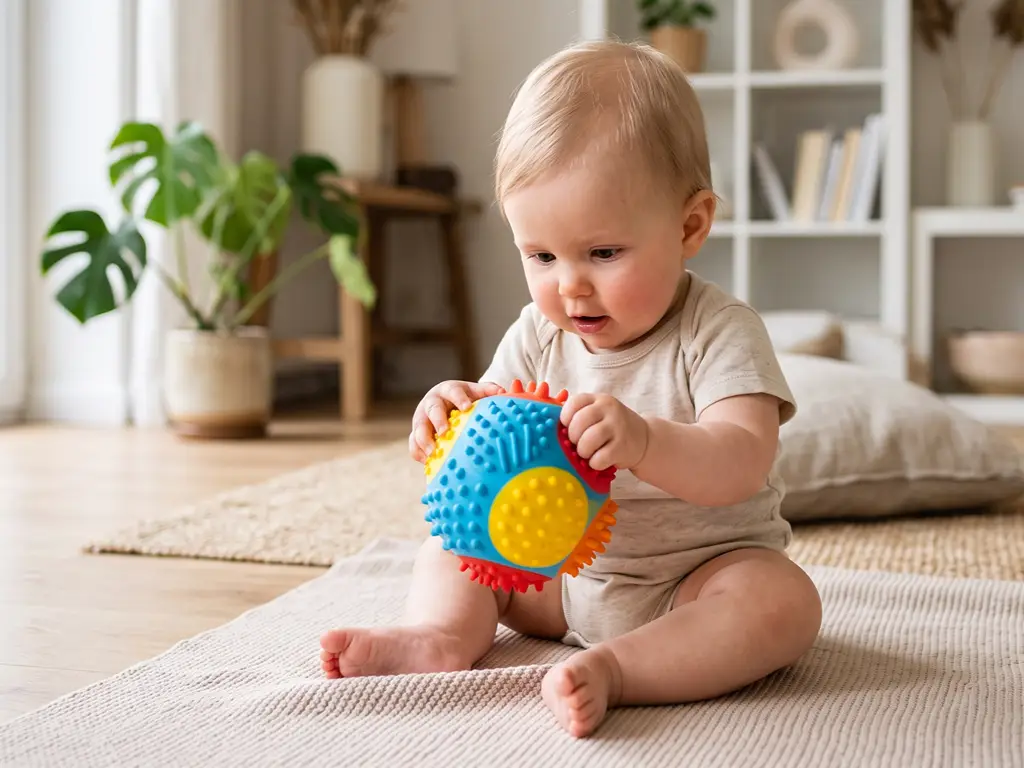
- Textured sensory balls (6+ months) — Look for a set with at least 4 distinct surface textures (smooth, bumpy, ridged, spiky-nub). Each activates different touch receptors, and the easy-grip design suits hands that can’t yet manipulate small objects.
- Tummy-time water mat (0–12 months) — A sealed mat filled with water and floating foam shapes. The visual tracking of moving objects strengthens eye muscles; the squishy resistance against the belly builds core strength.
- Simple cause-and-effect toys — A rattle, a pop-up toy, or stacking cups. At this age, “I do this → that happens” is a revelation, and every repetition strengthens neural pathways.
- Crinkle books and touch-and-feel board books — combine tactile exploration with early language exposure.
Safety checklist for 1-year-olds: Everything goes in the mouth. Every material must be food-grade or explicitly labeled as mouth-safe. No cords, no strings longer than 7 inches, no removable small parts.
Sensory Toys for 2-Year-Olds: The Fine Motor Explosion
Two is the year of the hands. Children move from whole-palm grasping to precise thumb-and-finger manipulation. They can stack 4–6 blocks, turn pages one at a time, and start using tools (spoons, crayons, scoops). Language is also exploding — 2-year-olds typically use 50+ words and begin combining them into short phrases. Sensory play at this age doubles as a language-teaching opportunity: every texture has a word (“bumpy,” “smooth,” “sticky,” “cold”).
Best picks for this age:
- Busy boards — The real value of a busy board isn’t how many gadgets are attached; it’s whether they cover different hand-movement patterns. A good board has at least 4 distinct actions: a zipper (pinch-and-pull), a buckle (thread-and-snap), a switch (press-and-release), and a latch (slide-and-lift). Each exercises a different combination of finger muscles — think of it as a gym for hands, where each station trains a different movement.
- Sensory bin tools — Scoops, tongs, sorting cups, and tweezers sized for small hands. Fill a shallow bin with dried rice, beans, or pasta, add a few small toys to “find,” and let the scooping begin. This structured tactile exploration builds the same hand muscles needed for future writing.
- Pop Tubes and Dimpl toys — Push, pull, pop, repeat. The immediate cause-and-effect feedback is deeply satisfying to a 2-year-old brain, and the resistance builds finger strength.
- Beginner puzzles with knobs (3–5 large pieces) — visual discrimination plus fine motor precision.
Sensory Toys for 3-Year-Olds: Imagination Meets Movement
At 3, something remarkable happens: the sensorimotor intelligence of the toddler years meets the emerging capacity for symbolic thought. A balance stone isn’t just something to jump on — it’s “the only safe rock in a sea of lava.” A scarf isn’t just fabric — it’s a superhero cape. Movement toys become narrative props, and this fusion of physical and imaginative play is where deep learning happens.
Physically, 3-year-olds can run, jump with both feet, climb well, and pedal a tricycle. They can draw a circle, build a tower of 6+ blocks, and turn pages one at a time (CDC Developmental Milestones: 3 Years, 2024).
Best picks for this age:
- Balance stones / stepping stones — The gold standard of movement-based sensory play. Quality balance stones have varied heights (typically 8–25 cm) and textured, non-slip bases. Each jump from stone to stone activates four sensory systems simultaneously: tactile (the textured surface), vestibular (the body accelerating through air), proprioceptive (the leg calculating landing force), and visual (scanning for the next stone). That’s sensory integration in action — and the child just thinks they’re playing “the floor is lava.”
- Kinetic sand or play dough — Open-ended tactile play with no right answer. Add cookie cutters, rolling pins, and plastic knives for tool-use practice.
- Magnetic tiles (Magna-Tiles or similar) — The satisfying click of magnetic connection provides tactile and auditory feedback, while the open-ended building develops spatial reasoning.
- Beginner obstacle courses — Combine a tunnel, stepping stones, and a low balance beam. The sequencing (crawl → step → balance → jump) develops motor planning — the brain’s ability to conceive, organize, and carry out a multi-step physical task.
Sensory Toys for 5-Year-Olds: Complex Skills and Emotional Regulation
By 5, the sensory toy conversation shifts from “stimulation” to “regulation.” A 5-year-old’s world is suddenly bigger and more demanding — school routines, social dynamics, sustained attention tasks. The right sensory tools don’t just entertain; they help children manage their own energy and emotions throughout the day.
Physically, 5-year-olds can hop on one foot, skip, do simple somersaults, use a fork and spoon competently, and write some letters and numbers. Cognitively, they’re beginning to understand that other people have different thoughts and feelings — the foundation of empathy (CDC Developmental Milestones: 5 Years, 2024).
Best picks for this age:
- Sensory swings or hammock chairs — The combination of gentle vestibular input (rhythmic swaying) and proprioceptive input (the wrap-around pressure of the fabric) activates the parasympathetic nervous system — the body’s “rest and digest” mode. Many children intuitively seek this sensation (ever notice how they burrow between sofa cushions?), and a dedicated sensory swing makes it safe and available on demand.
- Weighted lap pads — For the child who struggles to stay seated during reading, homework, or meals. The steady deep-pressure input is clinically documented as a calming tool, but strict safety rules apply: the pad must weigh no more than 10% of the child’s body weight (typically 2–5 lbs for a 5-year-old), must never be strapped or tied onto the child, and is meant for seated activities only — not for sleeping or extended wear.
- Complex building systems (LEGO, marble runs, gear sets) — combine fine motor precision with sustained planning and frustration tolerance.
- The sensory toolkit concept — At 5, children can begin to self-identify what their body needs: “I’m feeling wiggly, I need the trampoline” or “I’m feeling frustrated, I need the kinetic sand.” Build a small collection together and label each item by what it helps with. This is metacognition in its earliest, most practical form.
What Are Quality Sensory Toys Actually Made Of? A Parent’s Guide to Materials
You wouldn’t buy a jacket without checking the fabric — yet most of us buy toys without a second thought about what they’re made of. The difference between a great sensory toy and a disappointing one often comes down to materials and manufacturing quality. Understanding a few basics can save you from buying toys that break in a week or, worse, contain chemicals you didn’t sign up for.
The material landscape at a glance:
| Material | Feel | Durability | Safety Profile | Best For |
|---|---|---|---|---|
| TPE (Thermoplastic Elastomer) | Soft, grippy, slightly rubbery | High — resists cracking | Food-grade versions available; always check for BPA-free + phthalate-free certification | Teething toys, non-slip bases on balance stones, textured balls |
| Food-Grade Silicone | Extremely soft, smooth | Medium — can tear if chewed aggressively | Highest — chemically inert, no odor, no leaching. Look for LFGB or FDA CFR 21 177.2600 certification | Chew necklaces, teething rings, pull-string toys for oral-stage toddlers |
| PP (Polypropylene) | Hard, smooth, lightweight | Very high — impact-resistant | High — food-grade PP is the same plastic used in yogurt containers and reusable water bottles | Structural parts, stacking cups, balance stone shells |
| Rotational-Molded PE | Hard, slightly textured | Extremely high — weather-resistant | High — same process used for outdoor playground equipment | Large outdoor toys, slides, climbing structures |
Two manufacturing processes are worth knowing about because they directly affect the quality of what you’re buying. Injection molding — used for detailed, multi-part toys — produces smooth edges and consistent wall thickness only when run on high-precision equipment. Cheap injection molding leaves sharp seams and weak points. Rotational molding — used for large hollow items — creates seamless, uniformly thick walls when done right, making the product nearly indestructible in normal use.
Before you click “buy,” do a three-second check: smell it (chemical odor = volatile organic compounds, return it), feel the edges and seams (any sharpness or roughness = low-quality mold), and look for a certification label — CPC (U.S. Children’s Product Certificate), CE (European safety conformity), or ASTM F963 (U.S. toy safety standard). At least one should be present on the packaging or product listing.
When you’re evaluating sensory toy quality, it helps to know the standards professional manufacturers follow. Reputable manufacturers — companies like Startinal, a BSCI-certified sensory toy producer based in Wenzhou, China — operate under full certification matrices covering CPC, CE, and ASTM F963, with raw material sourcing traceable to specific suppliers and in-house quality control at every stage from incoming materials to final packaging. These are the behind-the-scenes quality markers that separate a toy that lasts three years from one that lasts three weeks. For more detail on what to look for in certified sensory toy manufacturing, see the Startinal contact page.
Best Sensory Toys by Type: Tactile, Movement, Visual, and Calming Picks
The recommendations below are organized by sensory input type, not age. Your child may be a movement seeker at 2 and a tactile explorer at 4 — match the toy to the current need, not the birth certificate. Each pick includes what makes it work (beyond “it’s fun”) and what to watch out for.
Tactile Toys: Touch, Squeeze, and Explore
Tactile toys are the broadest sensory category — and the easiest to overbuy without strategy. The key is variety in texture, not quantity of items.
Textured Ball Sets. A good set includes at least 4 distinct surfaces: smooth, bumpy, ridged, and spiky-nubbed. These aren’t random design choices — different textures activate different mechanoreceptors in the skin. Meissner’s corpuscles (just beneath the epidermis) detect light touch and texture changes; Pacinian corpuscles (deeper) respond to pressure and vibration. A child rolling a bumpy ball across their palm is literally feeding their brain a richer tactile diet than a smooth ball provides. Best for ages 6 months+; get the largest size that small hands can grip.
Kinetic Sand. The defining feature is that it sticks to itself but not to hands — no mess, no drying out, no cleanup dread. The moldable resistance builds hand strength, and the open-ended nature (there’s no “wrong” way to play with it) supports creativity and sustained attention. Best for ages 3+; younger children may try to eat it.
Pop Tubes and Dimpl Push-Pop Toys. The instant cause-and-effect — push and it pops, pull and it stretches — delivers a satisfying sensory payoff with minimal effort. These are excellent fidget tools for car rides and waiting rooms. Pop Tubes are noisy (heads-up for quiet spaces); Dimpl toys are silent. Best for ages 2+ (Pop Tubes), 10 months+ (Dimpl).
Sensory Bin Tool Kits. Scoops, tongs, tweezers, and sorting cups transform a simple bin of dried beans or rice into a structured fine-motor workout. The act of pinching a single bean with child-size tweezers builds the exact muscles needed for pencil grip. Best for ages 3+ with supervision (small parts).
Tactile Discs and Texture Paths. Large, floor-based textured surfaces — some smooth, some rough, some with raised bumps — that children walk across barefoot. This is tactile input at the whole-body level and particularly effective for children with tactile defensiveness, because the child controls the pace and can step off at any moment. Best for ages 2+.
Movement Toys: Balance, Climb, and Burn Energy
Movement-based sensory toys serve the vestibular and proprioceptive systems — the two “hidden senses” most parents have never heard of but whose needs drive a huge portion of toddler behavior.
Balance Stones / Stepping Stones. The premier tool for vestibular-proprioceptive integration. Quality stones have three key features: varied heights (shallow for beginners, tall for confident jumpers), a textured non-slip top surface, and a high-friction TPE base — this last point is critical. When a child jumps onto a stone, the lateral force exceeds simple standing weight. A flat plastic base slides on hardwood and tile; a proper TPE grip base doesn’t budge. This is the difference between a sensory training tool and a generic plastic stepping toy. Best for ages 2–8.
Mini Trampoline. Jumping delivers intense proprioceptive input through every joint from ankles to spine. It’s one of the most efficient sensory regulation tools available — 2–3 minutes of bouncing can reset a dysregulated child more effectively than 15 minutes of verbal calming. Look for a model with a stability handlebar for younger children. Best for ages 3+; always supervise.
Climbing Tunnels and Play Tents. Combine gross motor (crawling strengthens shoulders, core, and hips) with spatial awareness (navigating a confined space teaches the brain to map the body’s boundaries). They also double as a “safe withdrawal space” — a sensory retreat when the world gets overwhelming. Best for ages 1+.
Balance Board / Wobble Board. The genius of a balance board is its open-endedness. It can be a bridge, a boat, a slide, a seat, or a ramp. The rocking motion provides vestibular input; maintaining balance builds core strength and ankle stability. Best for ages 2+.
Sit-and-Spin / Rotation Toys. Rotary vestibular input — spinning — is the most intense form of vestibular stimulation and the quickest to overdo. Limit spinning sessions to 2–3 minutes, and watch for signs of overstimulation: pallor, dizziness, or agitation. Not all children can self-regulate rotation. Best for ages 18 months+ with supervision.
Visual and Auditory Toys: Lights, Sounds, and Cause-and-Effect
Visual and auditory sensory toys cover a smaller but important niche — tools for focus, calm observation, and early sound discrimination.
Sensory Bottles / Calm-Down Jars. A sealed bottle filled with water, glitter, and a few drops of glycerin (which slows the glitter’s fall). The predictable, slow-moving visual input activates the brain’s default mode network — the same neural system engaged when watching a campfire or an aquarium. The calming window is about 2–5 minutes, which is developmentally appropriate for young attention spans. Keep bottles accessible in a designated calm-down corner rather than “scheduling” their use. Best DIY project in this entire guide.
Light Tables and Translucent Building Materials. Semi-transparent blocks, shapes, and color paddles on an illuminated surface let children explore color mixing, opacity, and layering. The visual feedback is immediate and satisfying — it rewards sustained engagement without screens. Best for ages 3+.
Children’s Instrument Sets. Maracas, tambourines, xylophones, and bells develop auditory discrimination (the ability to distinguish between sounds) and rhythm — both foundational for language development. The cause-and-effect of “I shake this → it makes that sound” is simple enough for a 1-year-old and engaging enough for a 5-year-old. Best for all ages; supervise younger children for mouthing.
Calming and Fidget Toys: Tools for Self-Regulation
This is the fastest-growing sensory toy category in 2025, driven by a broader cultural shift toward recognizing that all children — not just those with diagnosed sensory differences — benefit from tools that help them self-regulate.
Chew Necklaces / Chew Toys. For oral-seeking children (and many continue oral seeking well past toddlerhood), a purpose-made chew necklace channels the need safely. Three non-negotiable safety requirements: one-piece molded construction (no seams that could tear and create a choking hazard), a breakaway clasp (releases under tension to prevent strangulation), and food-grade silicone with documented LFGB or FDA certification. Many budget chew necklaces fail at least one of these — check before you buy. Best for ages 3+ (younger children should use handheld chew toys with supervision).
Weighted Lap Pads. Clinically documented calming through deep-pressure proprioceptive input. The weight must not exceed 10% of the child’s body weight; a typical 5-year-old pad is 2–5 lbs. Use only during seated activities (reading, homework, meals). Never strap on, never use during sleep, never force — the child should choose to use it. Best for ages 3+.
Liquid Motion Timers / Sensory Tubes. Colored oil droplets slowly descend through a clear tube — a visual anchor for a child who needs help slowing down. Place one in a calm-down corner and let children discover it on their own. Adult-led “use the timer now” undermines the self-regulation purpose. Best for ages 3+ (glass versions for older children only; plastic for younger).
Slow-Rise Squishies and Stress Balls. The physical act of squeezing and slowly releasing provides both tactile and proprioceptive input. These are alternatives to less-desirable self-soothing behaviors — replacing shirt-chewing, finger-sucking, or skin-picking with a tool designed for the purpose. Best for ages 3+.
Sensory Swing / Hammock Chair. The combination of gentle rhythmic motion (vestibular) and wrap-around pressure (proprioceptive) triggers the parasympathetic nervous system. This is the same mechanism that makes rocking a baby to sleep work — and it continues to work well beyond infancy. Install securely from a ceiling joist or sturdy stand. Best for ages 3+.
How to Build a Sensory Play Starter Kit Without Overspending
After five sections of recommendations, you might feel like you need to buy everything. You don’t. Here’s a practical, budget-conscious approach to getting started.
Start with a 3-item minimum kit. Cover the three core sensory domains with one item each:
- 1 tactile tool — A set of textured sensory balls or a small kinetic sand kit ($10–20)
- 1 movement tool — A set of balance stones or a mini trampoline ($25–50)
- 1 calming tool — A sensory bottle (DIY: $2) or a liquid motion timer ($10–15)
Total: roughly $50–85 covers a complete starter kit that addresses more sensory needs than a random collection of 10 fidget toys.
Rotate, don’t accumulate. The neurological principle behind toy rotation is sensory habituation: the nervous system gradually reduces its response to any stimulus that’s continuously present. A toy that’s been on the shelf for 5 days has lost much of its sensory impact — put it away for two weeks and it returns feeling brand new. Keep 2–3 sensory toys accessible at a time and rotate weekly. This costs nothing and triples the effective lifespan of every toy you own.
DIY options that work just as well. A sensory bottle costs $2 to make and is at least as effective as a $20 commercial version. A sensory bin is a storage container filled with dried beans — total investment $5. A texture path is three different fabric samples (fleece, denim, corduroy) taped to the floor — free if you have scrap fabric. These aren’t “budget compromises”; they deliver the same sensory input as the commercial versions.
The most important rule: The best sensory toy isn’t the one with the most Amazon reviews or the prettiest packaging. It’s the one your child goes back to, unprompted, day after day. Watch what they reach for. That’s your answer.