.png)
The Complete Guide to Types of Sensory Toys: Beyond the 5 Senses
Why Sensory Toys Matter for Development and Learning
Sensory toys are tools designed to stimulate one or more of a child’s sensory systems — touch, sight, sound, movement, and beyond. They serve a purpose far broader than most people realize. While they are essential resources for children with autism, ADHD, or sensory processing disorder (SPD), they are equally valuable for any child building the foundational ability to take in, organize, and respond to sensory information from their environment.
Here is a useful way to frame it: not everyone who wears glasses has a vision disorder. Some people need reading glasses, others need driving glasses, and some need blue-light filters for screen work. Sensory toys work the same way — different types serve different needs, and understanding those types is the first step toward choosing the right tool for the right situation.
The numbers back this up. Research indicates that between 5% and 16% of school-aged children experience sensory processing challenges significant enough to affect their daily functioning — roughly 1 in 6 children in any given classroom (STAR Institute for Sensory Processing, citing Ahn, Miller et al., 2004; Ben-Sasson, Carter et al., 2009). That means the audience for sensory toys is not a narrow clinical niche — it is a substantial and growing segment of the children’s products market.
Understanding the different types of sensory toys is therefore not just useful for parents and therapists. For anyone who stocks, sells, or sources children’s products — whether you run an Amazon storefront, supply early childhood centers, or manage a therapy clinic’s inventory — knowing the categories is a business advantage.
The Sensory Systems: A Framework for Understanding Toy Categories
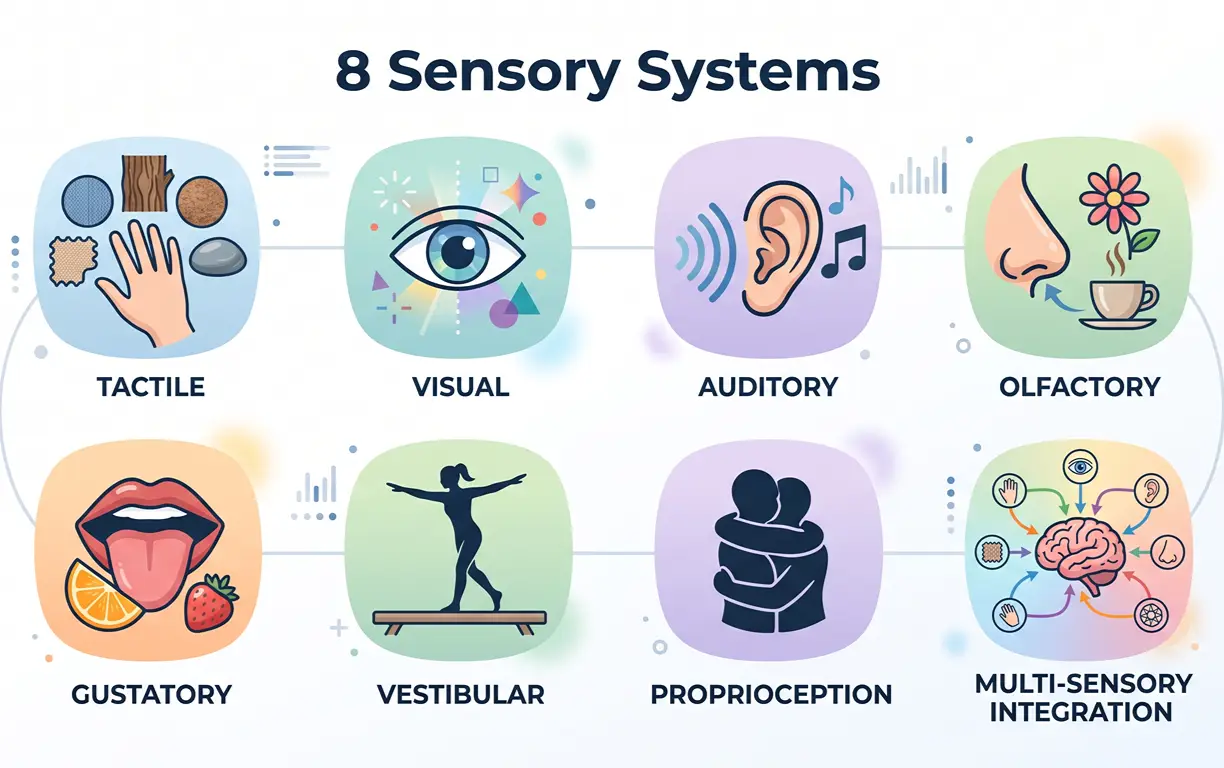
Before diving into specific toy types, it helps to understand the sensory systems those toys are designed to engage. Most people can name five senses. But occupational therapists and sensory integration specialists work with eight — and the three that most people miss are arguably the most important for regulation and development.
| Sensory System | What It Does | Example Toy Categories |
|---|---|---|
| Tactile (Touch) | Processes texture, pressure, temperature, and pain through skin receptors | Fidget toys, textured balls, sensory bins, therapy putty |
| Visual (Sight) | Interprets light, color, motion, and spatial relationships | Bubble tubes, fiber optic lights, lava lamps, sensory bottles |
| Auditory (Hearing) | Processes sound frequency, volume, and rhythm | Rain sticks, white noise machines, noise-canceling headphones |
| Olfactory (Smell) | Detects and identifies scents | Scented dough, aromatherapy tools, scented markers |
| Oral / Gustatory (Taste + Oral Motor) | Combines taste perception with mouth-based sensory input | Chewelry, chew tubes, bubble blowers, whistles |
| Vestibular (Balance & Movement) | Senses head position, motion, and spatial orientation through the inner ear | Swings, balance boards, wobble cushions, scooter boards |
| Proprioceptive (Body Awareness) | Senses body position, force, and muscle effort through joints and muscles | Weighted blankets, body socks, crash pads, resistance bands |
| Multi-Sensory Integration | Coordinates input across multiple systems simultaneously | Sensory activity boards, sensory room bundles, light-up tactile panels |
The three systems people most often overlook are vestibular, proprioceptive, and oral-motor. They operate largely beneath conscious awareness — you do not think about keeping your balance while sitting in a chair, or about where your hands are while typing, until something goes wrong. Yet these “hidden senses” are the foundation of sensory integration therapy, and any professional-grade product catalog that omits them is incomplete.
Below, we group all eight systems into three practical product families — starting with the familiar, building toward the overlooked.
Tactile, Visual, and Auditory Toys — The Familiar Three
These three categories form the bulk of most sensory toy inventories. But within each one, the same type of toy can serve two opposite purposes: stimulation (alerting an under-responsive sensory system) or calming (settling an over-responsive one). A spiky massage ball wakes up the tactile system; a weighted plush toy soothes it. Keep this alerting-vs.-calming lens in mind as you explore each category — it is the single most useful framework for matching a toy to a user’s actual needs.
Tactile Toys — Touch, Texture, and Fine Motor Exploration
Tactile toys are the largest sensory toy category, accounting for roughly 40% of the market. They range from simple stress balls to multi-textured activity panels, and they serve users across every age group and setting.
Grasp-and-squeeze toys include stress balls, therapy putty, and gel-filled shapes like the Nee-Doh ball. Therapy putty in particular has a standardized resistance grading system that buyers should know: Extra-Soft (yellow), Soft (red), Medium (green), Firm (blue), and Extra-Firm (black). Different resistance levels target different hand-strength needs, from post-injury rehabilitation to heavy sensory seeking.
Texture exploration toys include sensory bins filled with rice, dried beans, or kinetic sand, as well as textured panels and tactile discs. These are staples of early childhood classrooms and therapy gyms. Water beads (sometimes called gel beads or orbeez) deserve special caution for any environment serving children under 3. They can expand inside the body if swallowed, and several jurisdictions have moved to restrict or ban them from childcare settings.
Fine-motor fidgets — pop-its, fidget cubes, infinity cubes, marble mesh toys — are the quiet workhorses of classrooms and offices. They provide just enough tactile input to occupy restless hands without disrupting others, making them one of the highest-volume subcategories for school-focused inventory.
For anyone sourcing tactile toys, the material baseline is straightforward: food-grade silicone, BPA-free plastics, and water-based non-toxic paints are minimum expectations, not differentiators. Anything less is a liability.
Visual Toys — Light, Color, and Tracking
Visual sensory toys are the centerpiece of nearly every calm-down corner and sensory room. Their job is to provide controlled, predictable visual input that captures attention without overwhelming it.
Calming visual tools include bubble tubes, fiber optic sprays, lava lamps, and glitter jars (often called calm-down bottles). What makes these effective is their slow, rhythmic motion — the brain can track them without effort, which engages what researchers call “passive attention.” A well-designed calm-down corner typically pairs one light source with one soft-seating element (a beanbag chair, a weighted lap pad, or both).
Alerting visual tools serve the opposite function: LED projectors, spinning light shows, and kaleidoscopes are designed to attract and hold the attention of children who need stronger stimulation to stay engaged. Fiber optic strands should always use LED light sources — they stay cool to the touch and pose no burn risk, unlike older halogen models.
Bubble tube motor noise is a detail that trips up many first-time buyers. If the pump hums above roughly 35 decibels, the auditory irritation can cancel out the visual calming effect — especially for children with sound sensitivity. A quiet pump is not a luxury feature; it is a functional requirement.
Auditory Toys — Sound, Rhythm, and Sensory Regulation
Auditory sensory products fall into two camps that are opposites in function but equally important in a well-rounded inventory: tools that make sound, and tools that manage it.
Sound-making tools include rain sticks, boom whackers (tuned percussion tubes), shakers, and white noise machines. These help children explore cause-and-effect relationships with sound, develop auditory discrimination, and — in the case of white noise — mask unpredictable environmental sounds that might trigger distress.
Sound-management tools are the often-forgotten half of the equation. Noise-canceling headphones designed for children (such as Alpine Muffy Kids) and high-fidelity earplugs (such as Vibes) reduce auditory overload without fully isolating the user. The key specification to understand is NRR (Noise Reduction Rating): NRR 22–27 dB is appropriate for everyday environments like classrooms or grocery stores; NRR 30+ dB is suited for extreme-noise settings like fireworks displays or construction zones.
For children with autism, this category carries particular weight. Research shows that approximately 60% of children on the spectrum demonstrate measurable improvement in attention and engagement when provided with appropriate auditory accommodations — whether that means reducing ambient noise or offering controlled sound input.
Vestibular, Proprioceptive, and Oral-Motor Toys — The Hidden Senses
These three sensory systems are the foundation of sensory integration therapy, and they represent the categories most often missing from basic toy inventories. If tactile, visual, and auditory toys are the visible tip of the iceberg, these are the mass below the waterline — less obvious, but far more substantial. Understanding them is what separates a professional-grade product selection from a basic one.
Vestibular Toys — Balance, Motion, and Spatial Awareness
The vestibular system, located in the inner ear, tells the brain where the head is in space and whether the body is moving. It is the sensory system behind every playground swing, balance beam, and spinning ride — and it has a direct pipeline to the brain’s regulation centers. Fifteen minutes of appropriate vestibular input can produce measurable calming effects that last for several hours.
Balance equipment — river stones, stepping stones, balance boards, wobble cushions — is the most versatile subcategory. These products work across settings: a wobble cushion on a classroom chair helps a fidgety student stay seated, while a set of balance stones in a therapy gym builds core strength and motor planning.
Swing-and-spin equipment includes platform swings, cocoon swings, and spinning boards. Three safety metrics matter here above all else: the swing’s weight capacity should be at least 3× the labeled user weight (standard safety redundancy); rotation speed for spinning equipment should stay below 30 RPM to avoid vestibular overstimulation; and all mounting points must be rated for dynamic load, not just static weight.
Bouncing equipment — mini trampolines, peanut balls, hop-along balls — combines vestibular and proprioceptive input. These are high-engagement, high-exertion tools that work especially well for children who seek intense sensory input.
Why does swinging calm an agitated child? It is not just “tiring them out.” Rhythmic vestibular input activates the parasympathetic nervous system, lowering cortisol levels. The calming effect is physiological, not psychological — which is why it works even for children too young to understand why they feel better.
Proprioceptive Toys — Deep Pressure, Heavy Work, and Body Awareness
Proprioception is your body’s sense of itself — the feedback from muscles and joints that lets you touch your nose with your eyes closed or know how hard to push a door. For children with sensory processing difficulties, proprioceptive input is the most reliably organizing and calming of all sensory inputs. Deep pressure almost never overstimulates.
Weighted products form the core of this category: weighted blankets, lap pads, vests, and plush toys. The clinical guideline for weight selection is the user’s body weight × 10%, plus 0.5–1 kg for children (1–2 kg for adults). This is not a marketing suggestion; it is a safety parameter. The user must be able to remove the weighted item independently — this is an absolute requirement, not a recommendation. Weighted products should never be used for infants under 2 years old, under any circumstances.
On the manufacturing side, glass bead filling is superior to plastic poly pellets. Glass beads distribute weight more evenly, stay in place through washing, and do not degrade into microplastics. Beads smaller than 1 mm pose a leakage and inhalation risk and should be avoided.
Compression products — body socks, compression sheets, lycra wraps — provide full-body deep pressure without added weight. They are especially effective for children who seek proprioceptive input through crashing, squeezing into tight spaces, or wrapping themselves tightly in blankets.
Heavy work tools — crash pads, resistance bands, push-pull equipment — are the active end of the proprioceptive spectrum. These are essential for sensory-seeking children who need intense muscle and joint feedback to feel regulated. A well-designed sensory gym typically allocates at least as much floor space to heavy-work equipment as it does to fine-motor stations.
For B2B buyers, weighted products deserve particular attention: they consistently rank among the highest-average-order-value items in the sensory category, and their use cases (bedtime routine, homework focus, anxiety management) drive steady repeat purchasing — parents buy one weighted blanket per child, then a lap pad for school, then a travel-size version. It is a rare category where premium pricing aligns with clinically validated demand.
Oral-Motor Toys — Chewing, Sucking, and Oral Sensory Input
Oral-motor toys address one of the most common and least-discussed sensory needs: the drive to chew. Children who chew on shirt collars, pencil erasers, or their own fingers are not being difficult — they are self-regulating. The rhythmic jaw motion of chewing provides proprioceptive input to the temporomandibular joint, which has a naturally organizing effect on the nervous system.
Chew tools (chewelry) — chew necklaces, bracelets, pencil toppers, and handheld chew tubes — are the primary product type. They come in different resistance levels (light, medium, firm) and must be made of food-grade silicone with hardness in the Shore A 30–70 range. The cord must include a breakaway clasp that releases at no more than 2.5 kg of force to eliminate any strangulation risk.
Oral-motor skill builders — bubble blowers, whistles, straws of varying diameters — develop breath control and the oral muscle coordination needed for speech. These straddle the line between toy and therapeutic tool, and they are commonly stocked by both toy retailers and therapy supply companies.
Safety in this category is non-negotiable. Chew tools are not ordinary toys. They go in the mouth, repeatedly, for extended periods. The material must be FDA or LFGB food-grade certified. Worn or damaged chew tools must be replaced — a cracked silicone surface can harbor bacteria and become a tearing hazard. Any retailer stocking oral-motor products should include replacement guidance in product descriptions; it signals competence and builds trust.
Covering all 8 sensory systems in your inventory?
Browse Product CatalogMulti-Sensory Toys — When Categories Overlap
Most real-world sensory toys do not fit neatly into a single box. A sensory activity board might combine tactile textures, visual color contrasts, auditory bells and clickers, and fine-motor fasteners — all on one panel. A complete sensory room bundle layers fiber optic lighting (visual) with soft floor padding (tactile + proprioceptive) and a platform swing (vestibular) into a single integrated environment.
This overlap is not a classification problem — it is a product strategy. Multi-sensory toys allow buyers to cover two or three sensory systems with a single SKU, which reduces inventory complexity while increasing average order value. For classroom and clinic buyers operating on fixed budgets, a thoughtfully designed multi-sensory product often delivers more therapeutic value per dollar than purchasing separate single-system items.
The multi-sensory category includes sensory wall panels with integrated lights and textures; liquid floor tiles that respond to pressure with shifting colors; and cause-and-effect switch toys that activate lights, vibration, and music with a single press. These products are especially popular in special education settings, where engaging multiple sensory channels simultaneously can improve attention and participation.
How to Match Sensory Toy Types to Age, Need, and Setting
Knowing the categories is step one. Step two is matching the right category to the right person in the right environment. The single most important variable is the user’s sensory profile — are they sensory-sensitive (hyper-responsive, avoiding input) or sensory-seeking (hypo-responsive, craving input)? A child who covers their ears at loud noises and a child who deliberately crashes into furniture need completely different types of sensory toys, even if both carry the same diagnosis.
| Observed Behavior | Likely Sensory Need | Recommended Category | Best Setting | Key Precaution |
|---|---|---|---|---|
| Restless hands, constant fidgeting | Tactile / fine-motor input | Fidget toys, therapy putty, infinity cubes | Classroom, office, anywhere | Choose quiet options for shared spaces |
| Chewing shirts, pencils, fingers | Oral-motor input | Chew necklace, chew tube (food-grade silicone) | Any setting | Replace when worn; breakaway clasp mandatory |
| Seeks spinning, rocking, crashing | Vestibular + proprioceptive | Platform swing, crash pad, balance board | Therapy gym, playroom, supervised home | Adult supervision; safe fall zone required |
| Overwhelmed by noise, covers ears | Auditory sensitivity | Noise-canceling headphones (NRR 22–27 dB) | Classroom, supermarket, public transit | Ensure proper fit for age group |
| Difficulty settling, winding down | Deep pressure / proprioceptive | Weighted lap pad, compression sheet, body sock | Bedroom, quiet corner, homework station | Never for infants; user must self-remove |
| Stares at lights, visual fixation | Visual input | Bubble tube, lava lamp, fiber optic spray | Calm-down corner, sensory room | LED only — no heat sources within reach |
| Low muscle tone, poor body awareness | Proprioceptive + heavy work | Weighted vest, resistance band, scooter board | Therapy gym, PE class | Gradual progression; never force |
Sensory-sensitive children need gentle, predictable input. Sensory-seeking children need stronger, more varied stimulation. Match the toy type to the sensory profile — not just the diagnosis.
The age lens adds another filter. For infants and toddlers (0–3), focus on soft textures, high-contrast visuals, and simple cause-and-effect — avoid small parts, weighted items, magnets, and anything with a cord. For school-age children (4–11), classroom-compatible fidgets, wobble cushions, and chew pendants become the core inventory. For teens and adults (12+), discreet options — fidget rings, infinity cubes, weighted lap pads that do not look clinical — are essential for adoption and continued use.
What to Look for When Sourcing Sensory Toys — A Buyer’s Checklist
If you have read this far, you have moved beyond “what are the types” and into “how do I stock the right ones.” That transition — from learning the taxonomy to applying it — is where most content on this topic stops. Here is a practical sourcing framework organized around four dimensions to close that gap.
1. Safety certifications, by market. The regulatory landscape depends on where your customers are. For the United States: ASTM F963-23 (the current revision, published October 2023) and CPC (Children’s Product Certificate) are mandatory. The 2023 update added significant new requirements for expanding materials like water beads (Section 4.40) and strengthened battery-compartment security standards for button and coin batteries, now applicable to toys for children up to 14 years old (ASTM International, 2023). For the European Union: CE marking plus EN71 (Parts 1, 2, and 3 — mechanical, flammability, and chemical migration respectively) are the baseline. For international markets: ISO 8124 provides a widely recognized reference standard. Electronic sensory toys additionally require EN IEC 62115. Beyond product-level certifications, factory-level credentials like BSCI (Business Social Compliance Initiative) indicate that the manufacturing facility itself meets labor and safety standards — a complementary layer of assurance that matters increasingly to institutional buyers with formal vendor qualification processes. To put this in concrete terms: a supplier like Startinal, which operates a BSCI-audited facility and maintains CPC, CE, and ASTM certification across its sensory and active play product lines, demonstrates the kind of multi-layered compliance that institutional procurement teams look for. A ten-year operational history with zero safety incidents — verifiable, not asserted — adds a further layer of confidence that goes beyond any single certificate.
2. Material transparency, by category. Different sensory toy categories have fundamentally different material requirements. Oral-motor products must be food-grade silicone with FDA or LFGB certification. Weighted products should use glass bead fill, not plastic pellets. Wooden items need water-based, non-toxic coatings. Fabric products — soft play equipment, body socks, compression sheets — should meet flammability standards and be free of azo dyes. A supplier who cannot produce material composition data and corresponding test reports for each SKU is not a supplier you can confidently represent to your own customers.
3. Category coverage width. How many of the eight sensory systems does a single supplier’s catalog span? A manufacturer that covers tactile, vestibular, and proprioceptive categories — rather than specializing in only fidget toys or only weighted products — reduces the number of vendor relationships you need to manage. One invoice, one quality standard, one point of contact for reorders across three product families is operationally simpler than juggling separate suppliers for each. Some manufacturers with vertically integrated production — injection molding, metal fabrication, and textile lines under one roof — can offer this breadth natively. Others assemble it through subcontracting, which introduces variability. Knowing which model you are buying from matters.
4. Supply flexibility. The sensory toy market is projected to grow at over 8% annually through 2030 (Grand View Research, 2025), driven by rising awareness of neurodiversity and the expansion of sensory tools into mainstream education. In a growing market, rigid supply terms are a competitive disadvantage. Look for low minimum order quantities on stock items (so you can test new categories without overcommitting), consistent lead times (1–7 days for in-stock products, 3–4 weeks for production runs), OEM and custom-branding capability for differentiation, and pre-shipment inspection as a standard practice rather than an add-on. A ten-year track record without safety incidents — not as a marketing claim, but as a documented operational history — is one of the strongest signals a supplier can offer.
References
- STAR Institute for Sensory Processing. “Understanding Sensory Integration Process.” sensoryhealth.org. Ahn, Miller et al. (2004); Ben-Sasson, Carter et al. (2009). https://sensoryhealth.org/
- ASTM International. “ASTM F963-23 Standard Consumer Safety Specification for Toy Safety.” Published October 13, 2023. https://www.astm.org/
- The Toy Association. “ASTM International Publishes Revised F963 Toy Standard.” October 2023. https://toyassociation.org/
- Grand View Research. “Sensory Toys Market Size, Share & Trends Analysis Report.” 2025. https://www.grandviewresearch.com/
- https://www.startinal.com/why-startinal/
- https://www.startinal.com/
- https://www.startinal.com/contact-us/
Ready to Stock a Complete Sensory Toy Line?
From tactile fidgets to vestibular balance equipment — one supplier, all eight categories.
Request Catalog & Samples