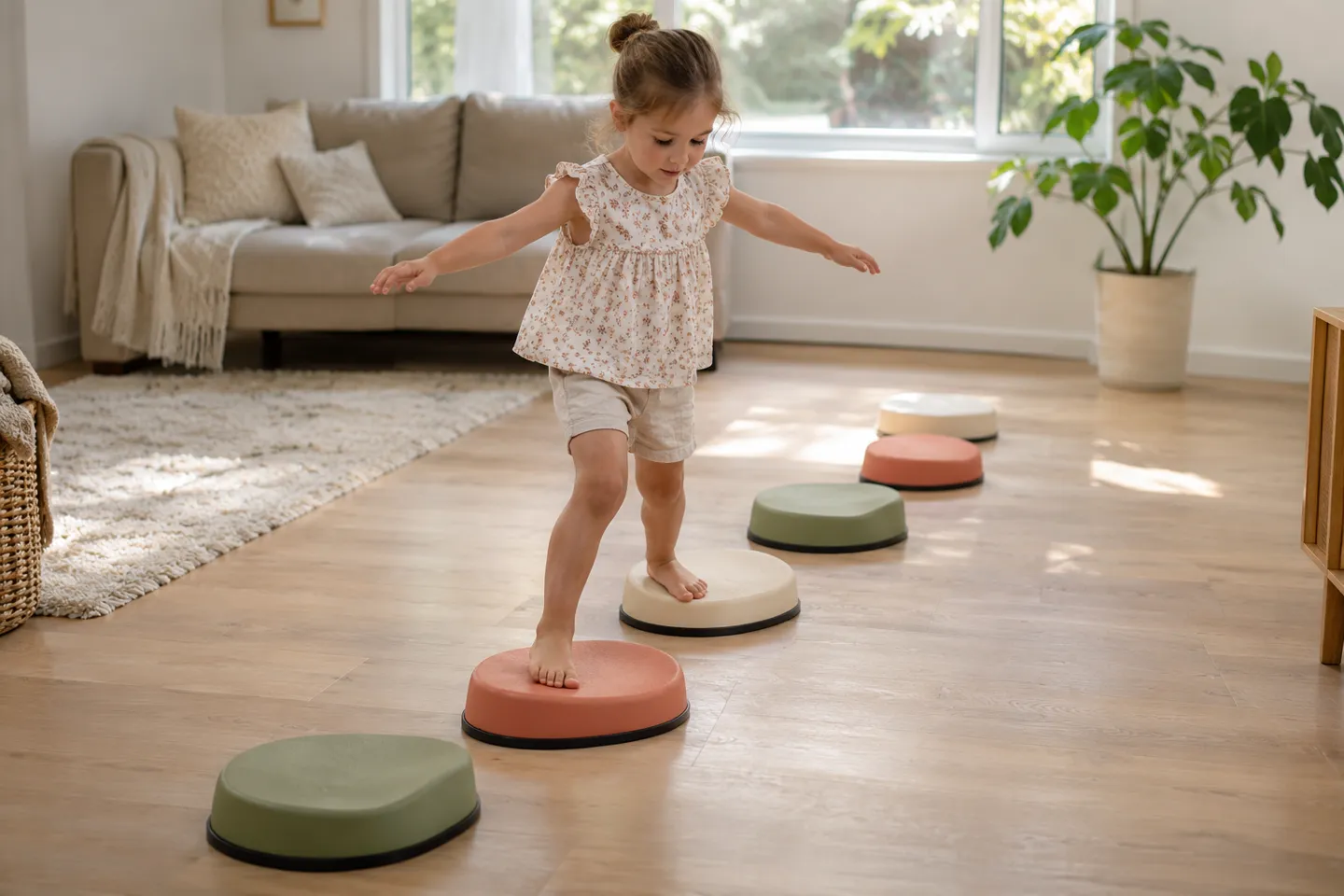
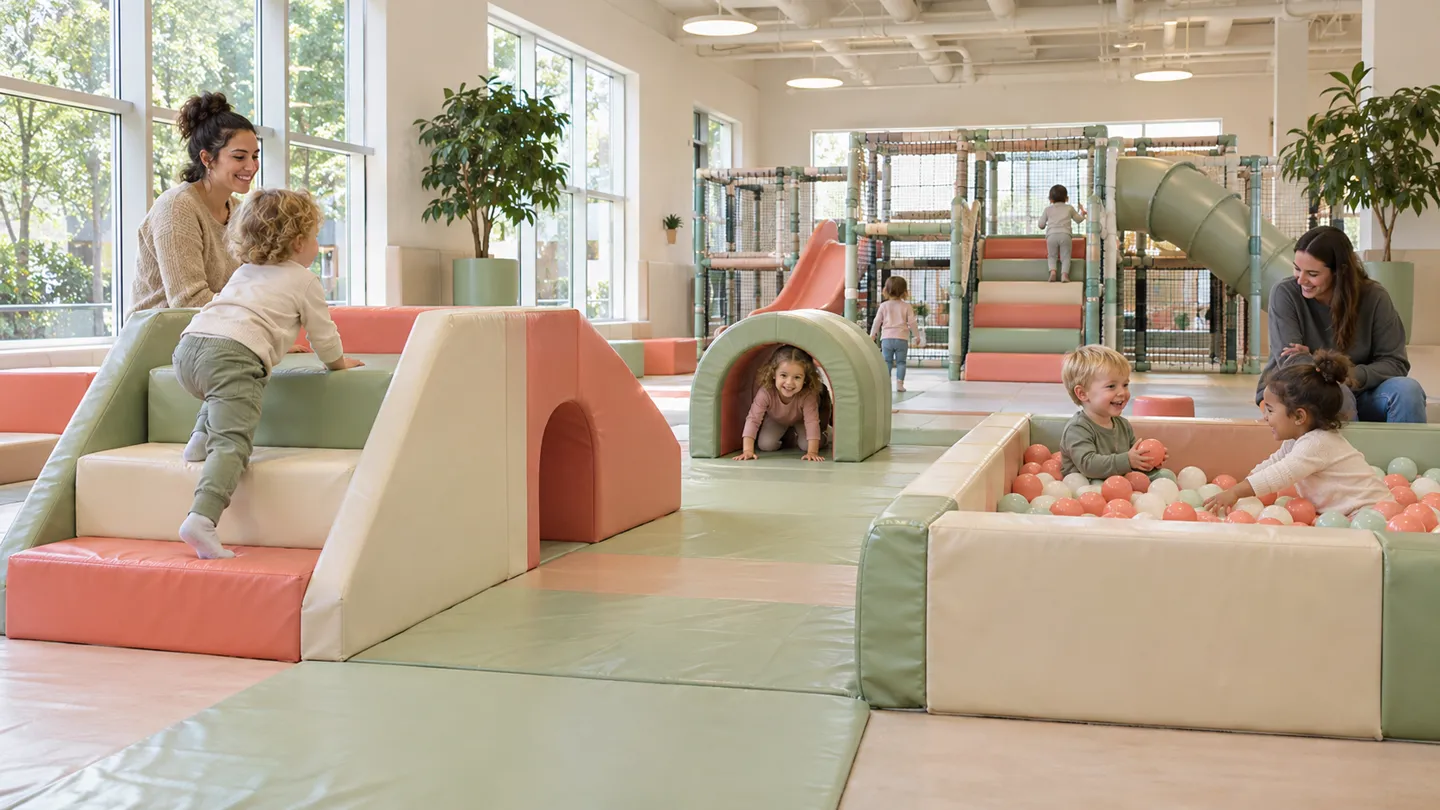
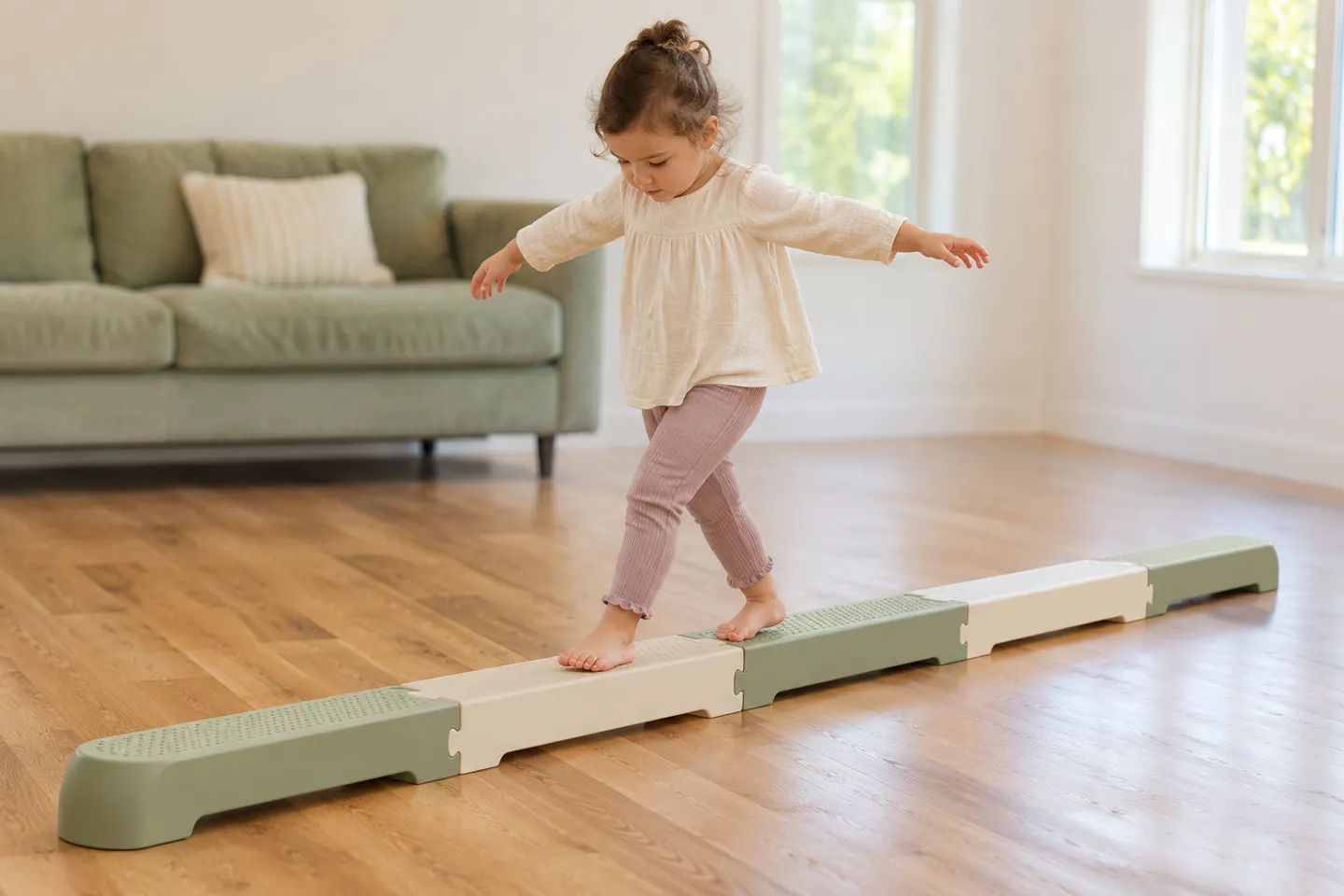
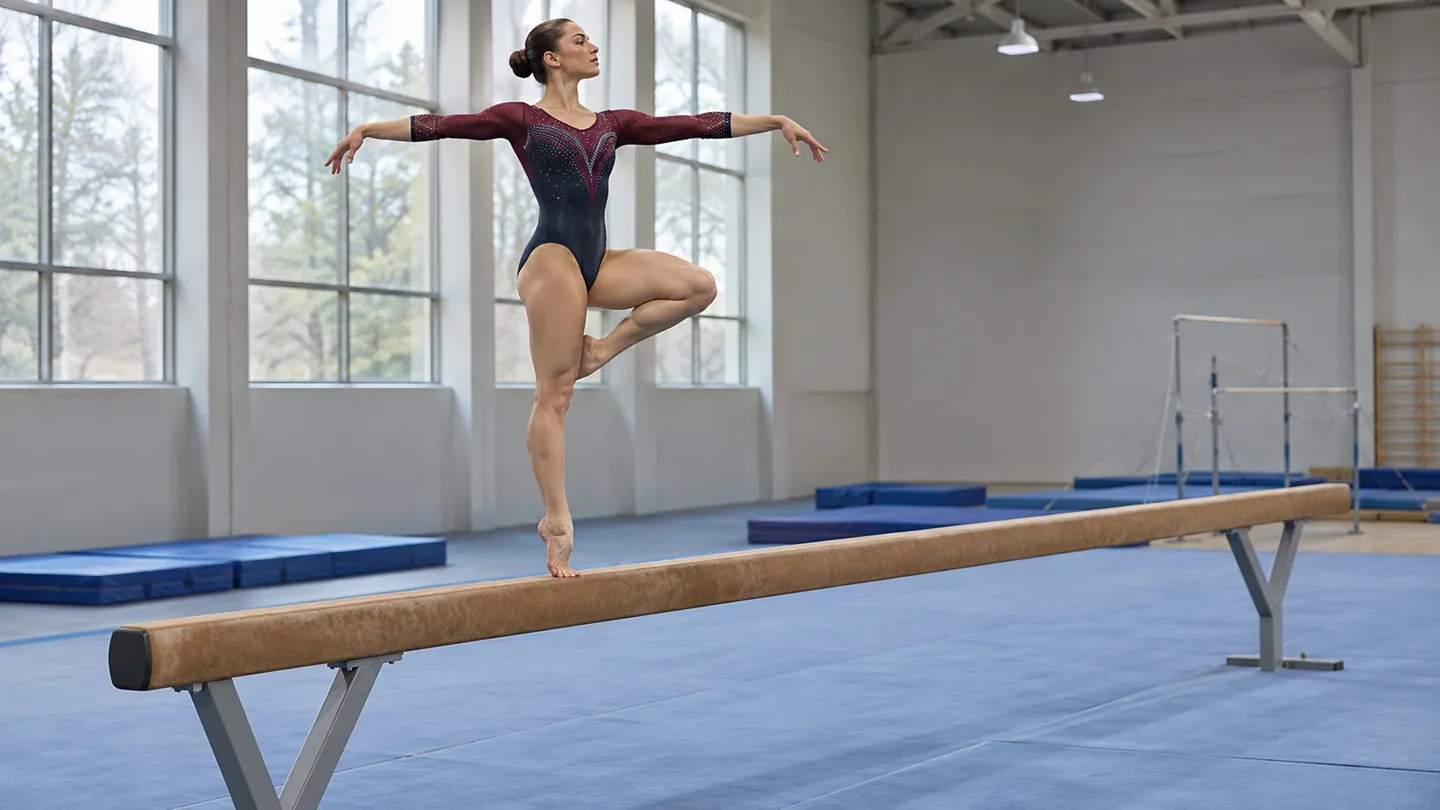
A gymnast presses up onto a beam that sits 125 centimeters above the floor, and every landing on it ends on more foam. Twenty minutes later, in a living room across town, an 18-month-old waddles across a low foam beam not even 10 centimeters off the ground. Both are called a balance beam, and both answers to “what is it made of” sound similar at first: foam, a grippy surface, something underneath. The real answer splits by type.
First, Which Balance Beam Do You Mean?
Here is the short version. Every balance beam is built in three layers. The core is laminated wood, hollow aluminum, EVA foam, or molded plastic. The cover is suede, synthetic suede, vinyl, molded-in texture, or bare wood. The support is fixed steel legs, folding legs, a floor-level base, or interlocking blocks. Which combination you are actually holding depends on which of the five beam types below you mean.
Five beam types, five material recipes
| Beam type | Core | Cover | Support | Typical price band |
|---|---|---|---|---|
| Competition apparatus (gym clubs) | Laminated wood or hollow aluminum + foam padding | Suede / synthetic suede | Fixed steel legs with rubber feet | Thousands of dollars |
| Home practice beam (school age) | EVA foam, firmer grades | Synthetic suede | Folding legs or floor level | Roughly $80-300 |
| Toddler play beam and stepping stones | Molded plastic (PP/PE) or low EVA foam | Molded-in non-slip texture | Floor level, interlocking blocks | Roughly $30-120 |
| Preschool and therapy settings | High-density foam core | Wipe-clean vinyl / faux leather | Floor level or low legs | Quoted per set |
| Outdoor playground beam | Solid pine log | Bare sanded wood | In-ground fixed mount | Installed per project |
Five types, five different answers. Outdoor playground beams get one line here: a solid pine log fixed into the ground, covered by public playground surfacing rules. The rest of this article stays with the four indoor types people actually bring home or into a classroom. All five get read through the same lens: what each layer is made of, why each layer fails, and what to check before money changes hands.
What Each Type Is Actually Made Of
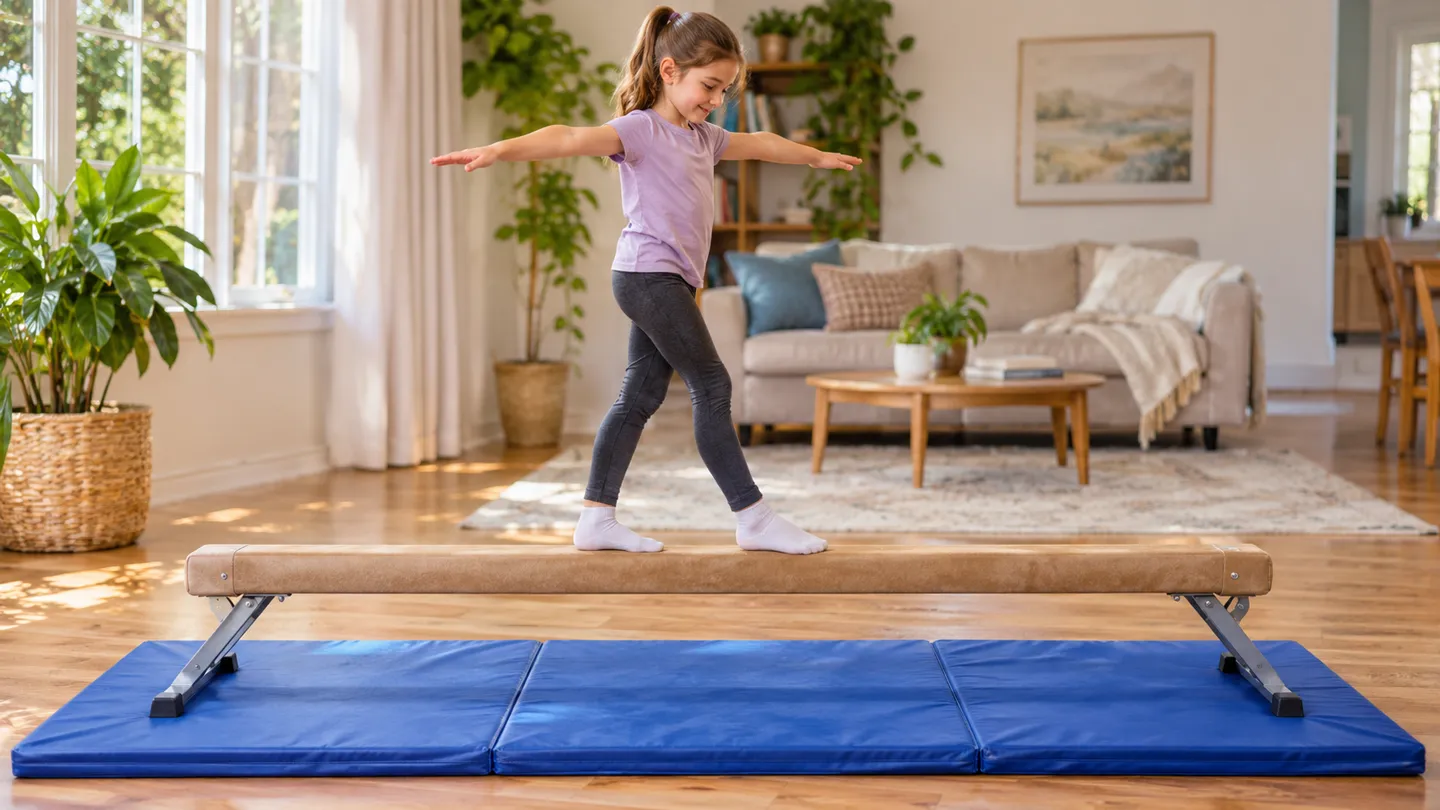
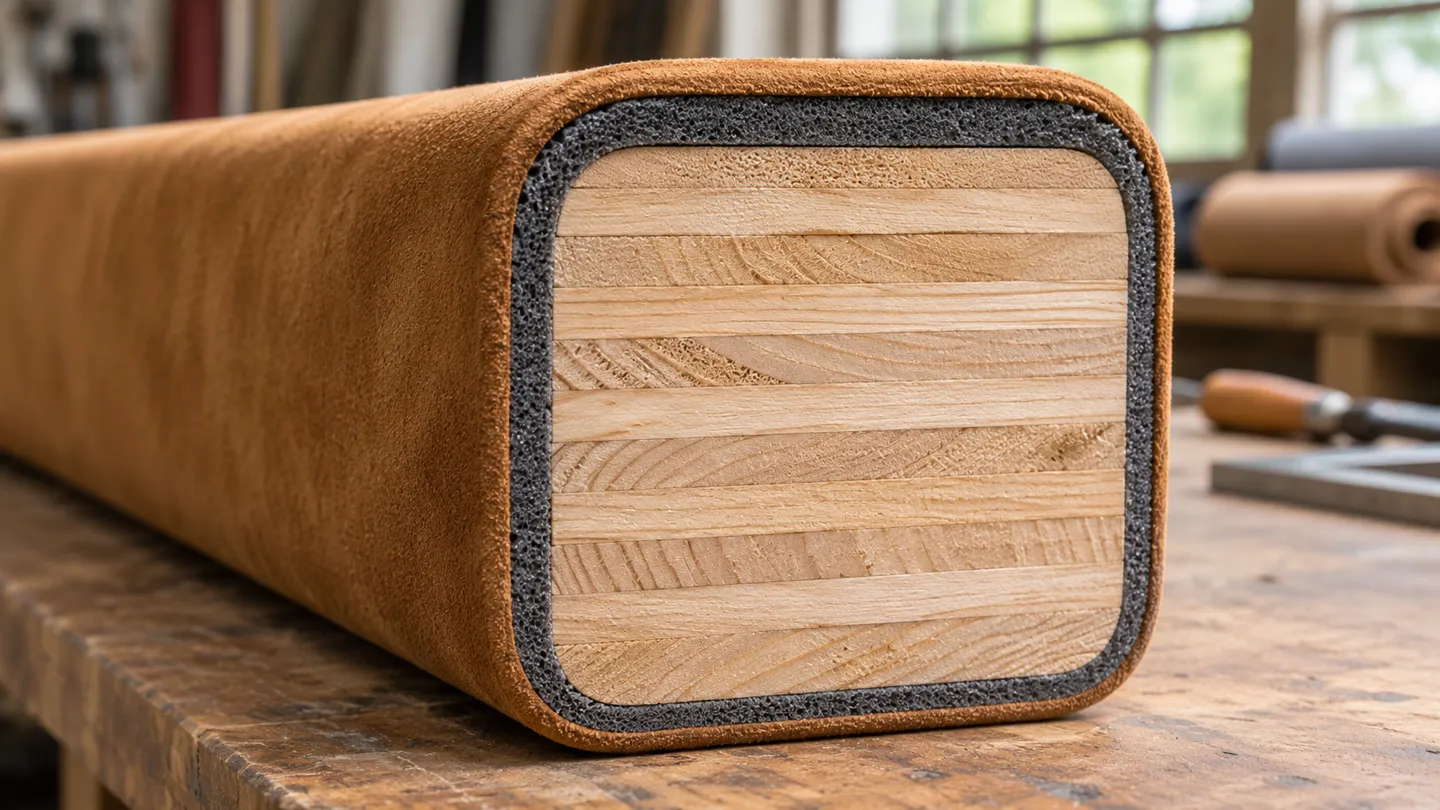
The competition apparatus is the reference point everything else imitates. Under the FIG Apparatus Norms it must be 5 meters long, 10 centimeters wide, and 125 centimeters tall (Wikipedia, FIG Apparatus Norms, 2026). The core is cross-grain laminated wood or a hollow aluminum body, wrapped in a foam padding layer and finished with suede or synthetic suede. That finish gives gymnasts in bare feet grip without stickiness (Wikipedia, 2026). Early beams were plain polished wood. The suede-covered, foam-padded beam only became standard through the 1970s and 1980s, and competition beams also built in a sprung, elastic response over time (Wikipedia, 2026). Home versions copy this recipe at smaller scale. A typical raised home beam uses the same synthetic suede over firmer EVA foam, on legs made of 12-gauge structural steel with rubber end caps (The Beam Store, 2026).
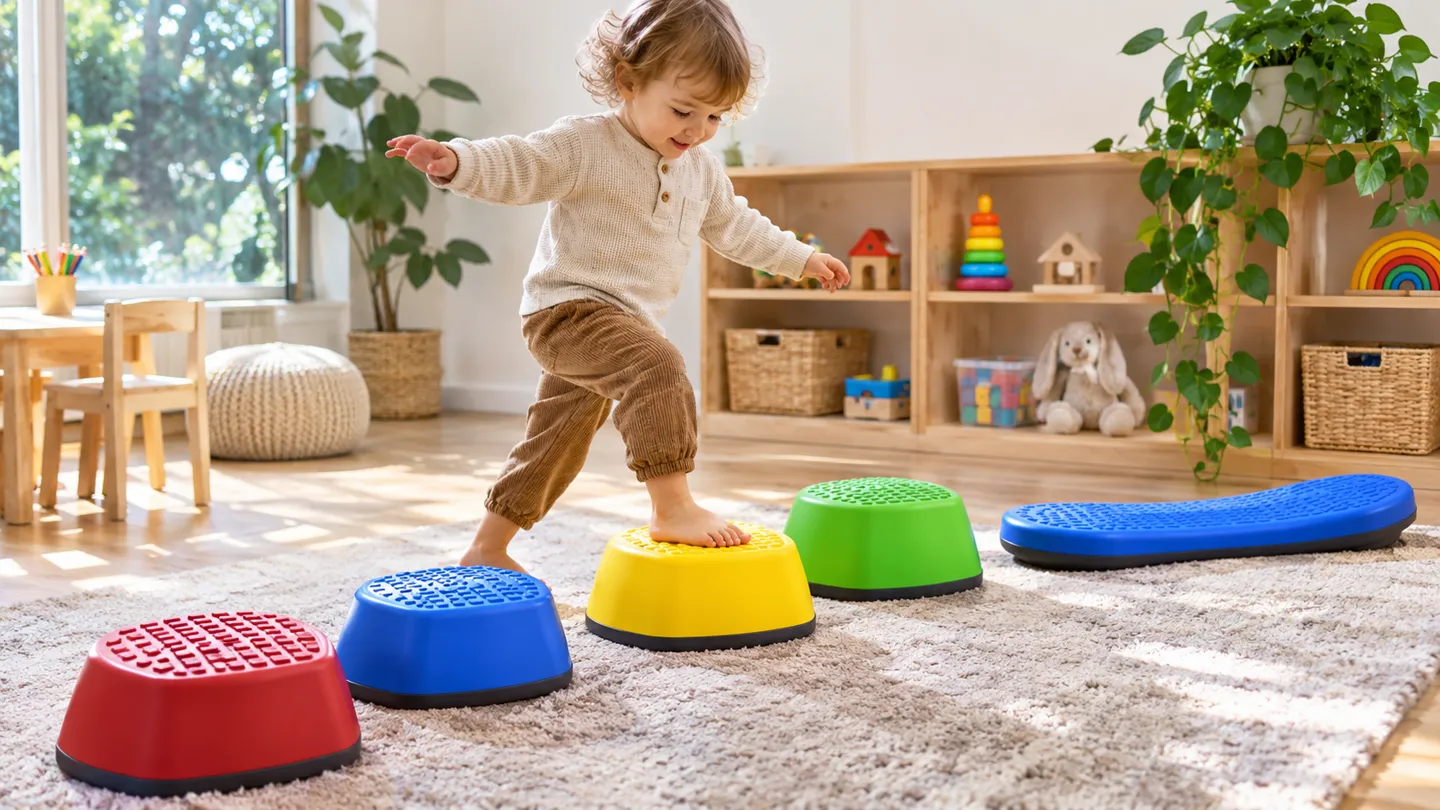
Toddler beams took a different path. Instead of imitating the apparatus, they solved a different problem: a 2-year-old who falls every few steps. So the toddler market moved to floor-level designs, and the materials changed with it. Molded plastic stepping-stone style beams (polypropylene, sometimes polyethylene) carry a molded-in textured surface and a separate rubber anti-slip base. The pieces connect like puzzle pieces, so the layout changes from day to day. Low EVA foam beams do the same job with less structure and lighter weight. Solid wood toddler beams, usually birch plywood sanded smooth, sell on durability and a Montessori look. Preschool and therapy settings mostly buy the foam-and-vinyl version: a high-density foam core wrapped in wipe-clean faux leather. A room of twenty children makes cleaning speed a daily requirement, not a nice-to-have.
How these choices feel in the hand is where catalog copy and reality diverge. Parents describe quality foam stones as feeling like solid styrofoam: surprisingly light, easy for a child to carry and stack (Reddit, r/moderatelygranolamoms, 2026). Wooden beams feel substantial and last for years. And yet families report the wooden beam sits unused while modular pieces get daily play, because the child can rearrange the pieces but not a fixed plank (Reddit, r/moderatelygranolamoms, 2026). And the cheap end of the foam market is real: foam that is too soft dents under an adult’s heel within weeks.
Construction and feel, type by type
| Type | Core material | Cover | Feel in use |
|---|---|---|---|
| Competition apparatus | Laminated wood / hollow aluminum | Suede | Firm, narrow, slight spring |
| Home practice | EVA foam (firmer grades) | Synthetic suede | Soft landing, slight give underfoot |
| Toddler plastic | PP/PE molded blocks | Molded-in texture | Light, warm to touch, rearrangeable |
| Toddler wood | Birch plywood | Sanded bare wood | Heavy, rigid, premium feel |
| Preschool/therapy | High-density foam | Vinyl faux leather | Cushioned, wipe-clean |
If you are the hands-on type, the DIY recipe has been stable for years. One 3.6-meter hardwood post 100 millimeters square, 3 millimeters of foam rubber padding, a suede cover, simple wooden stands (YouTube, padded beam build, 2014). It costs a fraction of any commercial beam and works, as long as you accept that a homemade beam has no anti-slip engineering underneath it.
The Three Layers That Decide Everything
Why can two products sharing one name differ by a hundred-fold in price? Because the price is not set by the object, it is set by the trade-offs made in three layers. Read any beam, from any seller, in this order.
The Core
Decides: load limit, failure mode, freight weight.
Fails as: under-dense foam slowly compresses into a squashed mat.
The Cover
Decides: grip, wear rate, cleaning speed.
Fails as: suede wears bald and needs re-covering; bare wood cannot be sanitized.
The Support
Decides: tip-over margin, storage volume, daily-use odds.
Fails as: high narrow legs tip, hinges loosen, beams too big for the room go unused.
The Core: What’s Inside Sets the Limits
The core decides three things at once: how much weight it takes without deforming, how it fails, and what it costs to ship. Competition cores are stiff on purpose; a beam that bounces unpredictably is a safety problem at jump-turn difficulty, which is why laminated wood and hollow aluminum dominate there. Home and toddler cores trade stiffness for forgiveness: EVA foam compresses under a stumble instead of resisting it, which is exactly what you want under a beginner. The failure mode to watch is density. Foam with low density and thin walls compresses permanently, so the surface dents and the “beam” slowly becomes a squashed mat. Molded plastic cores hold their shape well, and their variable is wall thickness. Thicker walls carry more weight per piece, which is why two visually identical plastic beam sets can differ in load rating. When a supplier cannot state a density or wall-thickness number, the dent risk is being priced into your order, not engineered out of it.
The Cover: Grip, Wear and Cleaning
Covers fail before cores do, and each cover material fails differently. Suede and synthetic suede exist because competitive gymnastics needs grip for bare feet plus a consistent slide for turns. The trade-off is wear. Gymnastics facilities treat beam covers as consumables, stripping and re-covering the beam when the surface goes bald or tears rather than replacing the whole apparatus. Vinyl and faux leather covers trade a little grip for a lot of practicality: they wipe clean in seconds, which is why institutions choose them. Molded plastic skips the cover entirely: the texture is part of the block, so there is nothing to tear, stain, or peel. The cost is less grip under sweaty socks. Bare wood looks premium and grips adequately when dry, but it shows every scratch and cannot be sanitized the way vinyl can.
The Support: Stability, Storage and Why Beams Go Unused
Support is where safety and daily usage actually live. Raised competition beams stand on fixed steel legs with rubber feet, and that width of footprint is deliberate. A narrow elevated beam that can tip is the single worst failure state in this category. Folding-leg home beams cut storage volume in half, and the hinge is the weak point to inspect. Floor-level designs (foam beams, plastic blocks) eliminate the fall height problem by eliminating the height, which is why every toddler product lives at floor level. Their failure mode is sliding: smooth plastic on a hard floor travels under load, and parents solve it with a rug or mat underneath (Reddit, r/moderatelygranolamoms, 2026). Support also decides whether the beam gets used at all. Gym parents who bought raised practice beams report the beam living in a closet for years after the first months of enthusiasm (ChalkBucket, gym parent forum, 2014). A beam that is too big, too heavy, or too fixed for the room becomes furniture, not equipment.
100×
One balance beam, one name, a hundred-fold price gap. The trade-offs behind it live in three layers:
Where Each Material Fails, and What to Ask For
The matrix below is the practical version of the three layers. Use it to pick for your situation, confirm what keeps that pick valid, and spot the signal that tells you to change plans.
Scenario x material x failure boundary
| Scenario | Material pick | Holds when | Fails / switch when |
|---|---|---|---|
| Toddler at home (1-3 yrs) | Floor-level foam or molded plastic blocks | Anti-slip base present, used on rug or mat | Slides on hard floors, or child outgrows floor level |
| School-age home practice | Folding EVA beam plus gym mat | Hinge locks solid, matting around the beam | Fold crease compresses, cover wears bald |
| Advancing gymnastics training | Suede raised beam, steel legs | Permanent space with proper matting all around | No space for required matting, then stay at gym |
| Preschool or therapy group | High-density foam with vinyl cover, or molded plastic | Certificates on file, wipe-clean surface intact | Dents appear, cover seams split, certificates missing |
| Outdoor / public playground | Solid pine beam fixed in ground | Protective surfacing meets fall-height rule for the beam (CPSC Public Playground Safety Handbook, 2015) | Wood checks or rots at ground contact |
Safety Standards: What the Certificates Actually Cover
In the United States, toys are governed by ASTM F963, a mandatory consumer product safety standard enforced under CPSIA. Its limits map directly onto beam materials: total lead content limits, and phthalate limits of no more than 0.1 percent in toys intended for children 12 and under (CPSC Toy Safety Business Guidance, 2026; CPSC FAQ, 2024). Sellers must hold a Children’s Product Certificate backed by third-party testing. In the EU, the Toy Safety Directive works through the EN 71 series. Part 1 covers mechanical and physical properties, the small-parts and sharp-edge tests that matter for toddler products. Part 2 covers flammability. Part 3 limits migration of elements from toy materials (EUR-Lex, 2026; Intertek, 2026).
The material-to-test mapping is the part catalogs never spell out. Foam and vinyl, being plasticized materials, are where phthalate limits bite. Paint, coatings, and substrates are where lead limits bite. EN 71-3 migration testing applies across material categories, simulating what would transfer if a child mouthed the material. Solid wood constructions raise their own questions in the adhesives (plywood glue) and surface finishes, which is why a certificate list that says only “safe wood” is not a certificate.
Four Checks Before You Buy
Anti-slip engineering: confirm the base design, not just a claim of non-slip (rubber base pads, textured underside, or intended use on matting).
Numbers on the core: ask for foam density or plastic wall thickness as a stated value; a supplier who cannot give the number is selling you an unknown.
Cover reality: what exactly is the surface, how do you clean it, and is a replacement cover available for worn beams?
Certificate set: CE for the EU, CPC backed by ASTM F963 testing for the US, and check the certificate matches the product category and batch you are buying.
Run those four checks and the remaining differences between vendors are price and logistics, which is exactly where you want the decision to end up.
The Same Facts, Read as a Sourcing Decision
None of the above changes once you sit on the supply side of the table. But the three layers start answering a different question: what you are really stocking when you stock beams. Foam cores compress small and ship light, which keeps freight low, and their failure mode (denting, the styrofoam feel) becomes your review page. Solid wood cores carry premium perception and years of durability, and their weight is a permanent freight tax plus the disuse risk the parent forums document. Molded plastic sits in the middle: heavier than foam per set, but stackable, nearly indestructible per piece. Its molded-in cover removes the most common warranty claim (surface wear) before it can happen.
So the failure modes documented above are a stocking map. Dent-prone foam concentrates returns and one-star reviews in value channels. Fixed wooden beams concentrate shelf-life risk in channels where buyers overestimate available space. Certified, wipe-clean, mid-weight constructions concentrate none of those risks. The institutions buying them select on certificates and parameters rather than price alone, which is a quieter but steadier margin. The practical advice follows directly. Match the material to the channel instead of forcing one construction to serve all of them. Audit suppliers on stated density, wall thickness, and certificate files rather than on product photography. Every claim in this article is checkable from the buyer’s side of an email thread, which is exactly how it should be used.
Startinal builds the toddler end of this spectrum. Our balance walking series uses food-grade plastics with anti-slip bases, is tested to CE and CPC standards, and most items ship from stock within 7 working days.
The Four Checks, Answered in One Email
Tell us your market and channel: the reply carries density values, wall thickness, anti-slip base details and the CE / CPC certificate files.
Request the Spec SheetReferences
- Wikipedia Contributors. “Balance Beam.” 2026. wikipedia.org
- U.S. Consumer Product Safety Commission. “Toy Safety Business Guidance.” 2026. cpsc.gov
- U.S. Consumer Product Safety Commission. “Toy Safety FAQ.” 2024. cpsc.gov
- U.S. Consumer Product Safety Commission. “Public Playground Safety Handbook.” 2015. cpsc.gov
- European Commission. “Toy Safety.” EUR-Lex, 2026. eur-lex.europa.eu
- Intertek. “EU Toy Safety Directive and EN 71 Testing.” 2026. intertek.com
- HowToWithPerla. “How to Make a Padded Gymnastics Balance Beam.” YouTube, 2014. youtube.com
- r/moderatelygranolamoms. “Toddler Balance Beam/Stepping Stones?” 2026. reddit.com
- ChalkBucket. “Balance Beam for Home Use.” Gym parent forum, 2014. chalkbucket.com