.png)
What Is Soft Play? The Complete Guide to Equipment, Benefits, and Smart Selection
What Is Soft Play?
Soft play is a specially designed indoor activity environment where virtually every surface is covered in thick foam padding or built from soft, impact-absorbing materials. That means floors, walls, climbing structures, and landing zones all absorb impact rather than causing it. The core idea is simple but powerful: create a space where children can climb, jump, crawl, slide, and explore with dramatically reduced injury risk compared to traditional hard-surface playgrounds.
Three elements separate soft play from any other play space. First, it is almost always indoor. This means year-round usability regardless of weather — a key advantage over outdoor playgrounds that sit empty through winter months and rainy days. Second, the full-surface padding is structural, not decorative. Unlike a traditional playground where rubber mulch covers the ground but the equipment itself is hard metal or plastic, soft play environments wrap the equipment in foam and durable fabric covers. Third, the defining value proposition is safe exploration: children are free to test their physical limits, make mistakes, and try again without the fear of serious injury that can inhibit risk-taking on hard surfaces.
One clarification on terminology: “soft play” is the dominant term in the UK, Ireland, Australia, and other Commonwealth countries. In the United States, you are more likely to hear “indoor playground” or “soft playground,” though the concept is identical. Do not confuse soft play with inflatable bounce houses — those are air-filled PVC structures, a different product category entirely. (And yes, “Soft Play” is also the name of a British punk rock duo formerly known as Slaves, but that is almost certainly not what brought you here.)
What Equipment Makes Up a Soft Play Environment?
A well-designed soft play space is not a random collection of padded objects. Professional soft play environments are built on a three-layer architecture: large multi-level play structures form the centerpiece, standalone equipment adds modular variety, and sensory elements transform the space from “playground” to “developmental environment.”
Multi-Level Play Structures: Slides, Climbers, and Tunnels
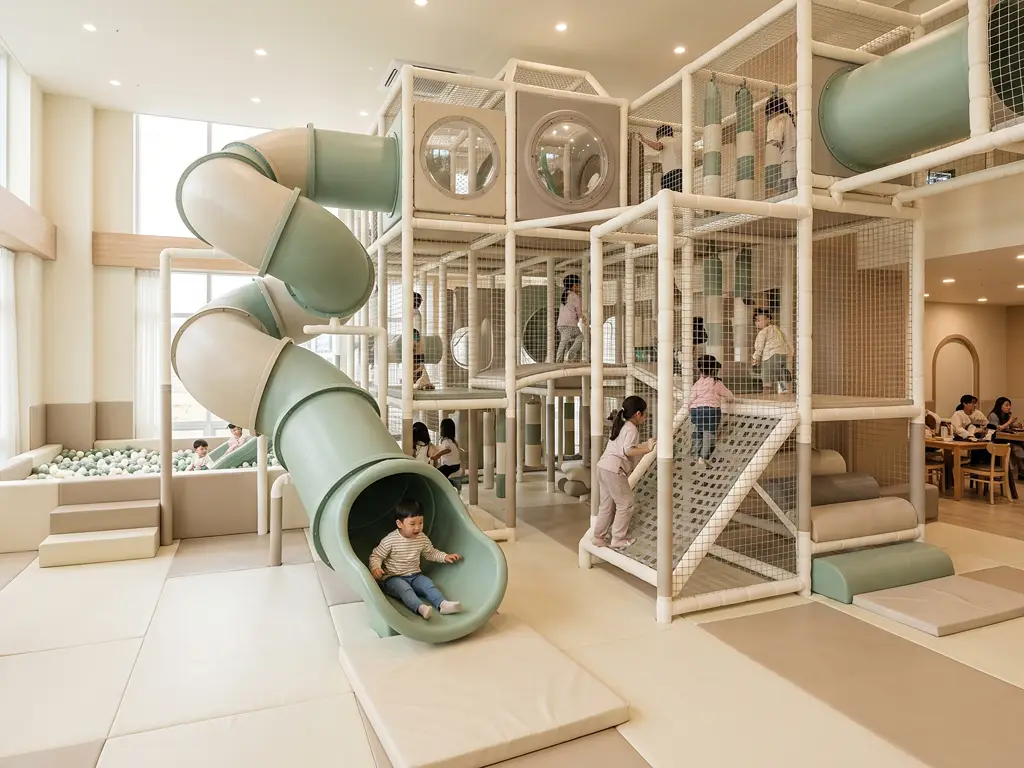
These are the flagship pieces. The colorful, multi-tiered climbing frames with integrated slides, tunnels, and platforms dominate the visual landscape of any soft play center. A typical multi-level structure combines padded slides of varying heights, climbing nets and ramps at different difficulty gradients, tunnel mazes for crawling exploration, and connecting bridges and platforms that turn the whole assembly into one integrated circuit.
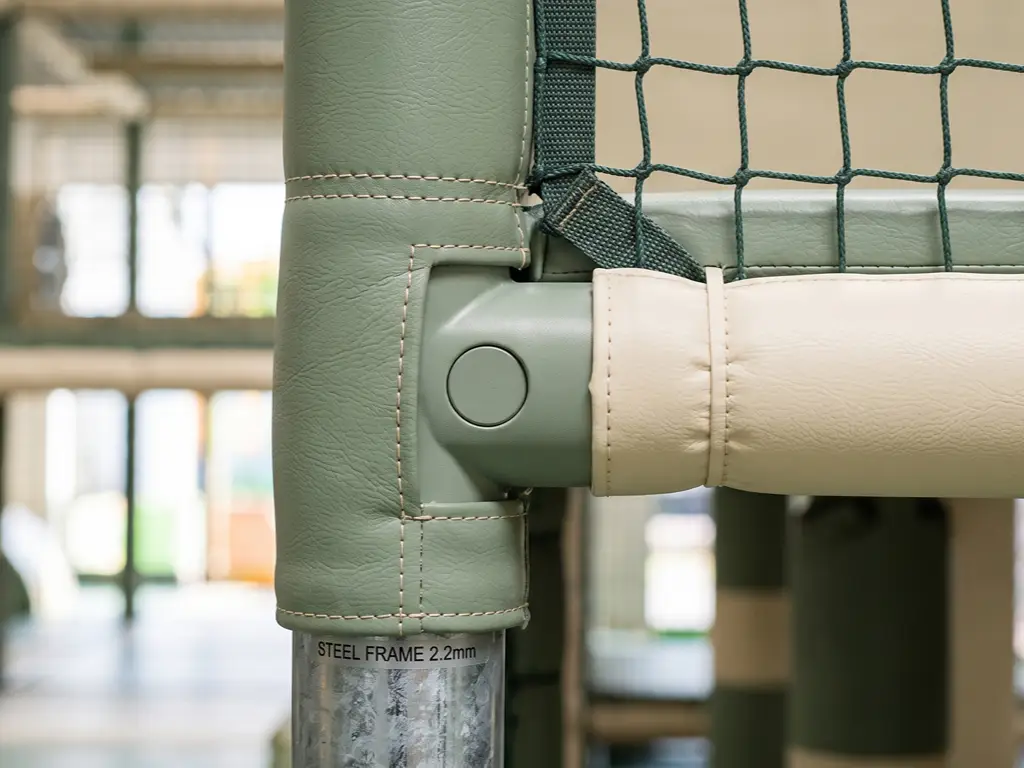
What you see as a parent — bright colors, curved slides, children disappearing into one tunnel and emerging from another — is the user experience. What a facility buyer sees is different: foam density specifications (commercial-grade EVA or EPE foam at 25–32 kg/m³), phthalate-free PVC covering with double-stitched seams, and structural compliance with EN 1176 (European playground equipment standard) or ASTM F1487 (U.S. public playground safety standard). The difference between a structure that stays firm and safe after 50,000 child-hours of use and one that sags after six months lives in those numbers.
Standalone Equipment: Ball Pits, Balance Beams, and Rockers
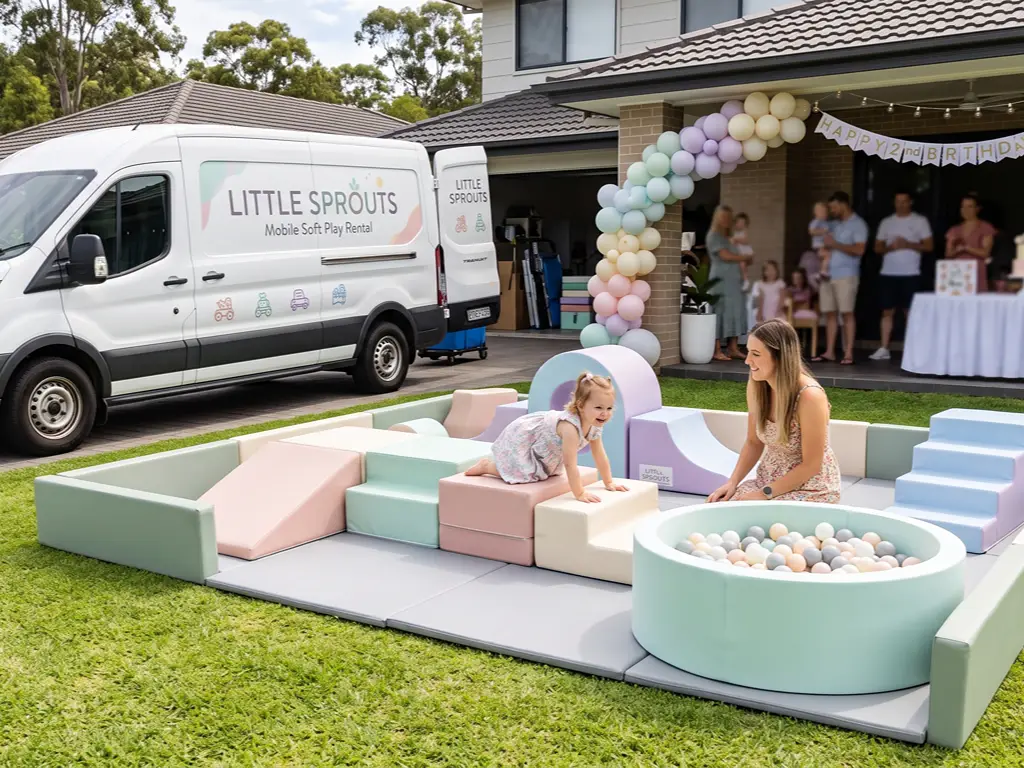
Not every piece of soft play equipment needs to be bolted into a multi-level structure. Standalone items give facility operators flexibility. They can reconfigure layouts, replace individual worn pieces, and tailor equipment selection to their specific age groups and space constraints.
Common standalone pieces include ball pits (pools filled with lightweight plastic balls, typically 5.5–7.5 cm in diameter, made from food-grade PE with seamless molding to prevent sharp edges), balance beams and stepping stones with anti-slip TPR (thermoplastic rubber) bases, wobble boards and rockers for vestibular stimulation, scooter boards for prone-position crawling and upper-body development, and play parachutes for group cooperative games. Each item serves a distinct developmental purpose: the balance beam trains proprioception, the scooter board builds arm strength, the ball pit provides tactile and visual sensory input. A well-curated standalone collection is not just “extra stuff” — it is a deliberate complement to the central structure.
Sensory and Interactive Elements: Panels, Textures, and Visual Stimuli
This is the layer that distinguishes a generic indoor playground from a developmentally intentional soft play environment. It is also the category most overlooked by first-time buyers. Sensory elements serve children who need more than physical activity: those with sensory processing differences, children on the autism spectrum, and any child who benefits from a rich, multi-sensory environment.
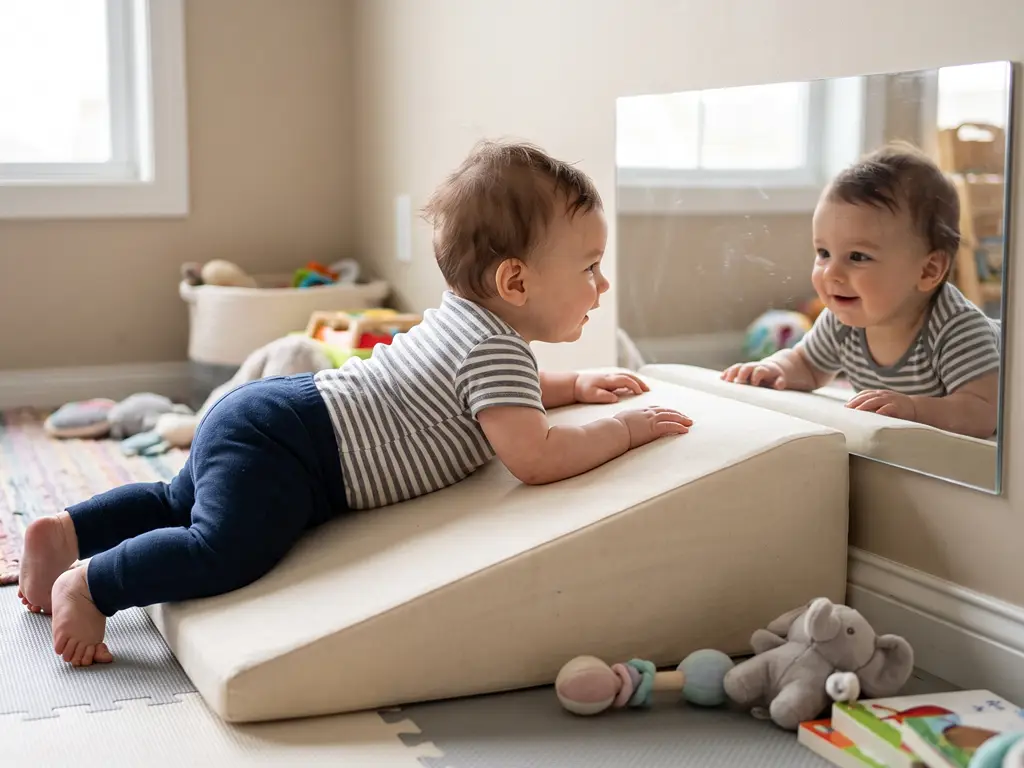
The sensory layer typically includes tactile wall panels with varied surface textures (smooth, bumpy, ridged, soft, firm), interactive LED bubble tubes and light panels for visual tracking and cause-and-effect learning, shatter-proof acrylic mirrors (never glass — this is a non-negotiable safety line between commercial-grade and consumer-grade equipment), and sound panels or interactive music walls for auditory stimulation. These elements directly support sensory integration, which is the brain’s ability to process and organize information from multiple senses simultaneously. For therapy centers and special education facilities, the sensory layer is often the primary purchasing consideration, not an afterthought.
Commercial-grade sensory equipment must also meet fire safety standards: NFPA 701 in the United States or BS 5852 in the UK for flame retardancy of textiles and foam. A sensory wall panel that looks beautiful but lacks fire certification is a liability, not an asset.
Why Soft Play Matters: Key Developmental Benefits
Soft play is easy to underestimate. From the outside, it looks like children burning energy in a padded room. But every slide, tunnel, and balance beam is doing developmental work — building neural pathways, strengthening muscle groups, and teaching social skills — in ways that traditional playgrounds and screen-based activities cannot replicate.
Gross Motor Development: Building Strength, Balance, and Coordination
The most visible benefit is also the most fundamental. Climbing a padded ramp engages core muscles and builds upper-body strength. Walking across a balance beam (even one just 10 cm off the ground) trains the vestibular system, the inner-ear mechanism responsible for balance and spatial orientation. Jumping from one platform to another develops proprioception: the brain’s map of where the body is in space, which allows a child to close their eyes and still know where their hands and feet are.
What makes soft play uniquely effective for motor development is the safety-to-challenge ratio. On a hard playground, a child who falls from a climbing frame may experience enough pain to avoid climbing for weeks. In soft play, the same fall ends in a cushioned landing and a reset. The child tries again, learns the movement pattern, and builds both skill and confidence. This loop of “attempt → fail safely → retry → succeed” is the engine of motor learning.
Cognitive and Social Growth: Problem-Solving, Sharing, and Confidence
When a child navigates a tunnel maze and chooses “left or right,” they are doing spatial reasoning. When they wait their turn at the top of a slide while another child goes first, they are practicing impulse control and social reciprocity. When they figure out that stepping on the red block — not the blue one — gives them the boost they need to reach the next platform, they are problem-solving in real time.
Soft play also creates a rare environment for what developmental researchers call “risky play.” This is the kind of physical risk-taking — climbing higher than usual, jumping a slightly longer distance, sliding faster — that builds genuine self-confidence. In a soft play setting, the consequences of miscalculation are trivial, but the psychological reward of pushing past a self-imposed limit is real. A child who previously refused to go down anything but the baby slide, and then works up the courage for the big spiral slide, has just logged a meaningful victory in self-efficacy.
Sensory Integration and Emotional Regulation
For children with sensory processing disorder (SPD), autism spectrum disorder, or heightened anxiety, a soft play environment provides something that most public spaces cannot: controlled, predictable, multi-sensory input with an “off switch.” A child who feels overwhelmed can retreat into a padded tunnel for deep-pressure calming — the same principle behind weighted blankets, delivered through physical compression in a cocoon-like space. A child who seeks vestibular input can spin, rock, and roll on equipment designed for exactly that purpose.
The sensory benefits extend to neurotypical children as well. The combination of bright but non-glaring colors, varied tactile surfaces, soft ambient sound (no echoing concrete, no clanging metal), and opportunities for both high-energy and quiet activities makes soft play one of the few public environments where sensory overload is designed out rather than managed reactively.
Physical Health: Active Play in a Screen-Dominated World
The most pragmatic argument for soft play may be the simplest: it gets children moving. In the United States, 14.9% of children aged 2–5 have obesity (CDC, 2021–2023), and screen time among preschool-aged children has risen steadily over the past decade. Soft play offers a weatherproof, parent-friendly solution. No sunscreen required, no raincheck needed, no “it’s too cold to go to the park today.”
The activity pattern in a soft play session is naturally high-intensity interval training for children: a burst of climbing (high effort), a slide down (recovery), a sprint through a tunnel (high effort), a pause in the ball pit (recovery). This spontaneous interval pattern is more effective for cardiovascular fitness than steady-state walking or jogging, and it happens without any adult instruction. The environment itself programs the workout.
Who Is Soft Play For? From Toddlers to Adults
The common assumption — “soft play is for toddlers” — captures only a fraction of the real audience. Soft play environments serve a remarkably broad range of ages, needs, and use cases.
| Audience | Typical Age | Primary Use Case | Key Equipment | Core Benefit |
|---|---|---|---|---|
| Babies | 0–12 months | Sensory exploration, tummy time | Soft floor mats, sensory panels, soft building blocks | Sensory stimulation, neck strength, secure attachment through parent-close play |
| Toddlers | 1–3 years | Foundational motor exploration | Low slides, shallow ball pits, soft ramps, short tunnels | Gross motor initiation, balance, cause-and-effect understanding |
| Preschool & School-age | 3–10 years | Social play, physical challenges | Multi-level climbers, long slides, mazes, rope nets | Peak motor development, peer social skills, risk assessment |
| Children with Special Needs | All ages | Therapeutic activity, sensory integration | Sensory rooms, deep-pressure spaces, shatter-proof mirrors, textured panels | Sensory regulation, emotional management, motor rehabilitation |
| Adults | 18+ | Fitness, rehabilitation, parent-child co-play | Adult-scale soft obstacles, soft fitness modules, co-play structures | Low-impact training, family bonding, post-injury exercise alternative |
The adult soft play category deserves particular attention. It is almost entirely absent from existing online content, yet the search term “what is soft play for adults” exists and goes unanswered. Adult-oriented soft play is an emerging category that includes soft obstacle courses (a safer alternative to the Ninja Warrior-style hard-impact courses), parent-child co-play spaces designed for multi-generational use, and soft rehabilitation equipment used in physiotherapy and post-injury recovery. Adult soft play equipment differs from children’s versions in structural specifications: higher weight ratings, denser foam for sustained load-bearing, and larger dimensions. But it serves the same fundamental purpose — a safe environment for physical challenge and exploration.
How to Choose Safe, High-Quality Soft Play Equipment
At this point, you may be considering soft play equipment not just as a visitor but as a buyer. Perhaps for a daycare, a play center, a therapy clinic, a school, or even a home playroom. Choosing soft play equipment is not like buying toys. It is a safety commitment, a durability investment, and (for commercial buyers) a business decision with real liability exposure. Here are the three evaluation layers that matter.
Materials Matter: Foam Density, Covering, and Fire Safety
The single most important number in soft play equipment is one most buyers never ask about: foam density. Commercial-grade soft play uses EVA (ethylene-vinyl acetate) or EPE (expanded polyethylene) foam at densities of 25–32 kg/m³. Higher density means firmer support, better shape retention under repeated impact, and longer service life. Low-density foam (the kind found in budget consumer products) can compress and lose its protective properties within months of heavy use.
The outer covering is equally critical. Commercial equipment uses phthalate-free PVC. Phthalates are plastic-softening chemicals restricted under both EU REACH regulations and the U.S. CPSIA (Consumer Product Safety Improvement Act). Non-compliant coverings can be seized at customs. More importantly, they pose genuine health risks with prolonged skin contact. Check also that seams are double-stitched and heat-sealed. Single-stitch seams on budget equipment can split within 3–6 months of commercial use.
Fire safety is non-negotiable for any commercial installation. Legitimate soft play equipment carries certification to NFPA 701 (U.S. flammability standard for textiles) or BS 5852 (UK flame retardancy standard). If a supplier cannot produce a fire test certificate from a recognized third-party lab, walk away.
Certifications and Safety Standards: Your Non-Negotiable Checklist
Most first-time buyers assume that if equipment is for sale, it must be safe. This assumption is expensive and potentially dangerous. Here is what to look for, organized by region:
| Standard | Region | What It Covers | What to Ask the Supplier |
|---|---|---|---|
| ASTM F1487 | United States | Public playground equipment safety — structural integrity, entrapment hazards, impact attenuation | “Send me your latest ASTM F1487 third-party test report” |
| ASTM F963 | United States | Toy safety — chemical composition, small parts, flammability | Confirm ball pit balls and small accessories are covered |
| EN 1176 | European Union | Playground equipment safety — the EU equivalent of ASTM F1487 | “Provide your EN 1176 certificate of compliance from a notified body” |
| EN 71 | European Union | Toy safety — mechanical, chemical, and flammability requirements | Confirm all small components meet EN 71 |
| CPSIA | United States | Children’s product safety — lead content, phthalate limits, tracking labels | “Are all materials CPSIA-compliant with third-party lab reports?” |
| ISO 9001 | Global | Quality management system — indicates consistent manufacturing processes, not product safety per se | Confirm the certificate is for the factory, not a trading company |
| BSCI | Global | Social compliance — factory working conditions, no child labor, fair wages | “Send your most recent BSCI audit report” |
A critical distinction: a CE mark is a manufacturer’s self-declaration of compliance with EU regulations. An EN 1176 test report from SGS, TÜV, Intertek, or Bureau Veritas is independent third-party verification. These are not the same thing. When evaluating a supplier, insist on the test report, not just the mark.
Evaluating Suppliers: Beyond the Brochure
Even with perfect materials and complete certifications, your equipment is only as reliable as the company that builds it. Here are five practical checks:
1. Factory vs. trading company. A manufacturer owns the production line; a trading company sources from multiple factories and resells. Manufacturers offer better pricing transparency and more direct quality control. How to tell the difference: ask for a live video tour of the production floor. If they hesitate or show only a showroom, you are likely dealing with a trading company.
2. Sample policy. Most manufacturers charge for samples — this is normal. What matters is whether the sample fee is credited against your production order. If it is not, ask why.
3. Lead time and capacity. Typical production lead times for commercial soft play orders are 3–4 weeks. A factory’s annual output capacity (e.g., “1 million+ units per year”) is a useful reality check. A facility producing at that scale has the infrastructure to handle your order without delays.
4. After-sales commitment. Ask explicitly about replacement parts availability and response time guarantees. Get the answers in writing. A supplier who commits to 48-hour response and has a documented replacement-parts program is genuinely supporting their product.
5. Past projects. Request photos or videos of completed installations, ideally in the same type of facility you are outfitting (daycare, play center, therapy clinic). A supplier who has done similar work is dramatically less risky than one doing your project as a first-of-its-kind.
If you are evaluating soft play equipment suppliers and want to compare a manufacturer’s full certifications and product range, Startinal’s factory credentials and compliance documentation are available online, or you can reach their team directly.
References
- Centers for Disease Control and Prevention. “Childhood Obesity Facts.” 2021–2023. https://www.cdc.gov/obesity/childhood-obesity-facts/childhood-obesity-facts.html
- JAMA Network Open. “Youth Overweight and Obesity Remain Widespread, 2024 National Data Show.” 2026. https://jamanetwork.com/journals/jama/fullarticle/2845867
- Replay Magazine. “Product Profile – Soft Play.” 2026. https://www.replaymag.com/soft-play-0326/
- Maia Research. “Global Indoor Play Equipment Industry Trends Analysis Report 2025, Forecast to 2033.” 2025. https://www.marketresearch.com/Maia-Research-v4212/Global-Indoor-Play-Equipment-Trends-44392787/
- Startinal. “About Us — Factory Credentials and Certifications.” https://www.startinal.com/about-us/
- Startinal. “Contact.” https://www.startinal.com/contact-us/