Tape lines on the living-room floor, a low beam at the playground, relay races in the school gym: balance beam games span three different worlds. This guide is about the one most parents and teachers mean: physical games on a low beam, organized so a child can start on day one and keep finding harder versions for years.
What Is a Balance Beam Game? (And What It Isn’t)
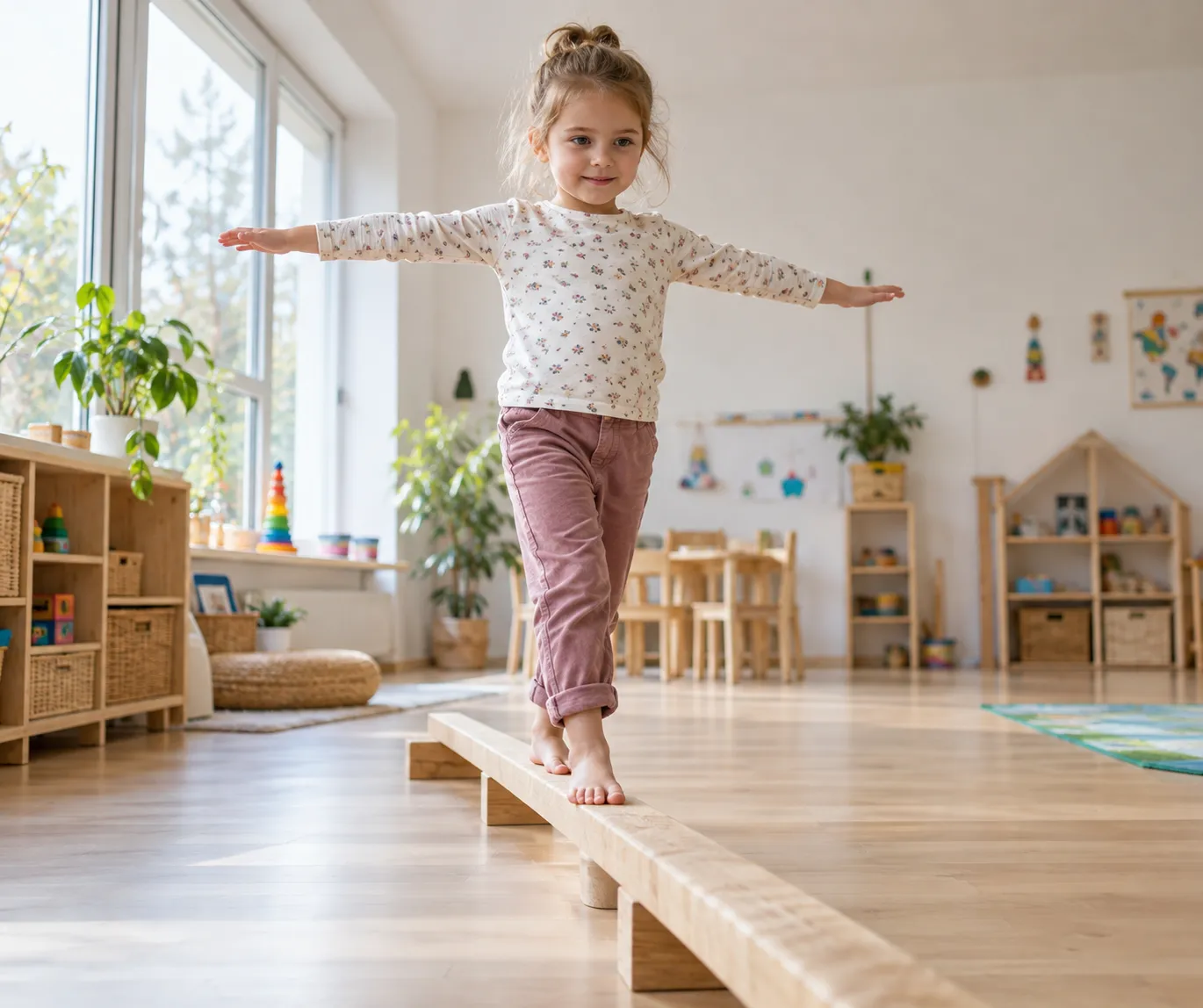
A balance beam game is any game where the challenge lives in staying on a low beam while the body, or the brain, does one extra thing. The beam sits close to the floor. The fun comes from the wobble, not from height.
Because the same phrase pulls in unrelated searches, sort the traffic first.
Not what you were looking for?
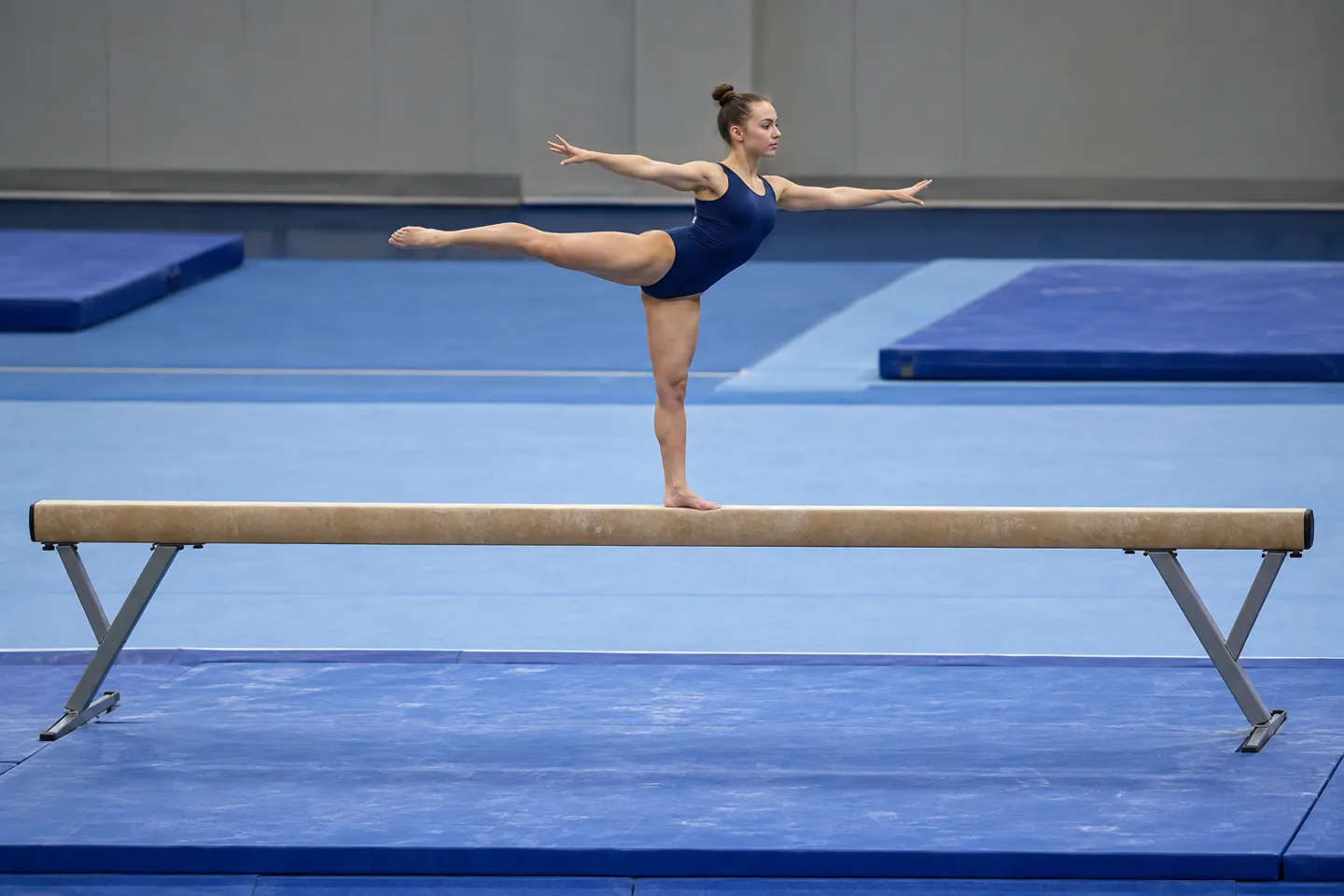
“Balance beam game” also points to: a fan-made Battle for Dream Island mini-game on Scratch, a physics classroom simulator about torque, assorted mobile balancing games, and competitive gymnastics beam routines. Those are different worlds. This article covers physical games on low beams for toddlers through primary school.
Still here? Then you want the play version. Pediatric therapists have used beam walking as skill-building play for a long time, because one activity stacks balance, coordination and body awareness into a few steps (The Inspired Treehouse, 2015).
Three conditions keep every game in this guide safe: start low, keep the surface from sliding, and stay within arm’s reach of new walkers. Hold the elevation until plain heel-to-toe walking looks boring. A tumble from ankle height is a lesson; a tumble from knee height is how a child decides the beam is not for them.
The Game Ladder: From Walking Games to Brain Games
Every beam game sits on one of two rungs. Rung one changes what the body does. Rung two keeps the body walking and loads the brain. The rung tells you how to grow a game: add one variable at a time, and step back down a level after two consecutive fails.
Ten beam games you can run this week
| Game | How it plays | Ages | Fewest players | What you need |
|---|---|---|---|---|
| Forward walk | Plain crossing, eyes ahead, arms out | 2+ | 1 | Low beam or floor line |
| Heel-to-toe walk | Each step lands heel against toe | 3+ | 1 | Beam or line |
| Backward walk | Step off backward without turning around | 3+ | 1 | Beam or line |
| Side steps | Face sideways, small controlled steps | 3+ | 1 | Beam or line |
| Animal walks | Bear or crab walk along the beam | 3+ | 1 | Beam or line |
| Single-leg hold | Freeze on one leg mid-beam and count | 4+ | 1 | Beam |
| Freeze walk | Music stops, everyone freezes on the beam | 3+ | 2 | Beam and music |
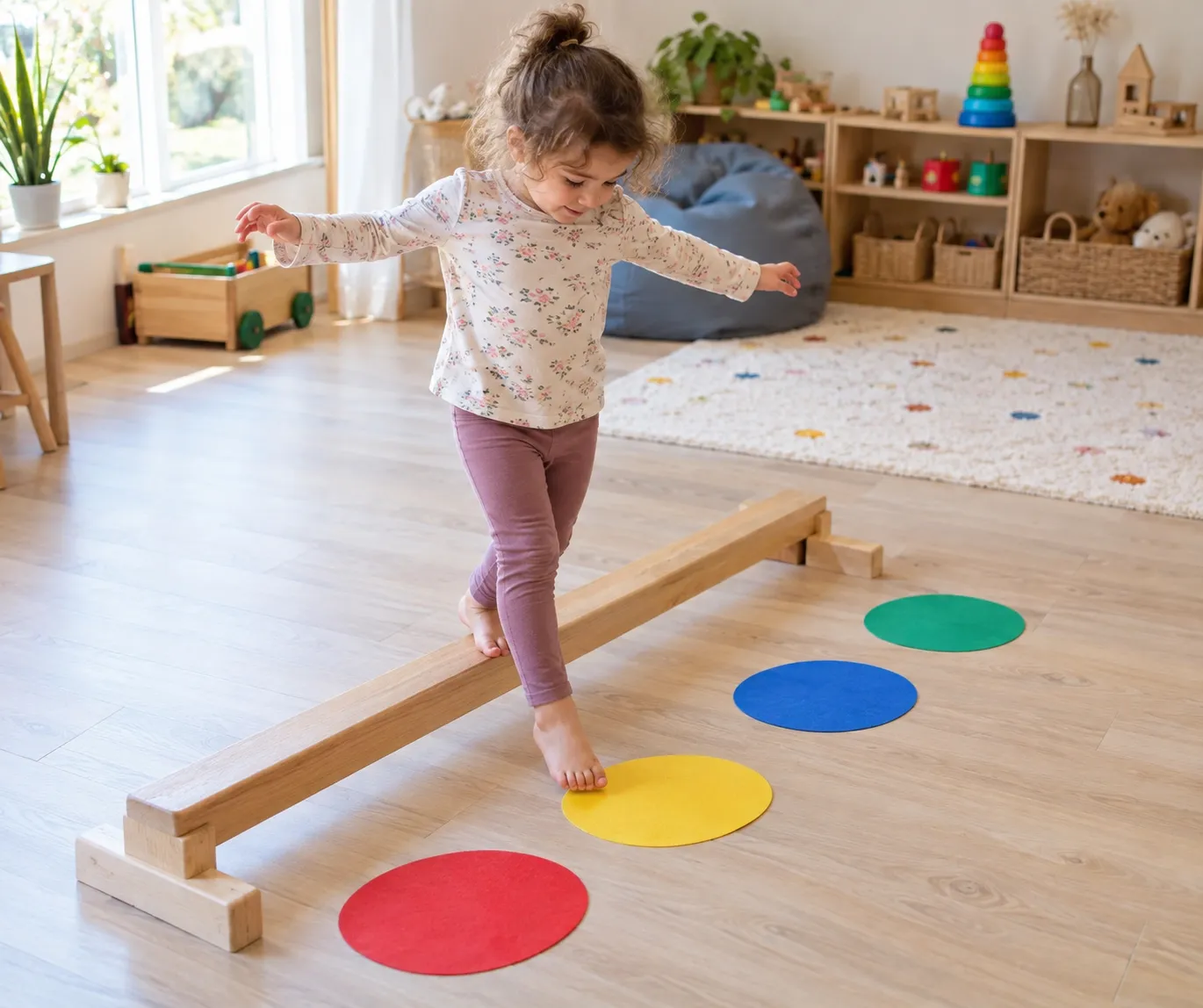
| Color steps | Step only on the called color | 3+ | 1-4 | Beam and colored spots |
| Number pickup | Fetch a number, step forward or back by that count | 4+ | 1 | Beam and number cards |
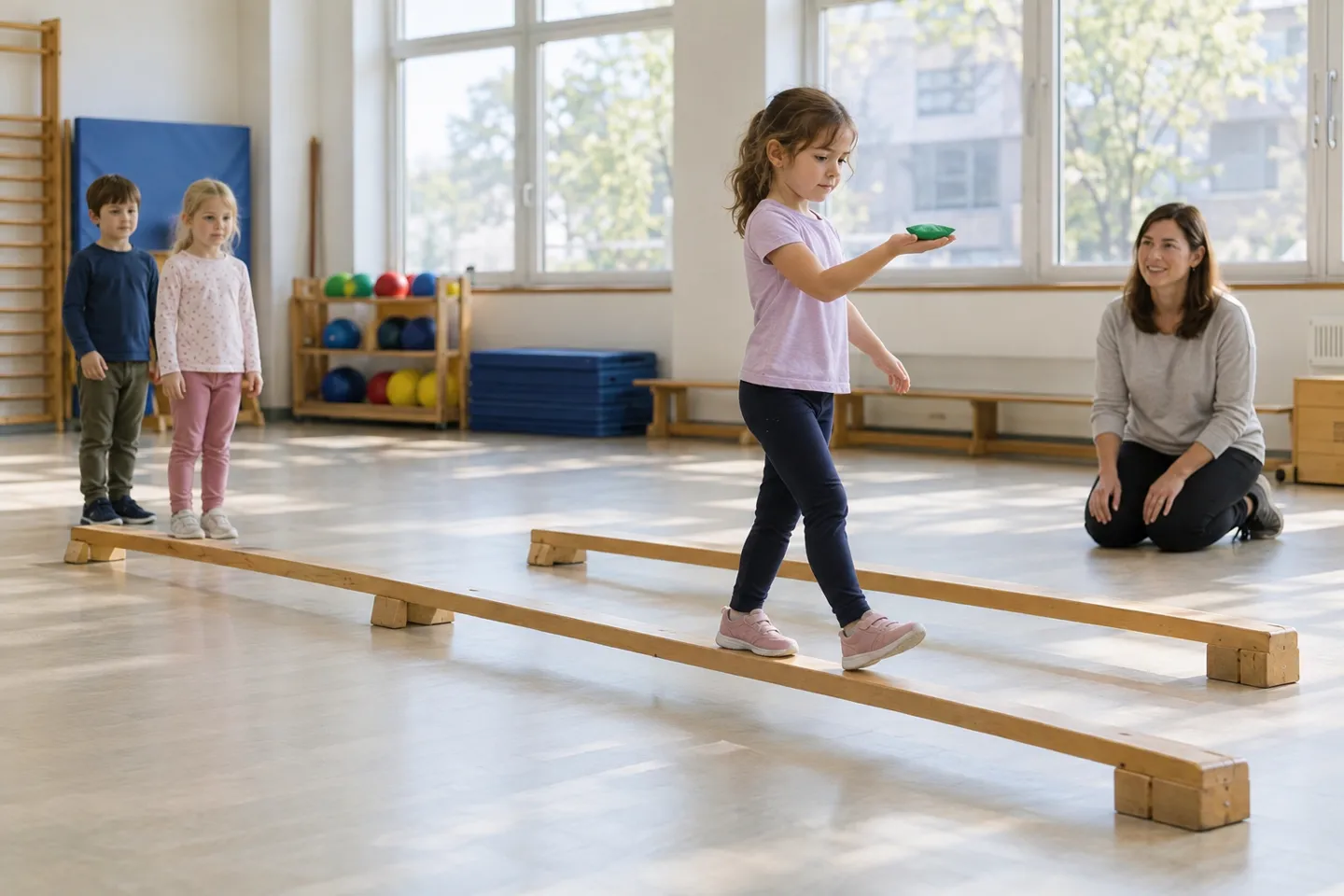
| Beanbag carry | Carry a beanbag on the palm across and back | 4+ | 1 | Beam and beanbag |
A taped line on the floor is a legitimate starting point, not a consolation prize. Penn State Extension’s Better Kid Care program lists taping a line down for walking and hopping practice as a standard classroom activity (Penn State Extension, 2024).
The line stops being enough at rung two. Once a game asks a child to remember, decide or grab something, prop placement and real beam width start to matter. Watch the load, too. A child who must walk backwards while remembering three hops then a spin is doing math on a wobble. Both tend to fail together.
Beam Games for a Whole Class (Without the Stampede)
One beam and twelve children is a queue, not a lesson. The fix is not a longer beam. It is a different structure.
Run a class circuit in four moves
Set up three or four stations, with the beam as just one.
Cap each station at three or four children.
Rotate on a music or clap cue, not a countdown you police.
If anyone waits longer than about one turn, simplify the station.
Station Rotation: One Beam, Three Other Things
Set the beam up as one station in a circuit. Walking the beam feeds into stepping stones, then a ring-and-cone color match, then an animal-walk lap back to the start. Each station holds three or four children, so a class of twelve runs the whole circuit without a line forming anywhere. This kind of structure matches federal guidance. Head Start’s effective practice guide treats gross motor work as its own school-readiness sub-domain, with named teaching practices (Head Start ECLKC, accessed 2026).
Relays and Team Variants
Once everyone can cross, teams change the math. Split the class in half and run two identical beams, or two taped lines, in parallel. Beanbag relay: cross with a beanbag balanced on the palm, drop it in the basket, jog back, tag the next walker. Freeze walk in teams: music plays, everyone stands on a beam, and anyone who steps off joins the judges. Keep waits short. If a child stands still for about one full turn, change the rules before the rules change the mood for you.
Floor, Space, and Landing Room
Team play exposes what solo play hides. Parallel lanes need real floor, so measure the running lane plus a step of clearance on each side before promising two-lane races. Test what the beam does on your actual floor, because a base that slides on hardwood ends games and produces the fall nobody planned. Watch the joints as well. A beam whose sections separate mid-relay teaches a class to distrust it. Notice what happened there: group play wrote your equipment requirements. The next section reads them properly.
Beam Games in Therapy: Match the Game to the Goal
For clinicians, the ladder becomes a targeting question: which goal does each game serve? Walking variants load balance and postural control. Cognitive overlays load attention and motor planning. Carry-and-match games load bilateral coordination and task sequencing. The premise has measured support: in an eight-week program, twice-weekly balance work improved dynamic balance in healthy children, at doses as low as four minutes per session (Schedler et al., 2022).
Match this week’s goal to a layer
Postural control: rung-one walks (forward, backward, heel-to-toe).
Attention and motor planning: rung-two overlays (counting, colors, sequences).
Bilateral coordination: beanbag carry, ring-to-cone matching.
Peer task sequencing: station rotation with one partner.
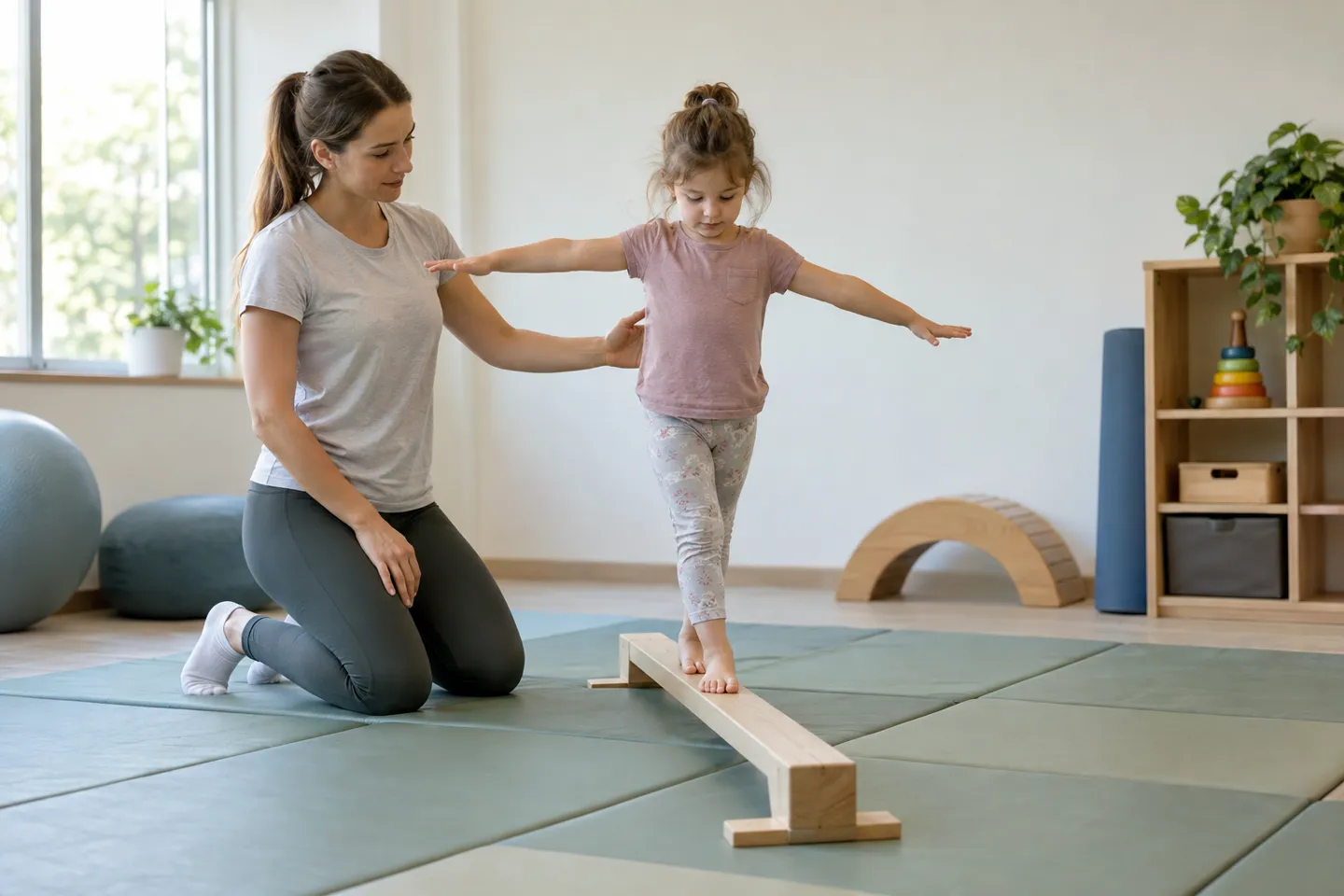
When a child stalls, drop a variable instead of raising the stakes. Two consecutive fails means step down a layer, shorten the crossing, or offer a hand for the first passes. Therapy adds one requirement play does not: the beam must not move at all. A shifting beam reads as broken trust, and hesitant children quit early. One boundary belongs here too. A game ladder is not a treatment plan; track pass rates per layer and loop anything that plateaus back to the treating therapist.
From Games to Gear: What Your Beam Must Survive
Each layer quietly added a requirement the floor line never had. Treat the ladder as a load test, and buy for the highest row your program will actually run.
The Load Behind Each Layer
Game layer × what the beam must take × where it fails
| Layer | Scene and group | What the beam must take | Where it fails | Upgrade signal |
|---|---|---|---|---|
| 1 Walking | Home, 1-2 kids | Floor line or low beam; base that grips; supervision within reach | Slides on hard floors; elevation too early | Start here, no upgrade needed |
| 2 Brain games | Home or small group, 2-6 | Stable width; props within reach of a child on the beam; one new variable at a time | Kids step off to reach props; two variables at once cause repeat fails | Child breezes through: add one variable |
| 3 Team games | Classroom, 8-20 | Length for two lanes or parallel beams; joints that stay locked; grip under hurried feet | Queues form; bases slide; joints separate mid-relay | Waiting longer than one turn |
| 4 Therapy work | 1:1 or pairs | Zero movement under load; predictable height; wipe-clean surface | Beam shifts mid-step; surface cannot be disinfected | Child hesitates at familiar tasks |
Use the matrix as a procurement script. Find the highest layer your calendar will really run, then require the beam to survive that row, not the row below it.
Toddler Beams and Competition Beams Are Different Sports
Most age confusion online comes from mixing two categories. Padded floor beams and low modular beams serve toddler and preschool play, the range in this guide. Adjustable competition beams serve gymnastics training for older children in a coach-led setting with different safety rules. When a source recommends a beam for age five and up without saying which kind, that mismatch is why. Check the category before the price.
The Spec Sheet to Hand Your Supplier
Put six checks on the list.
Base grip
Prove it on the floor you have.
Load margin
Headroom for adult spotters and hand-holds.
Joint security
Joints stay locked at full speed.
Modular layout
Straight lanes, zigzag paths, parallel tracks.
Daily storage
Stacks small for daily put-away.
Wipe-clean surface
Shared rooms need fast disinfection.
Then ask for measured numbers on each point. A supplier who publishes dimensions, materials and set contents lets you verify. A supplier who cannot has told you something too.
The Buyer’s Math: Spec for the Highest Game You’ll Run
Here is the argument the ladder sets up: budget from the top layer down, not from the price up. Write down the highest game layer your program will run within a year. Layer one only? A taped line and two cushions will genuinely serve you, and the money belongs elsewhere. Layer three or four? Then length, joints, base grip and storage are not upgrades. They are the product.
Order matters because equipment bought below its workload goes quiet. The failure is not hypothetical. A parent in a sensory-play Facebook group posted a photo of a new balance beam set and asked other members what games to play with it (sensory play group post, 2025). The set worked. Nothing was broken. There was simply no plan, and the set was quietly turning into furniture.
Equipment without a game plan is furniture.
Write the game layer first, then buy the beam that survives it.
So make play itself an acceptance test. Ask a supplier how the beam supports your game list, not only what it weighs. Request a sample and run your real highest-layer game on it before signing anything. Ask what happens when a joint wears or a base cracks, because free replacement parts and an honest turnaround time are part of the price you are comparing. A program that specs the beam for the games it will run gets equipment that earns its floor space. A program that specs by price gets the most expensive storage in the building.
If that sounds like how you already buy, it helps to work with a supplier who builds for recombination. Startinal’s balance beam system uses a bridge-pier design: beams and piers connect as modules, so one set re-lays into straight lanes, zigzags or parallel tracks as your game layers grow. You can see how the modular bridge-pier balance beam connects on the product page, and we are glad to map a layout against your floor plan before you order.
Start with the games your room will actually run. The right beam is the one that survives your best one.
Get a Beam Layout Matched to Your Game List
Send Startinal your highest game layer and floor plan — we come back with a module combination, measured specs and a quote.
Request a Layout & QuoteReferences
- The Inspired Treehouse. “Moving and Learning: Improving Balance!” 2015. theinspiredtreehouse.com
- Penn State Extension, Better Kid Care. “Supporting Fine and Gross Motor Skills In and Out of the Classroom.” 2024. extension.psu.edu
- Head Start ECLKC. “Gross Motor: Effective Practice Guide.” Accessed 2026. headstart.gov
- Schedler, S., et al. “Effects of Different Balance Training Volumes on Children’s Dynamic Balance.” 2022. pmc.ncbi.nlm.nih.gov
- Sensory Play Facebook Group. “Parent Question: Games for a New Balance Beam Set.” 2025. facebook.com