.png)
How wide is a balance beam? One number answers it everywhere: four inches. That number is correct for exactly one beam, the one elite gymnasts compete on. If you are buying a beam for a two-year-old, a five-year-old, a gym, or a playground, the honest answer changes, and picking the wrong width is how good equipment ends up unused.
Which “Balance Beam” Are You Asking About?
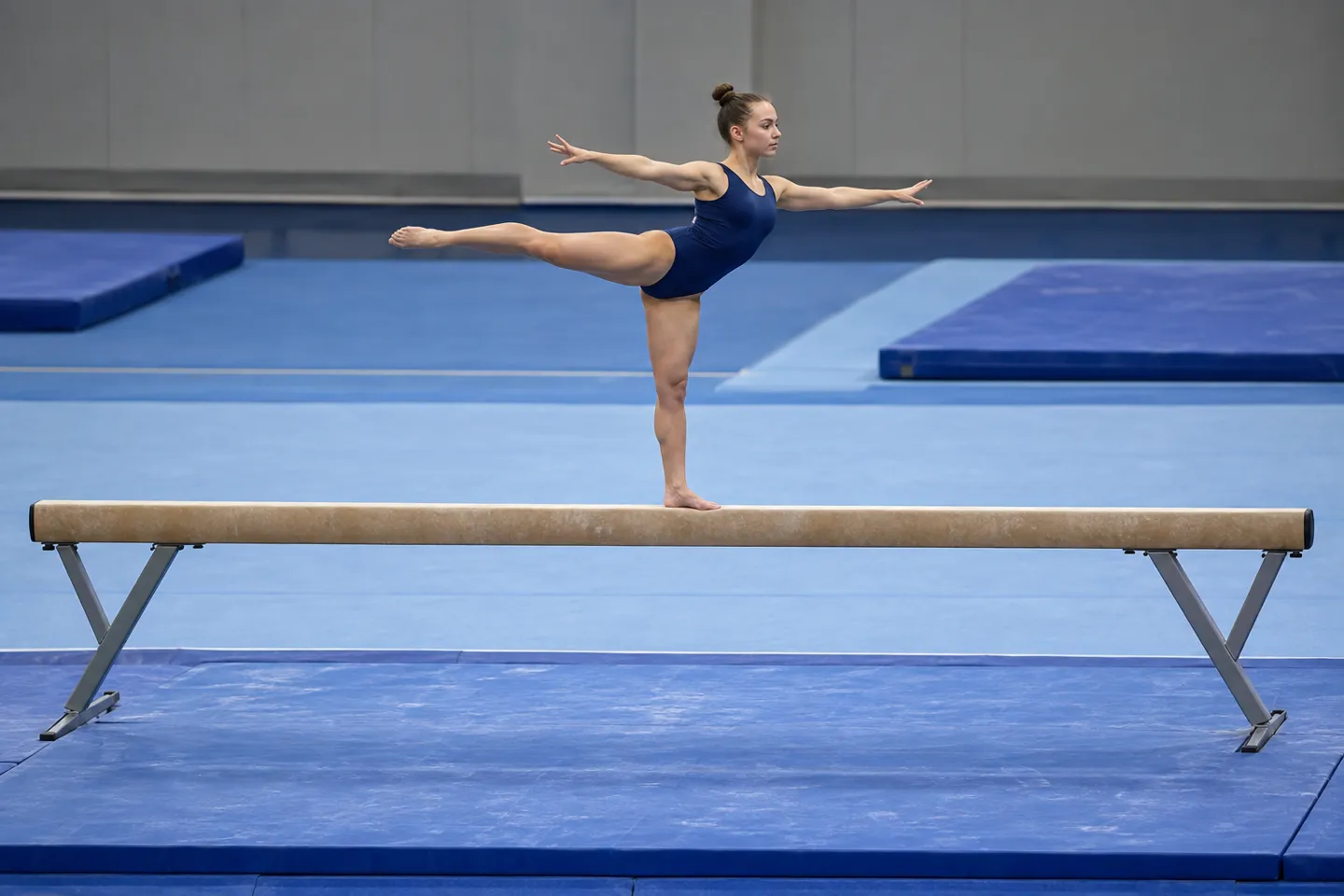
Here is the number you came for. A competition balance beam, as specified in the International Gymnastics Federation’s Apparatus Norms, measures 10 cm (4 inches) wide, 5 m (16 ft 5 in) long, and stands 125 cm (4.1 ft) off the floor (Wikipedia, 2026; Britannica, 2026). American Athletic lists its Classic competition model at 16 feet 5 inches long by 4 inches wide, weighing 310 lbs (American Athletic, 2026). If your question was about gymnastics, this is your answer.
The confusion starts because the same two words describe at least four different products. A dog-agility balance beam can run about 25 inches wide. A bolted-down playground beam has almost no width rule at all; US guidance regulates its height instead. A toddler’s wooden beam sits a few centimeters off the floor. None of these cares about the 4-inch figure, and carrying it across worlds is the fastest way to buy the wrong thing.
Four products, four answers to “how wide”
| What people call it | Typical width | Height | Who asks the question |
|---|---|---|---|
| Gymnastics competition beam | 10 cm / 4 in | 125 cm | gymnasts and their parents |
| Toddler & preschool toy beam | ~9 cm plank or wider foam | 5–23 cm | parents and teachers |
| Playground balance beam | width barely regulated | capped at 12–16 in by age | schools and playground operators |
| Dog agility beam | ~25 in | around 2 ft | dog-sport trainers |
The surface history matters too. Early beams were plain polished wood, and a basketball-like coating was banned for being extremely slippery; since the 1980s beams have been covered in leather or suede and built with spring (Wikipedia, 2026). Slipperiness, not width, is what retired those designs.
This article walks through the three beams people actually step on: the competition standard, the home-practice range, and the toddler and institutional world that barely gets written about. The specs do not transfer between them. The useful question is not “how wide is a balance beam” but “how wide should this beam be for this user”, and the next section starts where most buyers start.
Balance Beam Width for Home Practice: Match the Beam to the Skill Level
The 4-inch walking surface is a training target, not a starting point. Coaches use narrow beams to force precision in athletes who already have balance. A beginner, a cautious child, or an adult returning to sport has none of that reserve yet, which is why the home market splits width by skill level instead of selling one standard beam.
Foam floor
Low beam
Raise height
4-in width
Foam Floor Beams: The Floor-Level Start ⭐
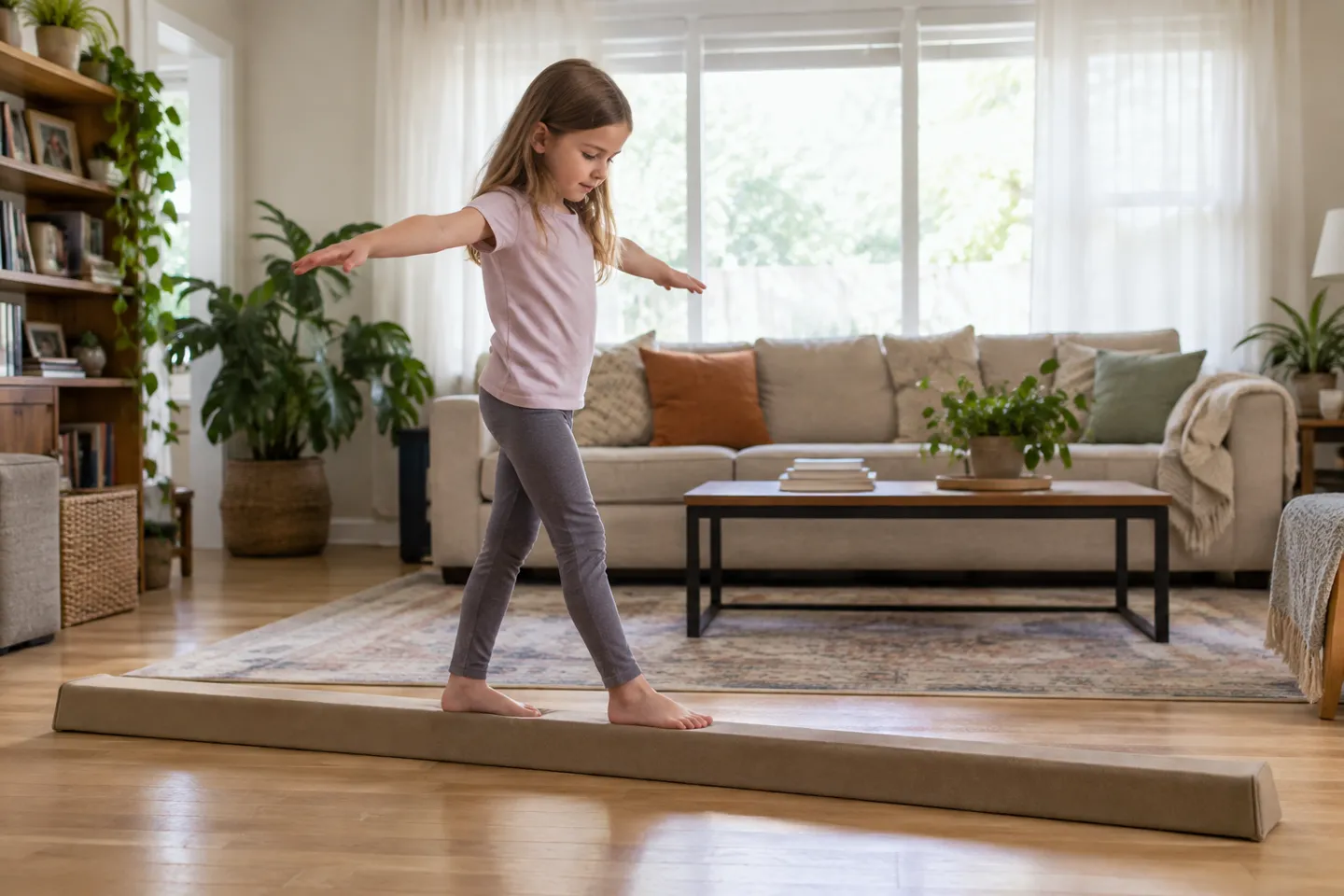
Foam beams lie directly on the floor and are the softest, most forgiving way to begin, so buying guides call them the safest starting point for toddlers and first-time users (Kangaroo Hoppers, 2026). Because the walking surface sits at floor level, there is no fall height to manage at all. The tradeoff is realism: foam compresses underfoot, so the feel differs from a wood-core beam, and skills learned on foam deserve a re-check on a firmer surface.
Folding and Sectional Beams
Folding beams solve the space problem; an 8-foot folding model is the all-around pick for most families because it balances practice length against storage (Kangaroo Hoppers, 2026). Sectional beams snap short segments together and stow in a closet, and half-round beams sit between a wobble board and a full beam (Tumbl Trak, 2026). Most of these keep the standard 4-inch surface but sit low, so the challenge comes from narrowness rather than height.
Wider Work Surfaces: 4 in vs 6 in
Width itself is a marketed variable. The Beam Store sells its standard suede beam with a 4-inch work surface and, alongside it, a 6-inch extra-wide version with fixed legs at 12, 18, and 24 inches plus an adjustable leg running from 15 to 30 inches (The Beam Store, 2026). The extra two inches exist for a specific buyer: the one who is scared of the standard width. The usual objection is that a wide beam builds bad habits. In practice the wide beam is a confidence stage, and training moves back to the 4-inch surface once balance is automatic.
The failure mode here is a mismatch, not a defect. Put a nervous beginner straight onto a 125 cm competition-height beam and the usual path runs fear, avoidance, then a resale listing. The checkable sequence: start floor-level on foam, move to a low beam, raise the height, and only then shrink the width back to standard.
Home beam forms compared
| Form | Walking surface | Height | Best for | Watch out for |
|---|---|---|---|---|
| Foam floor beam | extra wide | floor level | toddlers and first-timers | soft feel differs from a firm beam |
| Folding beam (8 ft) | ~4 in | low | most families | hinge line underfoot |
| Sectional beam | ~4 in | low | small spaces and drills | segments can separate |
| Extra-wide beam | 6 in | 12–30 in legs | scared beginners | plan the transition back to 4 in |
Toddler & Preschool Balance Beams: Width, Height, and Age Fit
Parents shopping for a first beam ask about width before anything else, and one parent thread puts the logic plainly: get the one with the wider base if you are worried about falls (Reddit, r/moderatelygranolamoms, 2026). That instinct is right, but it is only half the spec. For the youngest users, height does more work than width, and the two are designed together.
Height First, Width Second: What Each Age Needs
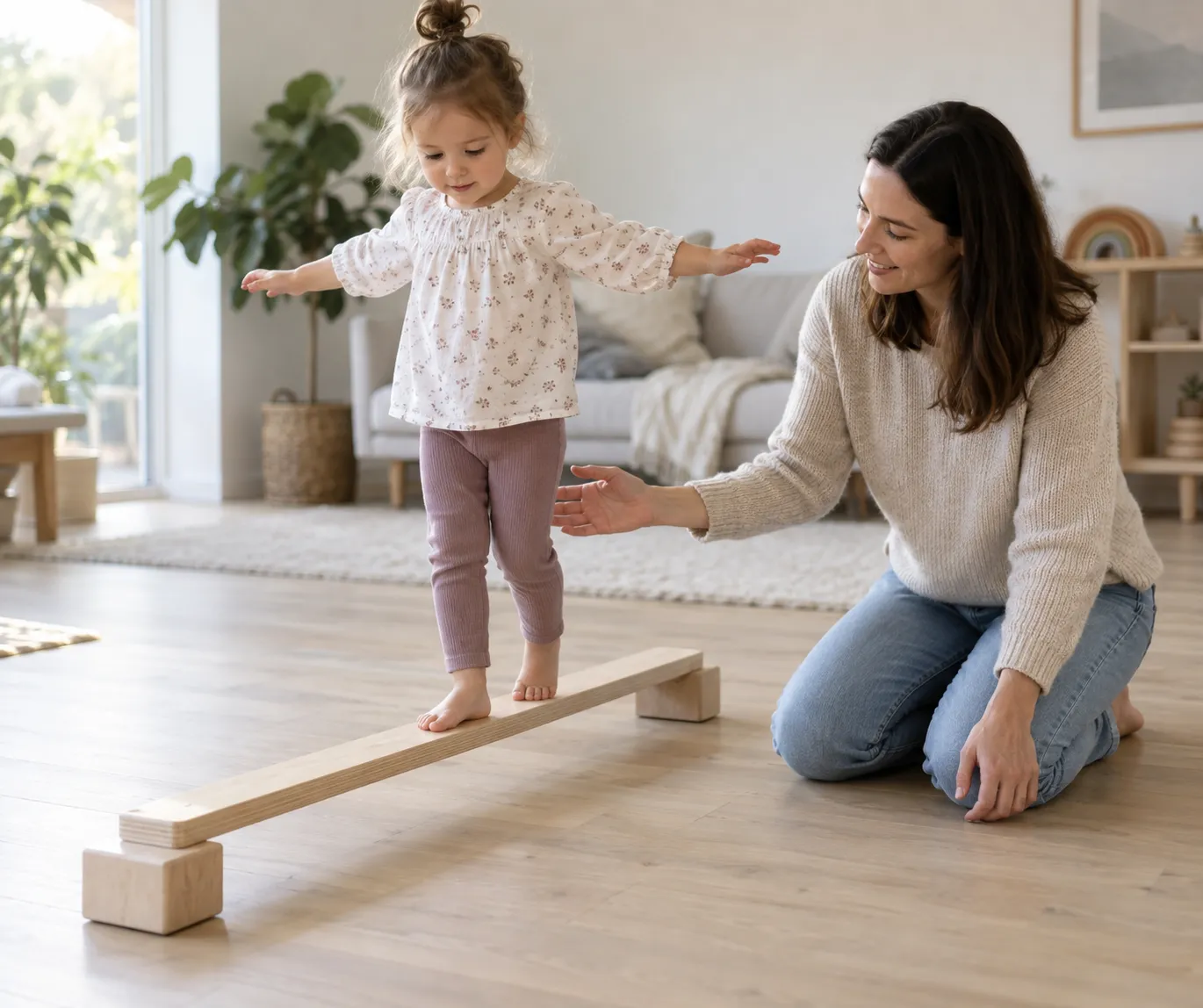
A modular wooden toddler beam shows how this market actually specs things. One Montessori-style set sells a 9 cm (3.5 in) wide, 75 cm long plank with height options of 5.5, 7.5, and 9 cm and a 60 kg load rating (Etsy, 2026). Notice two things. The walking surface is about as narrow as a competition beam’s, yet it sits at roughly one-fourteenth of competition height. And the height is sold in steps, because the point is to raise it as the child improves.
One plank, three difficulties — width stays about 9 cm; only the height changes
Under 3 — floor-level or the lowest step, with a parent spotting.
Ages 4–6 — the middle steps, once balance is steady.
School-age — the tallest step, or a low bench line.
Wood, Plastic, or Foam: Matching Material to Age
Wood, usually birch ply, feels warm, carries weight, and survives years of classroom use, at a price and heft that matter to anyone moving it daily. Injection-molded plastic, typically PP or TPE, is light, stackable, and easy to wipe down; the textured anti-slip base is the feature to check, since a slick surface repeats the exact slipperiness problem gymnastics banned decades ago (Wikipedia, 2026). Foam is the softest option and stays nearest the floor, which keeps it firmly in the young end. For the toddler segment, food-grade material matters on its own, because mouthing is still a real behavior under 3.
Beam materials for young children
| Material | Feel | Weight | Cleaning | Suits |
|---|---|---|---|---|
| Birch wood | warm, firm | heavy | damp cloth, keep dry | ages 3+ and classrooms |
| Plastic (PP/TPE) | firm, textured base | light | wipe-clean | ages 2–6, home and school |
| Foam | soft | very light | spot clean | under 4, floor-level use |
The Progression Path: Wide to Narrow, Low to High
Occupational therapists describe beam work as a progression along both axes at once: children move from easier to harder and from larger to smaller, and that includes height (Sprout Kids, 2026). Stacking blocks under a plank is not a gimmick; it is the next station on the ladder. Sensory-integration classes use exactly this ladder for two- to six-year-olds, starting wide and low, then narrowing and raising as balance becomes steady. The load rating decides whether an adult can step on to assist; a 60 kg home-rated plank has no margin for a parent’s weight.
Two limits end the tuning. First, an age floor exists: the youngest toddlers are not who these beams are built around, and the next section gives the regulatory version of that line. Second, environment: wood planks warp outdoors, plastic handles weather better, and foam is indoor equipment, plain and simple.
Fixed Beams and the Compliance Line: CPSC Height Rules
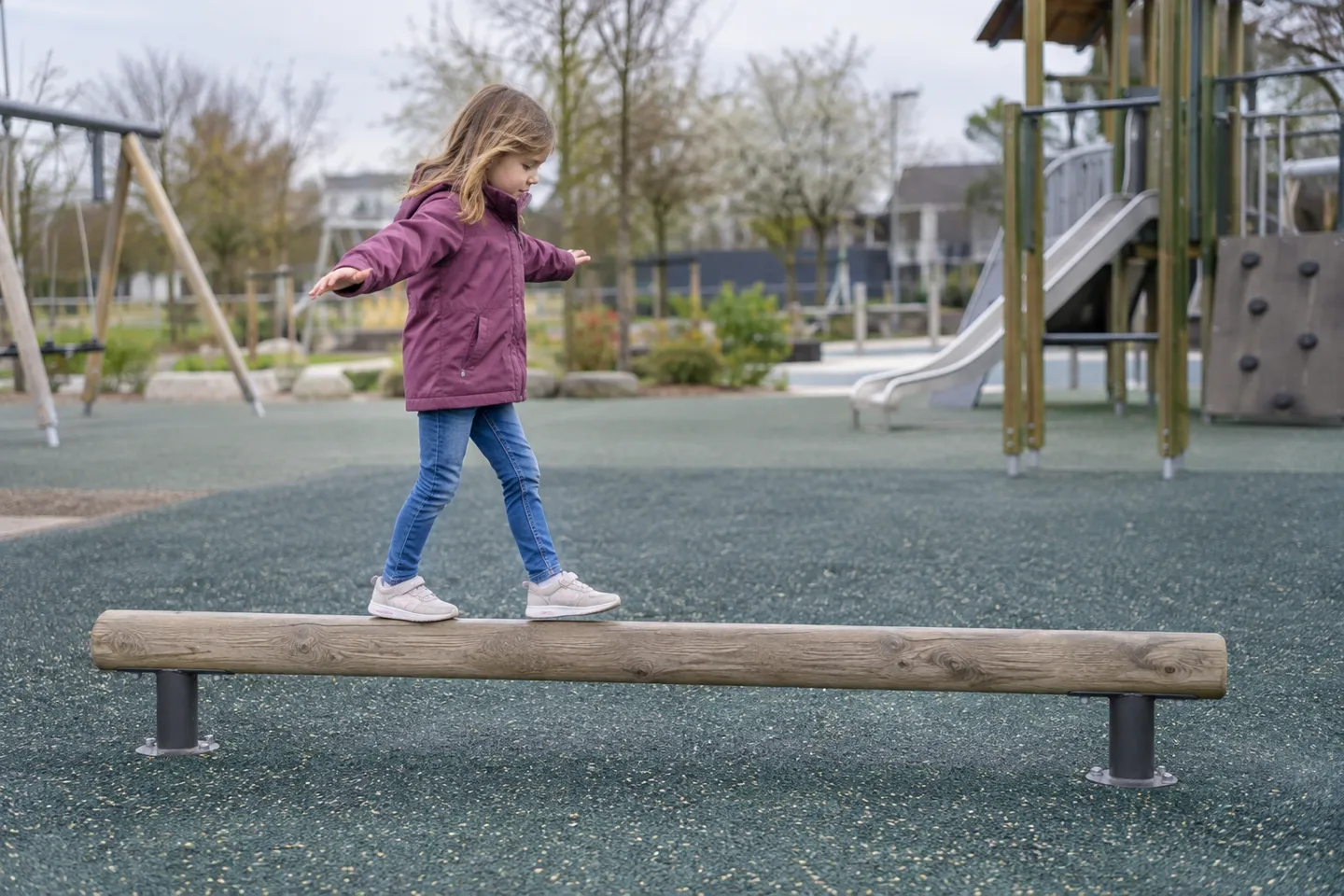
Bolt a beam to the ground and a different rulebook takes over. Public playground equipment in the United States falls under the CPSC’s Public Playground Safety Handbook and ASTM F1487, while a beam carried into a classroom is a toy under ASTM F963 and EN71. Procurement teams that quote the wrong standard fail inspection for the right product.
The CPSC height line, in numbers (Public Playground Safety Handbook, 2025 · §5.3.1)
≤ 12 in
Preschool (2–5): public-playground height cap
≤ 16 in
School-age (5–12): public-playground height cap
Not recommended
Toddlers: no public-playground balance beams at all
The same handbook defines the fall height of a balance beam as the distance from the top of the walking surface to the protective surfacing beneath it (CPSC, 2025). That number only works when the surfacing material matches it. A beam that passes over engineered wood fiber can fail over concrete, and the beam itself never changed.
Beam rules by age band
| Age band | Beam form | Height rule | Width and base notes | Where it fails |
|---|---|---|---|---|
| Toddler (under 2) | floor-level foam at home only, with spotting | not recommended in public settings | widest possible, floor level | any raised surface |
| Preschool (2–5) | low fixed beam or classroom plank | ≤12 in in public playgrounds | wide plank, textured surface, stable base | over 12 in, slick surface, hard surfacing |
| School-age (5–12) | fixed beam or bench line | ≤16 in in public playgrounds | standard walking surface acceptable | over 16 in, no impact area |
| Adult assist or demo | floor-level or institutional-rated | per equipment rating | load rating must cover the adult | exceeding the load rating |
Three checks settle acceptance: measure from the top of the walking surface to the ground, confirm the impact area and surfacing material match that fall height, and write the age restriction into the posted rules. Notice what the regulation never mentions: width. Regulators bound the risk through height and surfacing, which is worth remembering the next time a product page argues about inches.
What “How Wide” Means When You’re Stocking Balance Beams
Read this article back as a product manager and the pattern is hard to miss. Width is the first spec question buyers ask. It changes with the user’s age and skill, and the regulation draws its lines by age band rather than by width. A single-width SKU answers one buyer’s question and hands every other inquiry to the competitor who stocked the right tier.
The shelf already works this way. One US gymnastics supplier runs 4-inch standard and 6-inch extra-wide beams side by side (The Beam Store, 2026). The toddler market sells the same plank in three height steps (Etsy, 2026). Three tiers cover the demand: a competition-standard beam at the 10 cm surface for the gymnastics crowd, a wide-base toddler beam with stepped heights for the early-years crowd, and a floor-level foam form for the youngest users.
A three-tier width strategy for beam stock
| Tier | Width approach | Height | Buyer |
|---|---|---|---|
| Competition-standard | ~10 cm surface, full length | 125 cm equipment or low trainers | gymnastics families and clubs |
| Toddler wide-base | ~9 cm plank with a stable base | stepped 5.5–9 cm | parents and preschools |
| Floor-level soft | wide foam | floor | under-4 home use |
The stocking position worth taking, then, is concrete: tier the width, step the height to the age band, and put load and surface texture where the buyer can see them. Answer “how wide” on the first screen of the listing and again in the Q&A before it is asked. Keep certification claims literal, because a classroom beam is a toy under ASTM F963 and EN71 while a bolted playground beam is playground equipment, and mixing the two standards in one listing is the compliance error inspectors actually catch.
If you are vetting suppliers against that checklist, this is where we can close the loop. Our balance and walking range ships under CE, CPC, ASTM F963, and EN71 certification, and the certificates are published for verification in Startinal’s certification section, so your compliance team can check records before you even ask for a sample. The same food-grade PP and TPE builds with anti-slip textured bases carry across the line, which is what makes width-and-height tiering practical to request.
Ready to Stock Width-Tiered Balance Beams?
Startinal’s balance and walking range ships in stepped widths and heights with published CE, CPC, ASTM F963 and EN71 records — send your width, height and load tiers and get a matched quotation.
Request a Beam QuotationReferences
- Wikipedia. “Balance beam.” wikipedia.org
- Encyclopaedia Britannica. “Balance beam.” britannica.com
- CPSC. “Public Playground Safety Handbook.” 2025. cpsc.gov
- Reddit, r/moderatelygranolamoms. “Toddler balance beam / stepping stones?” 2026. reddit.com