.png)
Every importer and seller eventually runs into the same wall: you can judge a toy sample in your hand, but you cannot judge the production behind it. This guide walks the full path of plastic toy production: how the processes work, what each sourcing path really costs, and how to verify a factory before your money is on the line. The process knowledge matters less as trivia and more as bargaining power. Every fact below is something you can use to interrogate a supplier.
What Plastic Toy Production Involves: From Resin Pellets to Shipped Cartons
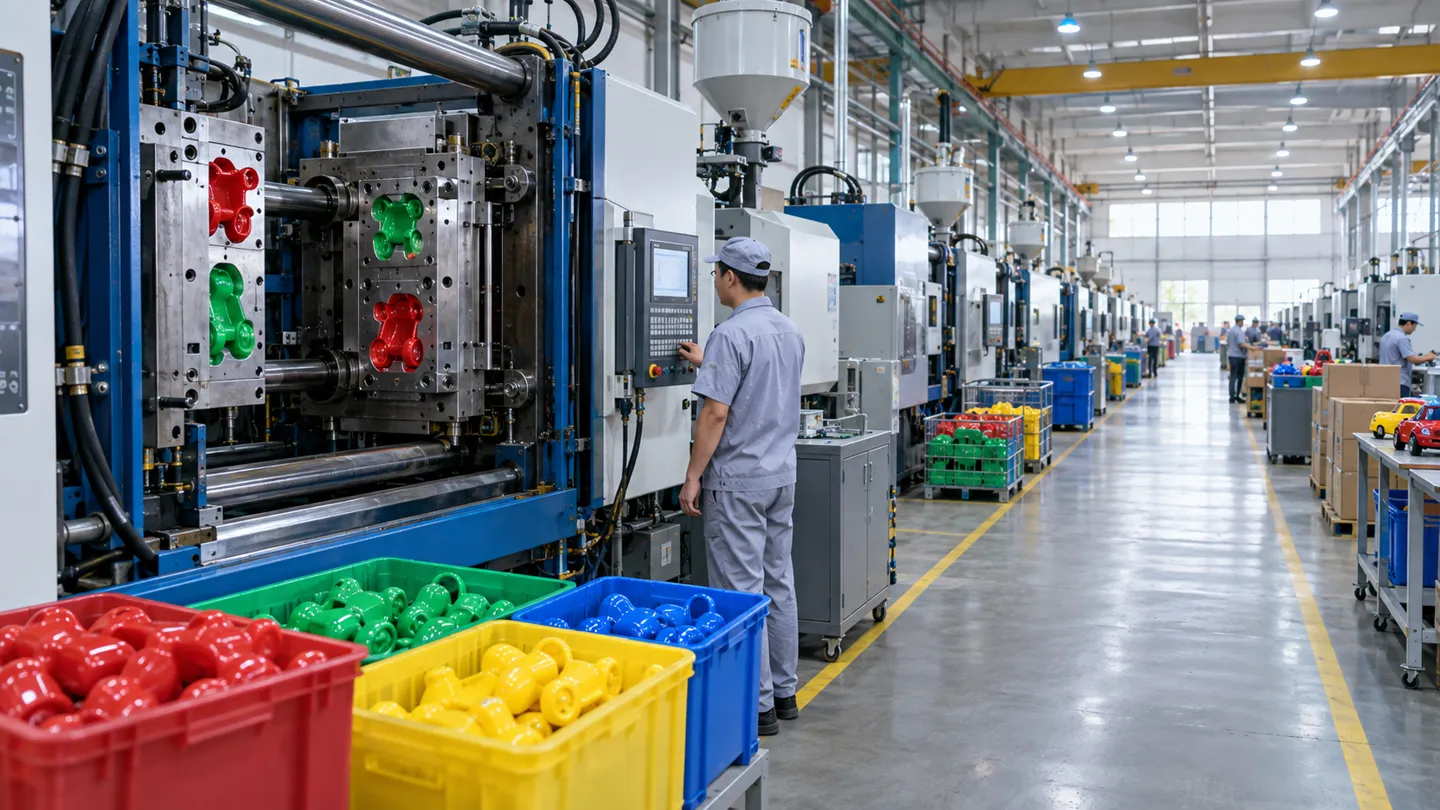
Before a factory can impress you, it helps to know what it is actually doing all day. Plastic toy production is a linear chain, and each link exists to catch a specific kind of mistake.
It starts with raw material intake. Plastic resin arrives in pellets, and a disciplined factory checks batch certificates and stores the material in a temperature- and humidity-controlled warehouse before anything touches a mold. Incoming material that fails inspection goes back; it never enters production.
Next comes coloring and molding. Masterbatch or color powder is mixed into the resin, the mold is mounted and set, and the machine injects or rotates the plastic into shape. Freshly molded parts carry seams and excess flash, so trimming and cleaning follow. Then comes the step buyers care most about: finished-goods inspection, where samples from each batch are checked for structure, color, and safety before packing.
The last two links, packing and warehousing, decide whether everything upstream survives the journey. Export-grade cartons, a documented loading process, and a separate finished-goods warehouse are what stand between a good batch and a container of damaged goods.
The six links, in the order a factory runs them
Material intake & inspection
Batch certificates checked, humidity-controlled storage, rejected lots returned
Color mixing
Pigment or masterbatch blended into resin
Molding
Mold mounted, parameters set, plastic formed
Trimming & cleaning
Flash removed, parts cleaned
Final inspection
Batch sampling for structure, color, safety
Packing & warehousing
Export-grade cartons, documented loading
Keep this chain in mind. Every check you will ever run on a supplier is a question about one of these six links.
The Three Molding Processes (and Materials) Behind Every Plastic Toy
Ask three factories what they do and you will hear the same three words: injection, rotational, blow. The differences are not trivia. They decide what a factory can make for you, how much each unit costs, and why one quote cannot be compared to another.
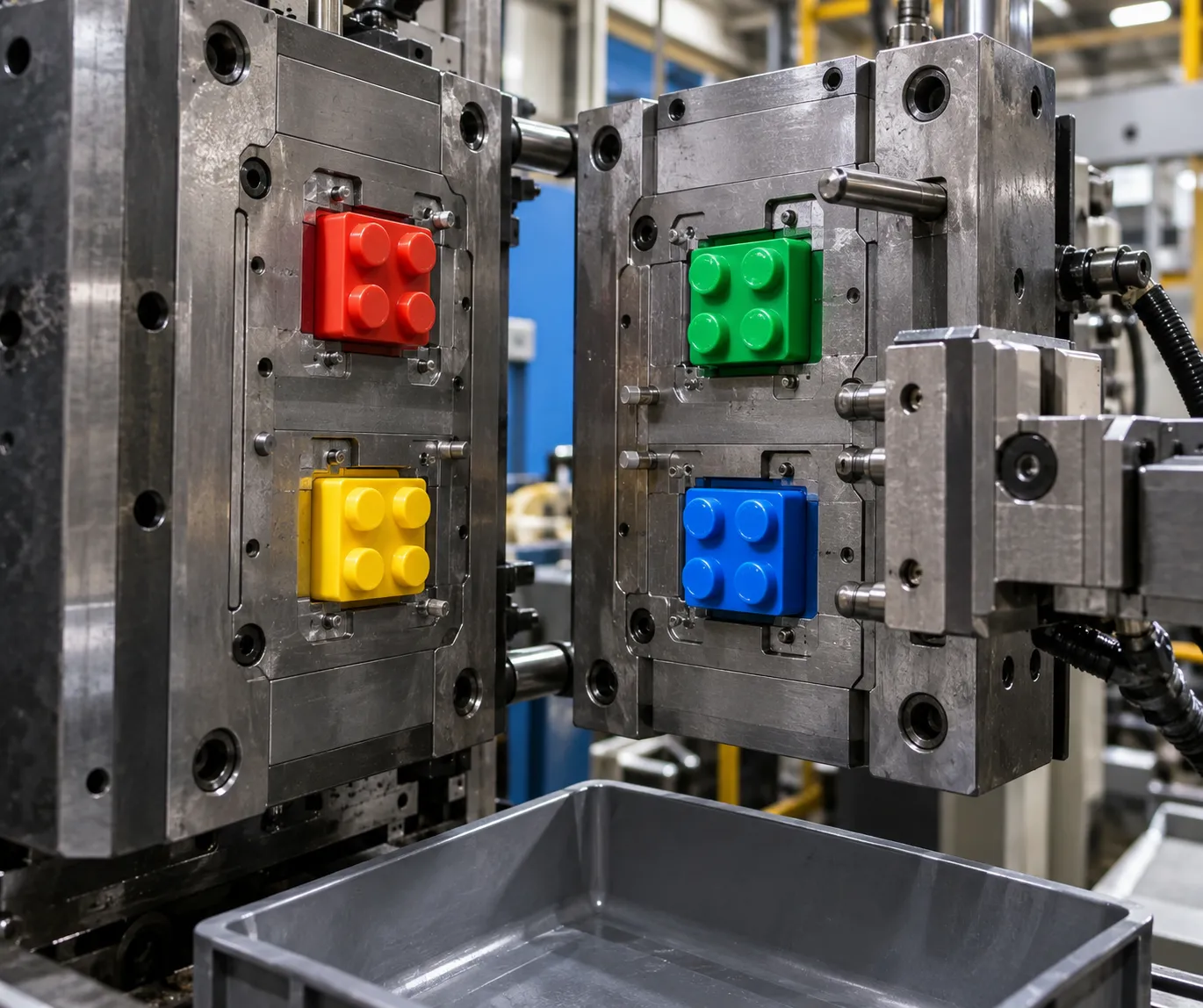
Injection molding ⭐ is the workhorse. Molten plastic is forced into a closed steel mold under high pressure, which produces solid, precise, repeatable parts: stepping stones, blocks, stilt bodies, furniture panels. It dominates because unit costs drop fast at volume, and most educational and sensory toys you see online are injection-molded.
Rotational molding works differently: powder tumbles inside a heated, rotating mold and coats it evenly, which makes large, hollow, seamless pieces such as playground tubes, rockers, and outdoor equipment. Tooling is cheaper than injection but cycles are slower, so it wins on big hollow shapes, not small parts.
Blow molding inflates softened plastic against a mold cavity, the way bottles are made. In toys it produces cheap hollow items: balls, rings, and some floats. Two rarer processes round out the map: extrusion (continuous profiles) and vacuum forming (thin rigid shells); you will meet them in niche products, not core catalogs.
| Process | Typical toy forms | Cost logic | Limit |
|---|---|---|---|
| Injection ⭐ | Solid precise parts: stones, blocks, panels | High tooling, low unit cost at volume | Not for large hollow shapes |
| Rotational | Large hollow seamless: slides, rockers | Lower tooling, slower cycles | Slow for small parts |
| Blow | Cheap hollow: balls, rings | Lowest tooling and unit cost | Thin walls, less precision |
Material choice follows the same logic. PP is the default for tough, washable, food-contact-friendly parts. ABS gives rigidity and a premium finish. Soft PVC (slush-molded) makes squishy figures. EVA and EPP foams make lightweight protective and sensory pieces. TPE shows up as the anti-slip layer on balance products.
The material is also a compliance variable, not just a feel. For the US market, toys are regulated under 16 CFR Part 1250, which incorporates ASTM F963-23 as the mandatory toy safety standard (US CPSC, 2024). In the EU, CE marking under the Toy Safety Directive relies on the EN 71 test series. A sample run is where material, color, and structure get proven together, which is why serious factories treat the sample round as a gate, not a formality.
Stock, Light Customization, or Custom Molds: Choosing Your Production Path
Knowing how toys are made still leaves the buyer’s real question open: which of the three ways of buying them fits your situation? Each path carries a different mix of capital, speed, and risk; choosing wrong costs more than any price negotiation can save.
The Stock Path: Buy Now, Test Fast
Stock products exist precisely so you can test a market without betting on it. Minimums are low or nonexistent, and shipments leave within days of payment. The trade-off is total: everything you buy, your competitors can buy too. The stock path fails when your listing competes on price alone. That is a race to the bottom against everyone who clicked the same supplier’s catalog.
The Light-Custom Path: Differentiate Without a Mold
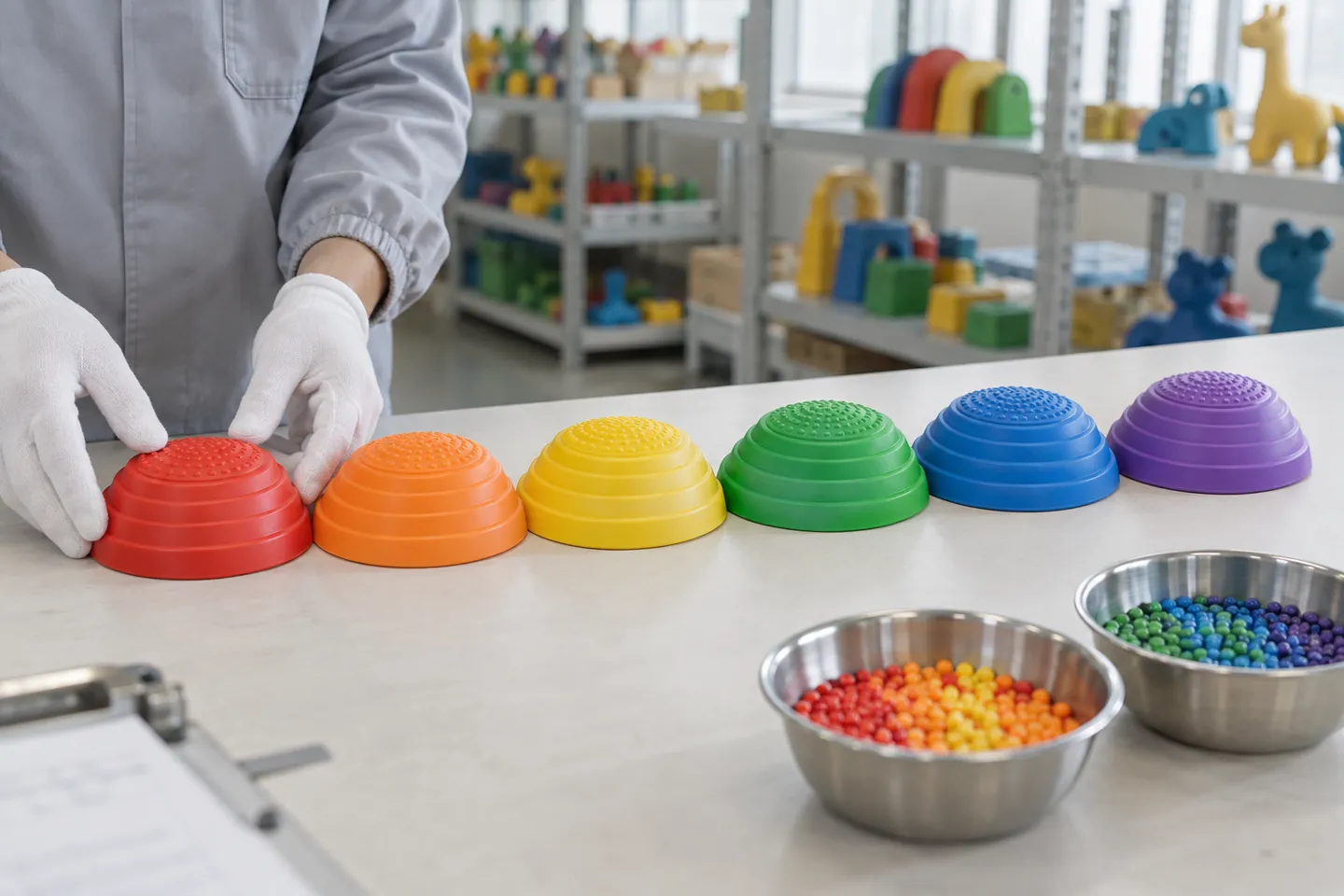
Light customization changes color, logo, and packaging without touching the mold. The working session starts with a Pantone-referenced color card, moves to a sample for confirmation, then to mass production; expect the sample round in days and production in weeks. This is the balance point for most sellers: real differentiation at a fraction of custom tooling cost. Its ceiling is equally real: the customization is cosmetic, so a fast competitor can copy it within a season.
The Custom-Mold Path: Pay for the Moat Once
A custom mold turns a design into property. It is also the path where buyer horror stories concentrate, because tooling quotes are opaque. One buyer on r/manufacturing collected quotes for the same prototype design and got prices from $3,000 to $30,000, a tenfold spread (Reddit r/manufacturing, 2022). The spread has causes you can interrogate: steel grade and cavity count, whether mold life belongs to you or quietly to the factory, and whether revisions are included or re-quoted. Ask those three questions and the quotes become comparable. The path itself is only rational once demand is proven; a mold pays for itself after the market has voted, never before.
10×
One prototype, tenfold quotes
The same toy design drew mold quotes from $3,000 to $30,000: a 10× spread. Steel grade, cavity count, and mold-life ownership are where the difference hides.
| Path | Best for | Cost & MOQ logic | Fails when |
|---|---|---|---|
| Stock | Testing demand fast | Low or no MOQ, ships in days | Your listing competes on price alone |
| Light custom | Standing out in season | Moderate MOQ, weeks not months | Copycats match you within a season |
| Custom mold | Proven, durable designs | Tooling paid upfront, ownership negotiable | Demand is unproven or quotes weren’t itemized |
| Mixed strategy | Portfolio sellers | Stock for tests, custom for winners | Capital locked in molds for unvalidated SKUs |
Run your decision through that matrix before you run it through a price list. The path you pick sets the ceiling on everything the factory can do for you.
How to Vet a Plastic Toy Factory Before You Commit
A quote and a sample prove one thing: the factory can look good once. Production capability is a different claim, and it has to be verified in a specific order: compliance first, capacity second, quality control third, terms last. Each step produces evidence; each also has a walk-away signal.
Compliance
Capacity
Quality control
Terms
Step 1: Verify the Compliance Paper Trail
Start with certificates, because they are the cheapest thing to fake and the easiest thing to check. A credible supplier shows certificates that name a testing standard, a certificate number, and a holder. Your job is to confirm the holder is the entity quoting you. The walk-away signal: when the certificate holder and the company on the quotation differ, ask for the business license and an authorization letter before anything else. If those do not arrive, stop.
Step 2: Read the Production Line, Not the Brochure
Next, make the capacity story reconcile. A factory’s claims must be internally consistent: stated molding machines should match stated workshop zones, and both should support the annual output figure. The classic tell of a trading company posing as a factory is a capacity claim with no molding equipment behind it. Ask for a live video walk-through of the workshops and, where available, third-party audit reports such as BSCI social audits: documents an auditor signed, not marketing copy.
Step 3: Trace the Quality Control Points
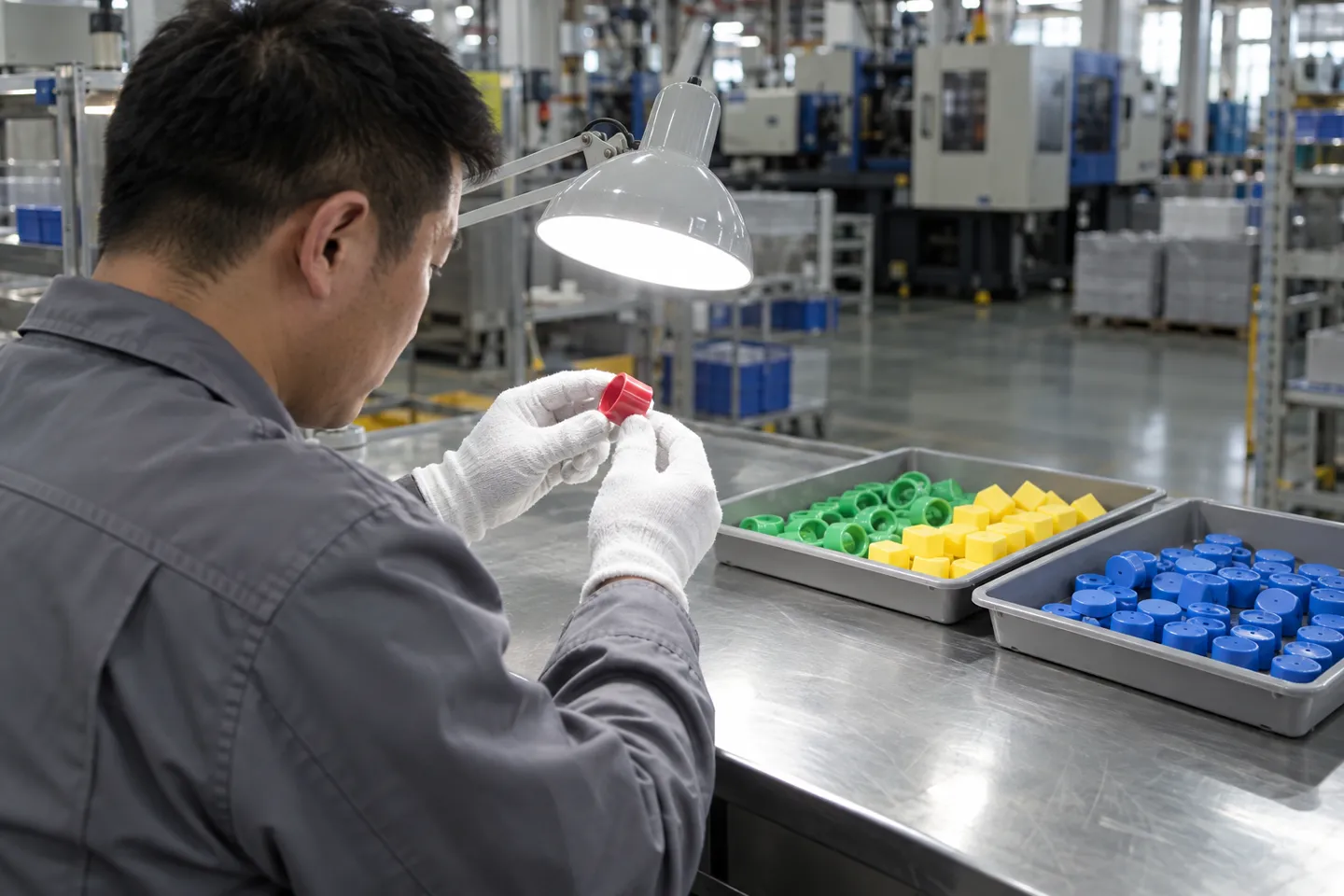
Then map where quality is actually checked. You are listening for three named checkpoints: incoming material inspection, in-process monitoring with per-batch records, and finished-goods inspection with a stated sampling rate. Vague answers here are themselves data. Two concrete requests sort serious factories from the rest: ask to see a batch traceability record (with identities removed), and ask whether they cooperate with drop-box tests before shipment. A factory that documents each batch can answer in one sentence; one that cannot will answer in paragraphs.
Step 4: Put the Safeguards in Writing
Finally, convert what you verified into contract terms. Pre-shipment inspection rights, meaning your inspection and their rework if it fails, are standard and reasonable. Delay compensation clauses exist and are signable. And make the trade terms explicit: EXW, FOB, C&F, and DDP allocate risk at different points, so name yours in the purchase order, not in a later dispute.
| Check | Ask for | Walk-away signal |
|---|---|---|
| Compliance | Certificate numbers + holder entity | Holder ≠ quoting entity, no paperwork follows |
| Capacity | Live workshop video, audit report | Output claim with no molding equipment shown |
| Quality control | Batch traceability record, drop-box test cooperation | No named checkpoints, no sampling rate |
| Terms | Inspection rights, delay clause, named Incoterm | “We’ll handle it” as a written safeguard |
Run the four steps in order and skip none. Every horror story in toy sourcing starts with one of these boxes left unchecked.
Skip the Cold Audit
Send your shortlist to Startinal and the first four answers arrive attached: certificates, workshop video, batch records, and named trade terms.
Start With the EvidenceWhat a Production-Ready Partner Looks Like
Flip the checklist over and the picture of a qualified partner comes into focus. Its certificates trace to a real testing standard and name the same entity that signs your invoice. Capacity numbers reconcile across machines, workshops, and output without gymnastics, and audit reports arrive because they exist, not because you begged.
The quality system has names and numbers: which checkpoint inspects incoming resin, which record tracks each batch, what sampling rate governs finished-goods inspection, and how a drop-box test gets arranged. Ask a question and the answer arrives as a document, not a reassurance.
And the commitments are in writing: inspection rights, delay remedies, named trade terms. A factory confident in its production does not need ambiguity to protect its margin. That is the profile you are screening for. The good news is that such factories exist and, as a rule, they are the ones most willing to be checked.
Where Toy Production Projects Actually Fail
Projects rarely fail everywhere at once. They fail in three specific bands, and each has a pre-emptive action that costs far less than the failure.
| Failure band | What it looks like | Pre-emptive action |
|---|---|---|
| Compliance | Listing pulled after launch (“listed, then delisted”) because a required children’s product certificate was missing or expired | Confirm certificate validity and market match before the PO, not after the listing |
| Quality | Cartons fail drop tests; batch color drifts because a color-card approval was skipped; anti-slip layers separate | Lock the sample as the standard batch-zero and tie acceptance to the approved card |
| Delivery | Peak-season capacity crunch pushes your order behind bigger ones; light-custom lead times slip | Book production windows early and put a delay clause in the contract |
Compliance failures are the least forgiving because they happen after you have paid: inventory that cannot be sold is inventory you warehouse at a loss. Quality failures compound quietly: a color drift across batches reads to your customers as a different product. Delivery failures are the most predictable and therefore the least excusable; a signed delay clause costs nothing to sign and changes how your order is prioritized.
Notice the pattern in all three: the failure was visible in the production chain long before it reached the balance sheet. That is the argument for verifying upstream. The earlier a link fails, the cheaper it is to fix.
Budgeting the Sourcing Mix: A Business Reading of Everything Above
Read the three paths again as a capital allocation problem instead of a product decision. Stock ties up the least cash and proves demand fastest. Light customization adds differentiation for a few weeks of lead time. Custom molds lock real capital behind a design that has already earned them. The failure modes from the last section are not evenly distributed either; they cluster where capital commitment outruns verification.
That reframes the old instinct to negotiate unit price first. A ten percent price cut on the wrong path is noise. The real losses come from a mold bought for an unvalidated design, or a season of stock delisted for a lapsed certificate. For traders and seller-operators, the durable structure is a ladder: stock to test the market, light customization to build your difference, and a verified production line to scale what survived. Verification is not a step before the discount; it is the thing that decides whether the discount means anything.
That ladder is how we run our own production floor at Startinal. Our in-stock gross motor catalog ships in 1–7 days. Samples for light customization (color, logo, packaging) come back in 3–5 days, with bulk production following in about 15–25 days. The whole line sits under a BSCI-audited quality system, and our CE and CPC certificates are published for you to check (the in-stock gross motor catalog). Put us through the four-step vetting above; a production partner should be able to pass the same test it hands to others.
And when a question comes up after the order, we at Startinal answer it the same way: 24-hour English support and free replacement parts on any confirmed quality issue, no hidden fees.
Send Your Design to a Verified Production Line
One message returns a quote, a sample timeline, and the published CE and CPC certificates to run through the four-step vet.
Request a Production QuoteReferences
- U.S. Consumer Product Safety Commission. “Toy Safety Business Guidance.” 2024. cpsc.gov
- Electronic Code of Federal Regulations. “16 CFR Part 1250 — Safety Standard for Toys.” 2024. ecfr.gov
- Reddit, r/manufacturing. “Manufacturing Toy in China.” 2022. reddit.com