.png)
The published cost of an indoor playground franchise scatters across a tenfold range. One 2026 industry guide puts franchise total investment between $250,000 for emerging brands and $2.5 million for top-tier family entertainment center formats (Didi Play Area, 2026). Luv 2 Play, an established chain, publishes an overall investment window of $600,000 to $2.5 million on its own franchise page (Luv 2 Play, n.d.).
That spread is not sloppy reporting. “Cost” in this business is four different kinds of money, and each kind behaves differently. This guide takes the number apart: the money you pay once, the money that leaves every month, and the money that can blow up mid-project. It ends with the one big block you still get to decide for yourself.
What the Franchise Cost Number Is Made Of
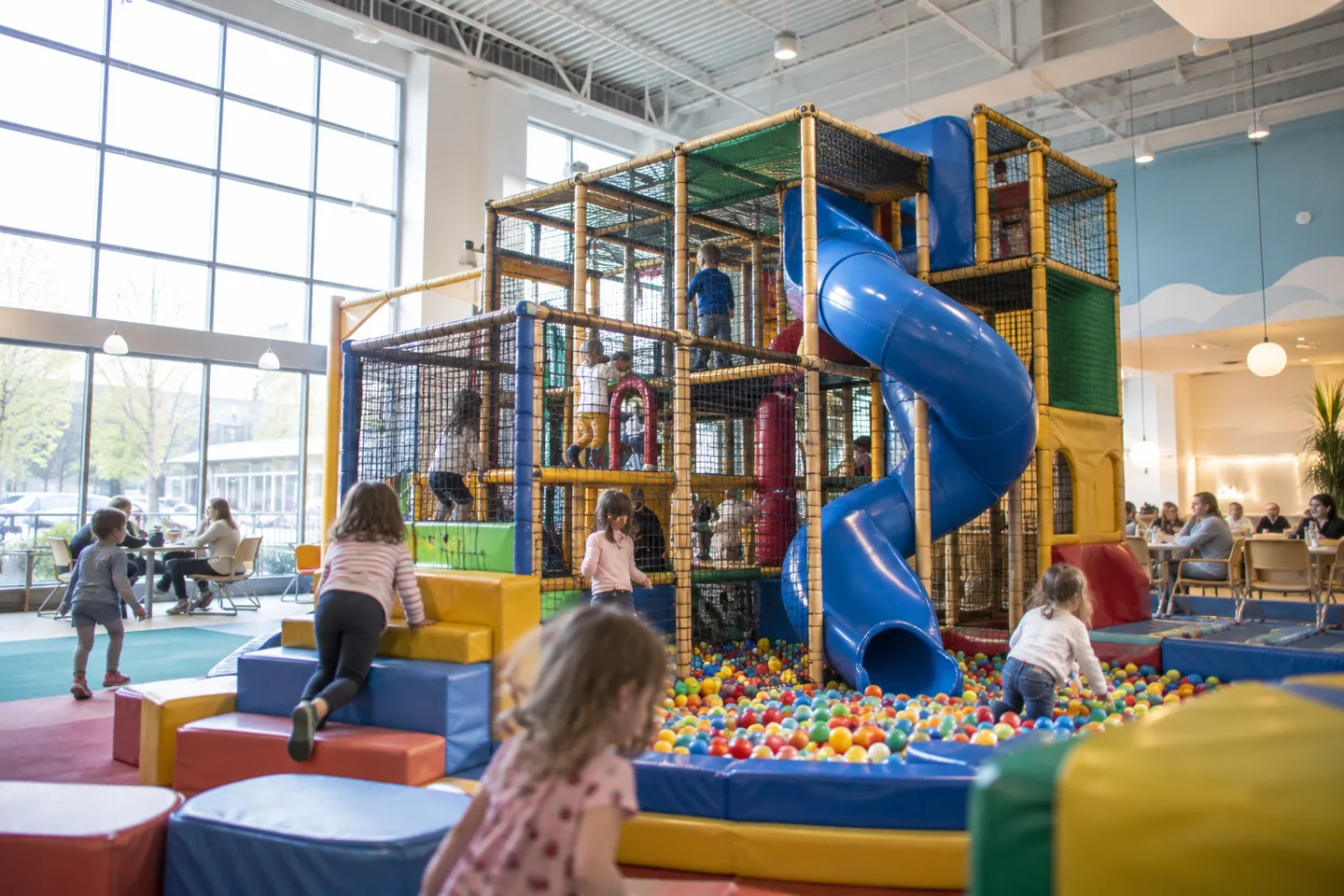
First, the scope. This article covers commercial indoor playgrounds: play cafés, soft play centers, and family entertainment centers where parents pay for admission, parties, and classes. Home play sets are a different market with different rules.
Now the headline ranges. Independent build-outs run $150,000 to $700,000 depending on footprint and theming (Didi Play Area, 2026). A 5,000 sq ft commercial playground typically costs $150,000 to $400,000 (Didi Play Area, 2026). Small café-style soft play concepts can start near $50,000, while one popular playground franchise concept lists an initial investment of $352,250 to $769,100 (Apex Leadership Co., n.d.).
Same keyword, wildly different buildings. The range exists because three things change the total: square footage, format (a café with mats is not a four-level FEC), and whether a franchise fee sits on top. When a source quotes you a single average, it is quoting one point on someone else’s curve.
A more useful frame is how each dollar behaves after you spend it.
Four Kinds of Money in a Playground Budget
| Species | Example items | Who controls it |
|---|---|---|
| One-time | Franchise fee, build-out, equipment, deposits, opening working capital | Your model choice and your contractor |
| Recurring | Royalty, ad fund, rent, payroll, insurance | Your contract, your landlord, your state |
| Contingent | Permit-driven upgrades, seasonal dips, early repairs | Discovered mid-project; catchable with checks |
| Controllable | Equipment mix, supplier choice, acceptance standards | You, especially going independent |
The one-time numbers get all the attention. The monthly ones decide whether the business is worth owning, so they come next.
Franchise or Independent: What Each Path Actually Sells You
The upfront franchise fee typically runs $30,000 to $60,000, stretching past $150,000 for larger systems (Didi Play Area, 2026; ROLLER, 2025). For that money you get four things: brand recognition that fills the door in month one, and an operations playbook that has already survived its first mistakes. You also get purchasing power through mandated vendors, plus a protected territory.
Independent owners give those four up. In exchange, they set their own pricing and attraction mix, respond to their local market without approval loops, and stop paying a percentage of gross forever.
What You Are Actually Paying For
| What it buys | Franchise | Independent |
|---|---|---|
| Brand recognition | Included, if the brand is truly known | You build it locally |
| Operations system | Playbook supplied | You assemble it (consultants, SOPs) |
| Purchasing power | Mandated vendors, bulk rates | Your own sourcing, often factory-direct |
| Recurring fees | 6–8% royalty + 1–3% ad fund | None; you fund your own marketing |
The useful question is not “franchise or independent” but “is this franchise mature?” A system with fewer than ten open units has no proof at scale. Its franchise fees fund its own experimentation (Didi Play Area, 2026). Michele Caruana has coached hundreds of play-based business owners. Her verdict on two- and three-location franchisors: “a startup asking you to pay for its experimentation” (Michele Caruana, 2025).
Before signing anything, have a franchise attorney read the Franchise Disclosure Document. Four items carry most of the weight. Item 7 asks whether build-out and permitting estimates are realistic; Item 12, how large and protected your territory is. Item 17 covers what happens if you sell or terminate. Item 19 shows whether the earnings claims include labor, rent, and owner salary (Michele Caruana, 2025). Then talk to former franchisees, not just current ones. Ask why they left, how long break-even took, and whether corporate support matched what was promised.
One honest boundary: franchising does work where the system is genuinely mature. National chains with millions in advertising budgets, field teams, and purchasing power deliver real economies of scale to their franchisees (Michele Caruana, 2025). That logic simply does not extend to a two-location franchisor. Size of the promise has to match the size of the system.
Whichever path you lean toward, the money that leaves every month is where the two models really separate.
Run your equipment shortlist through the same maturity test — STARTINAL publishes its CE and CPC certificates and answers every quote request with test reports and written terms.
Request a Written QuoteThe Money That Leaves Every Month: Royalties and Recurring Costs
The Royalty Math, Worked
Most indoor playground and family entertainment franchises charge a 6–8% royalty on gross sales, plus a 1–3% advertising fund (Didi Play Area, 2026). Individual brands set their own numbers: Luv 2 Play publishes a 6% royalty and a 3% advertising fund (Luv 2 Play, n.d.). The percentage looks small until you run it against a real profit and loss statement.
Take a store doing $400,000 a year in sales. At a combined 8% royalty and marketing rate, $32,000 leaves before anyone counts rent. Rent, labor, insurance, and supplies typically consume another 60–70% of revenue, which leaves a 10–12% net margin before loan payments or owner salary (Michele Caruana, 2025).
One Store, One Year, Real Take-Home
The royalty is charged on gross sales, not profit. The franchisor gets paid in your loss months.
That single contract term changes the risk profile of the entire investment.
The Fixed Base Both Models Share
Whichever model you choose, the base does not move. Rent, payroll, insurance, and utilities consume 60–70% of revenue for independent owners and franchisees alike (Michele Caruana, 2025). An independent owner swaps the royalty line for a marketing budget they control; everything else on the ledger looks the same.
Recurring Costs, Side by Side
| Recurring item | Franchise | Independent |
|---|---|---|
| Royalty on gross | 6–8% | None |
| Ad fund | 1–3% of gross | Your own budget, your own ceiling |
| Rent, payroll, insurance | 60–70% of revenue | 60–70% of revenue |
| Equipment maintenance | Ongoing | Ongoing, vendor of your choice |
| Technology and booking systems | Often mandated | Your choice |
So when is 8% worth paying? When the brand drives incremental revenue larger than the fee itself. Industry analysis associates that mainly with mature, multi-state systems rather than emerging brands (Didi Play Area, 2026). For a new store with unstable revenue, or a cold-climate site heading into a weak season, a royalty on gross behaves like a tax on income you have not earned yet. Verify every earnings claim against FDD Item 19 before you let an “average owner makes” number into your business plan.
Monthly money is at least predictable. The next category is not.
The Costs That Blow Up Budgets
Build-out overruns follow a pattern. Franchise brochures commonly quote $150,000 to $200,000 build-outs, assuming a brand-new retail shell (Michele Caruana, 2025). Most tenants lease existing spaces, and existing spaces have histories. In one documented case, a franchisor estimated $180,000 for a downtown space; required sprinklers, a second egress, ADA-compliant restrooms, and a Type-1 hood system pushed the final cost past $330,000. When the franchisee asked for help, the answer was that this was part of her local permitting process (Michele Caruana, 2025).
Seasonality works the same way: quietly, then all at once. In regions where winters stretch six months, summer sales can drop by 70% or more as families head outdoors (Michele Caruana, 2025). Corporate marketing calendars rarely account for this. They promote spring specials to cities still under snow.
The failure rate has a number, with a caveat. Industry estimates calibrated against small-business data suggest 30–50% of indoor playground businesses fail within three years (Didi Play Area, 2026). Treat it as an estimate, not a law. Budget as if your site could land in the wrong half.
The failure also has faces. Caruana reports that over half of her one-on-one consulting clients are trying to escape franchise or partnership agreements (Michele Caruana, 2025). One franchisee she describes, “Emily,” bought into a California play-café concept and opened in a Midwestern town. Corporate denied every request to adapt session length, seating, and menu to local habits. She closed within 18 months, deep in debt. A Florida owner was refused permission to run toddler drop-off camps despite a 60-family waitlist and lost the revenue entirely.
Three overrun triggers to clear before you sign: an existing-space build-out priced like a new shell, a cold-region site planned on average-month revenue, and any earnings claim not verified against FDD Item 19.
Three actions defuse most of this. Put the FDD in front of a franchise attorney, Item 7 first. Walk the site with an independent contractor and price the compliance list, sprinklers to hoods, before signing the lease. Build the year’s cash flow from your worst month, not your average one.
The Equipment Decisions You Still Control
Equipment is usually the largest line item an owner actually directs. In a franchise, the franchisor picks the vendor. Independent, the decision is yours, and it deserves the same rigor the royalty math just got.
Price by Square Meter, Size by Capacity
Factory-direct commercial equipment runs roughly $100 to $140 per square meter (Weiroo Play, n.d.). Multi-level play structures are quoted through a different lens: $15 to $40 per square foot of play structure (Didi Play Area, 2026). Both figures assume commercial grade, which brings us to the number that sizes everything else.
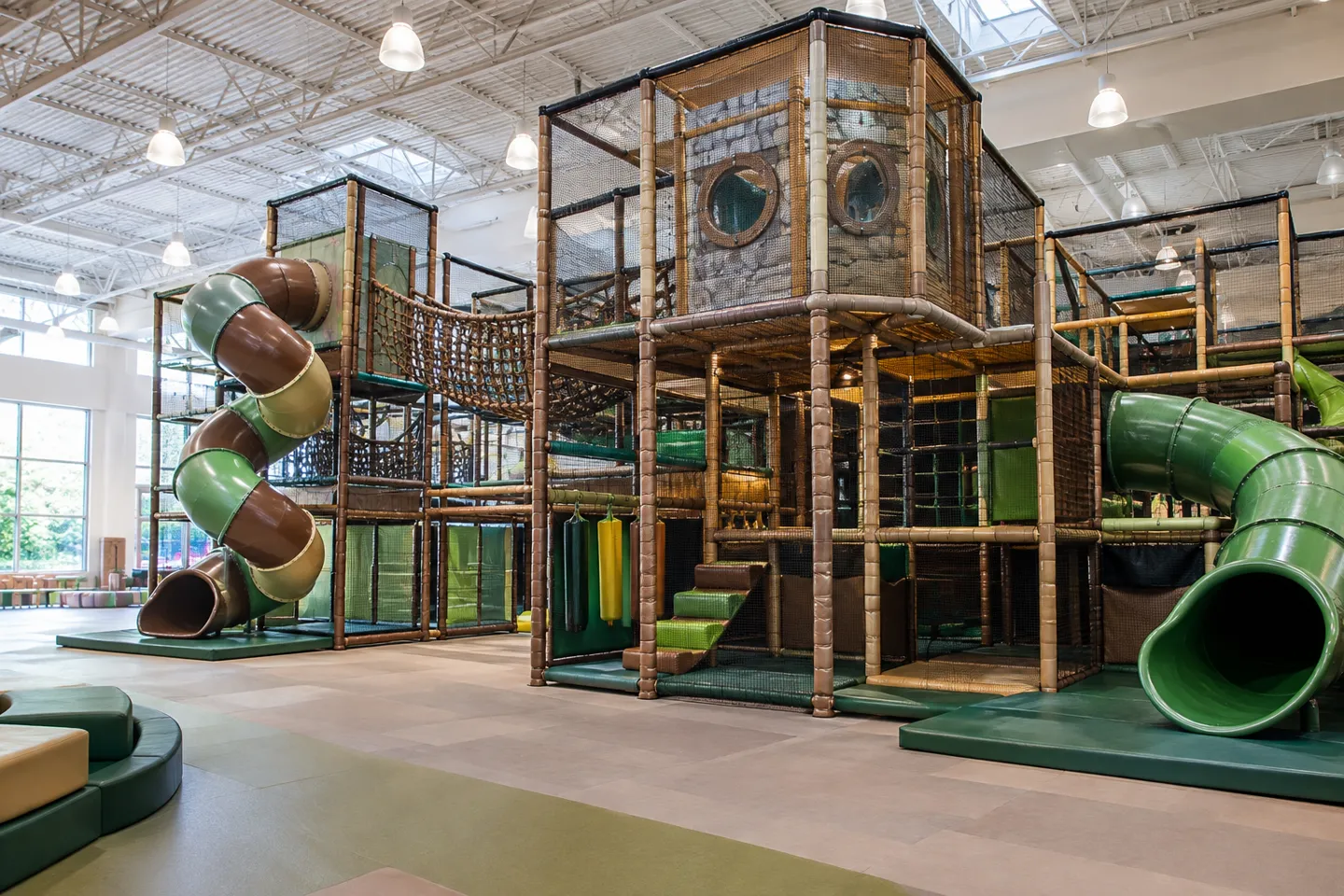
Plan about 3 square meters of active play area per child for maximum safe occupancy (Didi Play Area, 2026). A 150 sqm play floor supports roughly 50 children at capacity. You are not buying floor area; you are buying the equipment that fills it safely at that occupancy. Spend where revenue concentrates: zones that host parties, toddler areas parents trust, and sensory rooms that schools and therapists book tend to earn more per square meter than open floor.
Equipment Pricing Anchors
The Commercial-Grade Checklist
Home grade and commercial grade are different products with the same shape. Commercial equipment carries load ratings for daily use by dozens of children, higher foam density with flame-retardant coverings, connection hardware that survives repeated assembly, and surfaces that tolerate daily disinfection. A home-grade lookalike at half the price fails every one of those tests within months.
In the United States, toys and play products fall under ASTM F963-23, the federal toy safety standard in effect since April 20, 2024 (CPSC, n.d.; ASTM International, 2023). In the European Union, the EN 71 family applies under CE marking. Ask suppliers for test reports that cite the exact standard and version. A generic “certified safe” claim is not a document.
Treat certification as an entry requirement, not a bonus. Without CPC documentation in the US or CE in Europe, insurance, retail channels, and commercial landlords all get harder. The paperwork costs less than the doors it keeps open.
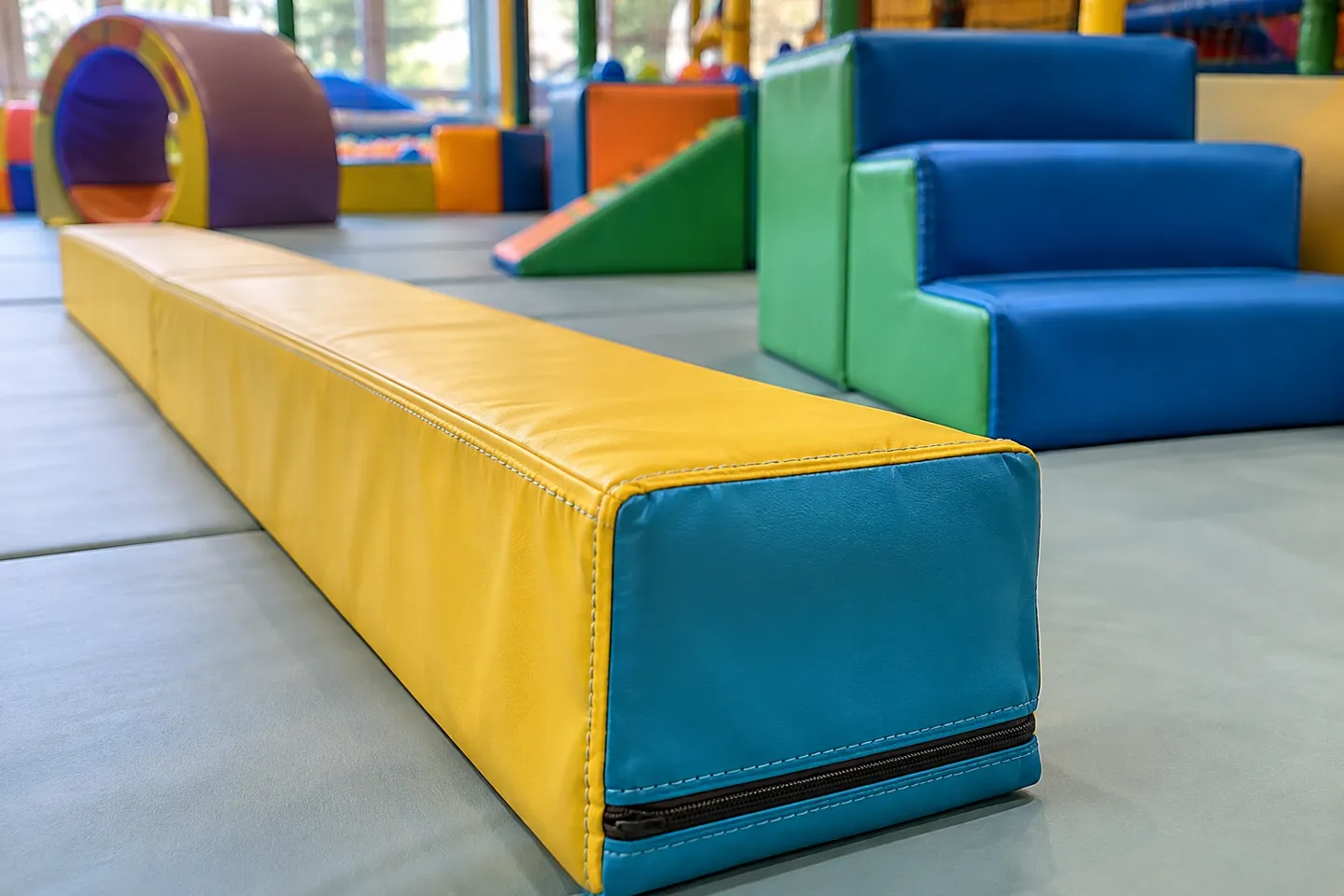
Comparing Suppliers: The Documents That Count
Before money moves, require five things in writing. Ask for parameter sheets with dimensions, load ratings, and foam density. Require test reports per standard and version, plus warranty and spare-parts terms in writing. Insist on a sample-confirmation step before mass production and staged payments tied to inspection points. The rhythm that protects you is sample first, deposit second, production photos third, pre-shipment inspection fourth, final payment only after on-site acceptance.
Equipment Zones: What Commercial Acceptance Requires
| Play zone | Commercial requirement | Confirm with the supplier before signing |
|---|---|---|
| Multi-level structure | Engineered load calcs, platform heights, guardrail spec | Structural drawings and load test report |
| Soft play zone | Foam density, flame-retardant tear-resistant coverings, sealed seams | Material spec sheet and EN 71 / ASTM test report |
| Toddler zone | Soft edges, no small detachable parts, low platforms | Age-grading documentation |
| Sensory room | Balance and weighted equipment rated for assisted adult use | Load rating and materials certificate |
| Interactive and arcade | Electrical safety, payment system compliance | CE or UL documentation and spare-parts list |
The last document that matters is the supplier itself. When we quote commercial soft play and sensory equipment at STARTINAL, the claim sheet is deliberately checkable. CE and CPC certificates are published on our site, not just asserted (commercial soft play and sensory equipment). Our OEM/ODM process runs from your Pantone reference to a confirmed pre-production sample (our OEM/ODM process). Stock items carry no minimum order quantity, and light customization such as colors, logos, and packaging takes about 15–25 days after the sample is approved. Ask every supplier on your list for the same three items in writing.
Reality-Check the Numbers Before You Sign
The return math has a normal range. Well-managed indoor playgrounds return 15–30% annually, with top-quartile operations reaching 30–45%. Payback typically takes 18 to 36 months, and operating break-even can arrive within 3 to 6 months with effective marketing (Didi Play Area, 2026).
Those ranges have conditions. They assume average seasonal patterns, build-outs that stayed on budget, and marketing that actually executed. A cold-region site running on one strong season can make the published range fiction for your location. So can a build-out with unbudgeted compliance work, or a plan built on an unverified Item 19 claim.
Admission alone rarely carries a playground. Birthday parties, memberships, and classes or camps are what separate a 15% return from a 40% one, because they convert the same square footage into booked, repeatable revenue. This is also where the equipment decisions connect back: a floor plan with a party room and a sensory zone has revenue lines a plain play floor cannot offer.
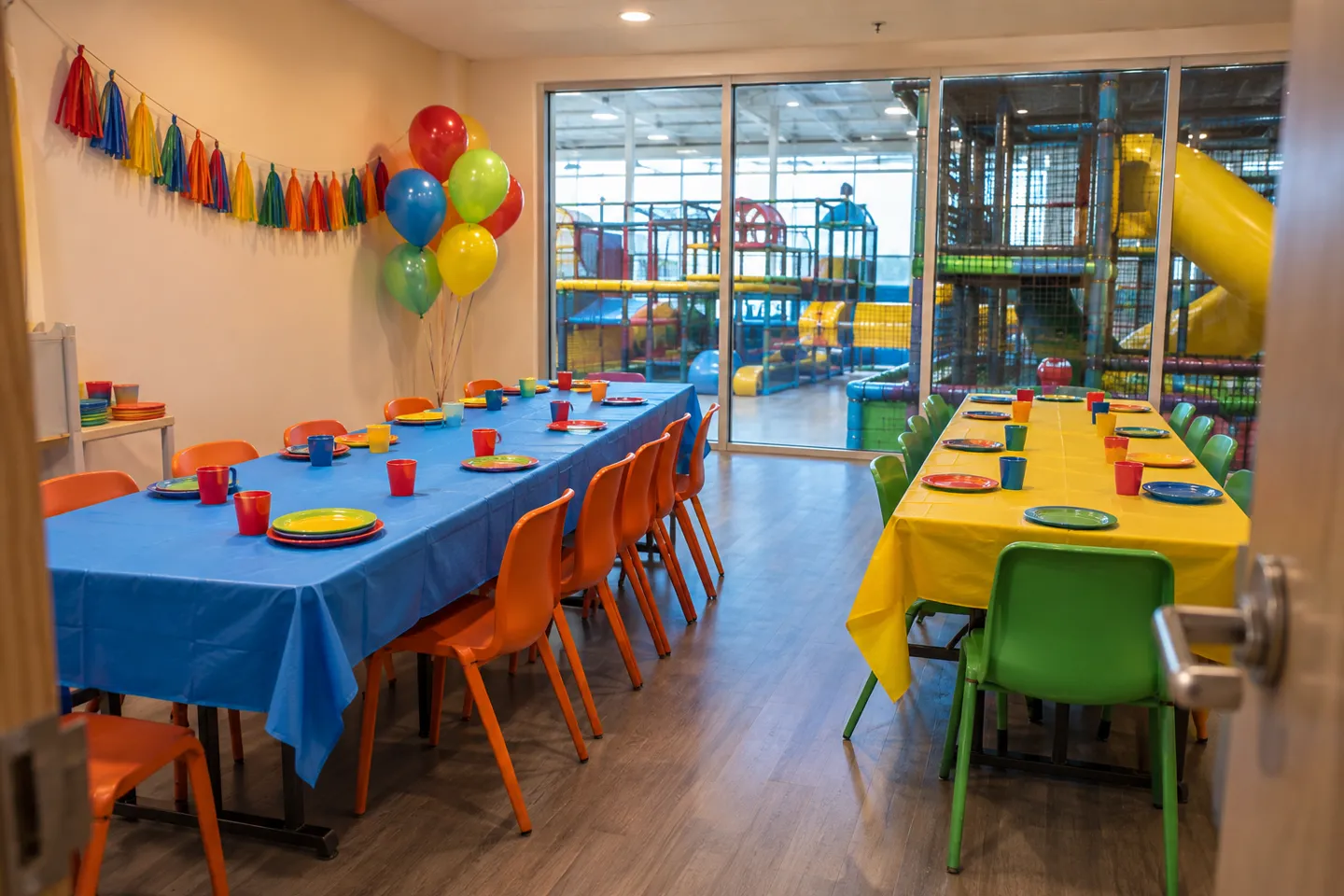
Run the checks in order. First, the attorney reads the FDD, Items 7, 12, 17, and 19. Second, interview former franchisees: why they left, how long break-even really took, whether support matched promises. Third, stress-test the cash flow on your worst month. Fourth, get a build-out compliance estimate from a contractor who does not work for the franchisor.
- FDD reviewed by a franchise attorney
- Former franchisees interviewed, including at least two who left
- Worst-month cash flow modeled, not average-month
- Site compliance estimate from an independent contractor
- Supplier documents in hand: test reports, parameter sheets, warranty and spare-parts terms
After the checks, one question remains: what does this cost structure say about how to run the business?
Reading Cost Structure Like an Operator
Three facts from the numbers above read differently together than they do alone. Recurring money is structural: royalties ride on gross sales whether the month is good or bad. Contingent money hits both models, but an independent owner owns the process for catching it early, from the contractor’s compliance estimate to the worst-month cash flow model. And equipment is the largest block an independent owner actually directs.
So the point of skipping the franchise fee is not the fee. It is that every dollar it represented becomes a decision you get to make. Spend part of it on verification: certified materials, rated loads, spare-parts commitments, staged payments tied to inspection. An independent operator who buys on price alone has kept the franchise’s risk and given up its purchasing power.
This stance has a limit, and it is worth naming. A solo operator with no time to run supplier verification genuinely buys something real from a mature system: vetted vendors, national advertising, field support at opening. Independence is not automatically the smarter buy. It is the higher-variance one, and the variance is mostly yours to manage.
When you build that supplier shortlist, our team at STARTINAL backs every quote with a 48-hour replacement commitment and free parts for quality issues, no hidden fees. Claim assessment runs straight from photos, so a failed component never waits on a dispute. Talk to our team before you lock your equipment budget.
Lock In an Equipment Budget That Survives Acceptance
Send your play-zone list to STARTINAL for a written quote — CE/CPC certified commercial equipment, OEM/ODM from your Pantone reference, 48-hour replacement on quality claims.
Get Your Equipment QuoteReferences
- Michele Caruana. “Read This BEFORE Joining A Play Cafe Franchise Program.” 2025. michelecaruana.com
- ROLLER. “Indoor Playground Franchise Guide: How to Get Started.” 2025. roller.software
- Luv 2 Play. “Franchise Opportunity.” luv2play.com
- Apex Leadership Co. “5 Drawbacks of Opening an Indoor Playground Franchise.” franchise.apexleadershipco.com
- U.S. CPSC. “ASTM F963 Requirements.” cpsc.gov
- ASTM International. “F963 Standard Consumer Safety Specification for Toy Safety.” 2023. astm.org