.png)
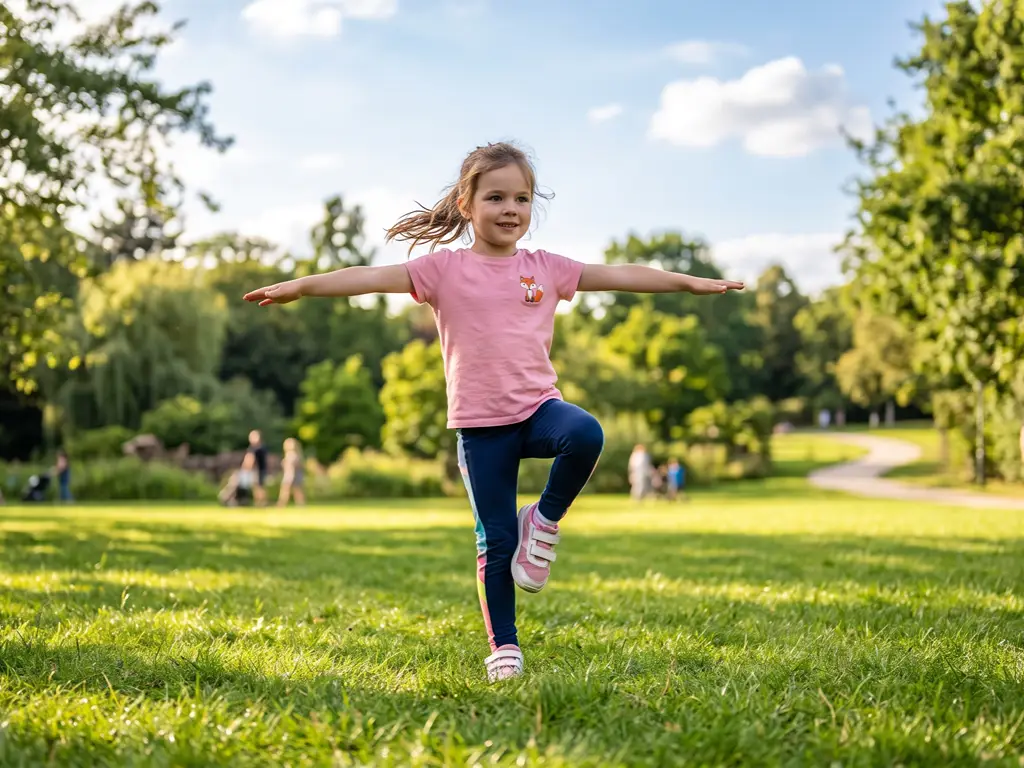
Your child wobbles when putting on socks. They trip over nothing on a flat sidewalk. Their teacher mentions they struggle to sit still during circle time. Every parent hits moments like these, and the good news is that balance responds fast to the right kind of play. You don’t need a gym, a therapist, or expensive equipment. You need games your child actually wants to play.
Balance for kids isn’t just about not falling over. It’s the hidden operating system behind almost everything your child does: sitting at a desk, tracking words across a page, kicking a ball, even holding a pencil steady. Balance improves quickly with consistent, playful practice.
This guide covers the best balance games for kids, along with targeted balance activities and coordination exercises that turn movement practice into something your child will ask to do again. Every idea is sorted by age, requires minimal setup, and works indoors or out.
Why Balance Is a Superpower for Growing Kids
Think of balance like a smartphone’s operating system. You never see it, but every app (running, jumping, reading, writing, sitting still) depends on it. When the OS is solid, everything runs smoothly. When it’s glitchy, even simple tasks feel hard.
Behind the scenes, three systems work together to keep your child upright and coordinated:
- The vestibular system. Tiny fluid-filled canals in the inner ear act like a built-in spirit level, telling the brain which way is up and how fast the body is moving. This system develops most rapidly before age 5.
- Proprioception. Sensors in muscles and joints tell the brain where each body part is, even with eyes closed. It’s how your child can touch their nose in the dark.
- Vision. The eyes confirm what the other two systems are sensing, creating a complete picture of the body in space.
When these three systems talk to each other smoothly, a child can sit cross-legged on a classroom rug without slumping, track words left to right without losing their place, and run across a playground without tripping. When they don’t, the brain spends so much energy just keeping the body stable that there’s less capacity left for learning.
Research backs this up. A 2025 randomized controlled trial of 66 preschool children aged 4–6 found that just four weeks of structured balance training significantly improved emotional control, working memory, and planning skills, with effects persisting at an eight-week follow-up (Chounchay et al., Archives of Allied Health Sciences, 2025).
Modern childhood stacks the deck against balance development. Screens keep kids still. Strollers replace walking. Padded playgrounds reduce the natural feedback that teaches bodies how to recover from a wobble. The fix isn’t complicated. It’s more movement, disguised as play.
What Balance Looks Like at Every Age
Before diving into games, let’s get oriented. Here’s what balance development typically looks like from toddlerhood through elementary school. Every child moves at their own pace. This table is a compass, not a stopwatch.
| Age | Static Balance (holding still) | Dynamic Balance (moving) | When to Check In |
|---|---|---|---|
| 1–2 years | Stands independently, squats to pick up toys | Walks, begins to run stiffly, climbs onto furniture | Not walking by 18 months |
| 2–3 years | Momentary single-leg balance (1–2 seconds) | Runs smoothly, kicks a ball, jumps with both feet leaving the ground | Cannot jump with both feet by 2.5 years |
| 3–4 years | Stands on one foot 2–5 seconds | Walks heel-to-toe on a line, hops on one foot, pedals a tricycle | Cannot stand on one foot briefly by age 4 |
| 4–5 years | Stands on one foot 5–8 seconds | Skips (may be uncoordinated), rides a bike with training wheels, catches a bounced ball | Frequently trips or falls compared to peers |
| 5–7 years | Stands on one foot 10+ seconds, eyes-open | Skips smoothly, jumps rope, swims, climbs playground equipment independently | Avoids physical play, fatigues quickly |
| 7+ years | Eyes-closed single-leg balance 5+ seconds | Complex sports skills emerge (soccer dribbling, gymnastics, martial arts) | Poor handwriting + clumsy movement together |
Sources: CDC “Learn the Signs. Act Early.” milestones; American Academy of Pediatrics.
If your child is a few months behind a milestone, it’s almost certainly fine. If they’re a year behind, or if you notice them actively avoiding activities their peers enjoy, a conversation with your pediatrician is worth having. Early support makes a big difference.
Fun Balance Games Kids Actually Want to Play
This is what you came for: the games. A great balance activity makes the child forget they’re practicing. These five categories of balancing games for kids cover different energy levels, spaces, and ages. Each includes classroom adaptation tips for teachers.
How to pick the right game: Match the challenge to your child’s current ability. Hard enough to be interesting, easy enough to avoid frustration. The best sign a game is working? Your child asks to play it again.
Beanbag Balance Games
Beanbag games are the perfect entry point. Almost zero setup, near-zero frustration, and surprisingly effective. All you need is a small beanbag (or a sock filled with rice, tied shut).
Three levels to try:
- Head carry walk. Balance the beanbag on top of your head and walk across the room without letting it fall. Eyes forward, arms out like airplane wings. For younger kids (2–3), just making it five steps is a victory. For older kids (5+), try walking backward.
- Body pass. Walk while balancing the beanbag on one shoulder, then the other. Then try the back of one hand. This forces the body to make micro-adjustments, engaging the same stabilization muscles used in sports.
- Single-leg scoop. Place the beanbag on top of one foot. Lift that foot and try to grab the beanbag with the same hand, all while balancing on the other leg. This is surprisingly hard and excellent for older kids (6+).
Coaching cues that actually help: “Head up, eyes on something that doesn’t move, aeroplane arms.” The fixed gaze point is critical. It gives the vestibular system a stable reference.
Classroom tip: Give each child a beanbag. Call out challenges (“on your head… now on your shoulder… now walk three steps!”). Takes three minutes, works for 20 kids at once.
Animal Walk Adventures
Animal walks are the crowd favorite for ages 3–7. The imagination hook makes kids forget they’re doing core work. Each walk targets different muscle groups and balance systems.
| Animal Walk | How to Do It | What It Builds | Age Sweet Spot |
|---|---|---|---|
| Bear Walk | Hands and feet on floor, hips high, walk forward | Shoulder stability, core strength | 3–6 |
| Crab Walk | Sit, push up on hands and feet, belly facing ceiling, walk sideways | Core, bilateral coordination | 4–7 |
| Frog Jump | Deep squat, explode forward with both feet | Leg power, dynamic balance | 3–6 |
| Flamingo Stand | Stand on one leg, other foot against inner calf, arms out. Count aloud. | Static balance, focus | 2–7 |
| Penguin Waddle | Arms straight at sides, short quick steps on heels | Ankle stability, body control | 2–5 |
The Flamingo Stand deserves special attention: it’s the simplest balance metric in your toolkit. A 3-year-old might hold it for 3–5 seconds. A 5-year-old should reach 10 seconds. Once they can do it eyes-open, try eyes-closed. Removing visual input forces the vestibular system to work much harder.
Make it a story: “We’re explorers crossing the animal kingdom! First, through Bear Forest (bear walk down the hallway). Then across Crab Beach (crab walk sideways). Now through Frog Swamp (five big frog jumps). Finally, the Flamingo Islands. Freeze on one leg and count to ten!”
Classroom tip: Line up animal walks as a relay. Five stations, 30 seconds each, kids rotate. Total time: 3 minutes for a full class brain break.
Balance Beam and Tightrope Games
The classic. From a strip of masking tape on the floor to a low curb outside, the balance beam is endlessly adaptable.
Three difficulty levels:
- Level 1: Tape Line. Run a 3-meter strip of masking tape (3–5 cm wide) across the floor. Walk heel-to-toe with arms out. Master this before attempting anything else.
- Level 2: Add Complexity. Curve the tape into a zigzag or wavy line. Walk it backward. Walk it on tiptoes. Walk it sideways. Add a beanbag on the head. Each variation challenges the balance system in a slightly different way.
- Level 3: Elevate It. A low wooden beam, a sturdy plank on the grass, or a sidewalk curb. Even 5 cm of height changes the perceived risk, and the body responds by recruiting more stabilizing muscles.
The heel-to-toe walk (tandem walk) is a key developmental marker at ages 3–4. If your preschooler can walk a straight line placing one foot directly in front of the other without stepping off, their balance development is on track.
Classroom tip: Lay multiple parallel tape lines (one per 4–5 kids). Everyone walks simultaneously. Fast, efficient, no waiting in line.
Freeze and Stop Games
These combine dynamic balance with impulse control. Two skills for the price of one. They’re also the easiest games to play with zero preparation.
Musical Statues (Freeze Dance). Play music. Kids dance (the wilder, the better). When the music stops, everyone must freeze in a balance pose: one leg up, arms out, or a star pose. Hold 3–5 seconds. Anyone who wobbles or falls does three jumping jacks and rejoins. For younger kids, don’t eliminate. Just celebrate the best freezes.
Traffic Lights. Call out commands: “Green!” (run), “Yellow!” (walk in slow motion, excellent for body control), “Red!” (freeze on one foot). The transition from full movement to stillness is the training stimulus. Vary the sequence to keep kids guessing.
Slow-Motion Race. Here’s the twist: the last person to reach the finish line wins. Moving in extreme slow motion demands extraordinary body control. Every micro-movement must be deliberate. Kids find this hilarious and they’ll beg to play again.
These games don’t just build balance. They build inhibitory control, a core component of executive function that predicts academic success better than IQ scores in early childhood.
Classroom tip: Musical Statues is arguably the most efficient classroom movement break. Twenty kids, three minutes, zero equipment. Done daily, the cumulative effect is real.
Stepping Stone and Pillow Path Games
These transform your living room into an adventure course. The concept: place “safe spots” across the floor that children must navigate without touching the “danger zone” (the floor).
Three setups:
- Cushion path. Line up sofa cushions with gaps between them. Start with 15–20 cm gaps. As your child improves, increase to 25–30 cm or more. They must step from cushion to cushion without touching the floor. The unstable surface of the cushion adds an extra balance challenge.
- Paper plate islands. Scatter paper plates across the floor. The child must hop, jump, or step from plate to plate without touching the “water” (floor) between them. You can call out specific plates (“jump to the blue one!”) to add cognitive load.
- Advanced: cup carry. Once they’ve mastered the path, hand them a cup half-filled with water. The goal: reach the end without spilling. This shifts focus from “don’t fall” to “don’t spill,” which paradoxically improves balance by making it subconscious.
Safety note: Always place cushions on a non-slip surface. On hardwood or tile, a yoga mat under each cushion prevents sliding.
Classroom tip: Paper plate islands are perfect for rainy-day indoor PE. Scatter 30 plates across the floor. Kids navigate in pairs, timing each other.
Balance Activities & Exercises for Targeted Practice
Games are for fun. Exercises are for focused improvement. The best approach combines both: structured exercises disguised as challenges. These balance activities for kids and balance exercises for kids are for the days when you want to spend 5–10 minutes on intentional practice.
Why add exercises to games? Some balance skills (single-leg stability, core endurance) require repetition to build muscle memory. Games naturally resist repetition because kids get bored. Exercises, packaged as “daily challenges,” solve this.
No-Equipment DIY Balance Exercises
Zero budget, zero gear, any room. These five exercises form a complete at-home balance routine.
- Single-Leg Stand (Stork Stand). Stand on one foot, hands on hips, eyes forward. Time it. At age 3, 3–5 seconds is great. At 5, aim for 10+. Switch legs. The gap between right and left leg times is informative. A difference of more than 30% might indicate one side needs more work.
- Tandem Walk (Heel-to-Toe Line Walk). Walk in a straight line placing the heel of your front foot directly against the toes of your back foot with each step. Ten steps forward, ten steps back. This challenges dynamic balance far more than normal walking.
- Eyes-Closed Single-Leg Stand. Same as #1, but close your eyes. Removing vision forces the vestibular and proprioceptive systems to work without their usual visual crutch. Most 7-year-olds can only manage 2–3 seconds with eyes closed. It’s dramatically harder than it sounds.
- Slow-Motion High Knees. March in place, raising each knee to hip height, but in extreme slow motion. Count “one… two… three… four…” as each foot rises and lowers. This builds the core control needed for smooth walking and running transitions.
- Sock-On-One-Foot Challenge. Stand on one leg. Using only that leg for support (don’t lean on anything), put a sock on the other foot. Then switch. This combines single-leg balance with a real-world functional task. Harder than it sounds.
How to use these: Pick two exercises per day. Do them for 5 minutes total. Rotate through all five over a week. Short daily practice beats one long weekly session. The research on motor skill acquisition calls this the “distributed practice effect,” and it’s one of the most robust findings in the field.
Classroom tip: Start each PE session with a 2-minute “balance challenge.” Kids track their own times and try to beat last week’s record. Self-competition, not peer comparison.
Yoga-Inspired Balance Poses for Kids
Yoga poses are the quiet side of balance training. Perfect for transitions, winding down, or days when the energy in the room needs to come down a notch.
Four child-friendly poses:
- Tree Pose. Stand on one leg. Place the sole of the other foot against the inner calf (never the knee joint). Hands together at the chest, then reach overhead like branches. For beginners, keep the toes of the lifted foot touching the floor as a “kickstand.” Sway gently. “The wind is blowing but the tree stays rooted.”
- Airplane Pose. Stand on one leg. Tilt the upper body forward while extending the other leg straight back. Arms out like wings. Hold for 5 counts, then switch legs. This is Warrior III simplified for young bodies.
- Eagle Pose (Kid Version). Cross one arm over the other at the elbows, bending to touch palms if possible. Cross one leg over the other at the thigh, balancing on the standing foot. It looks tangled and kids love it.
- Downward Dog with Leg Lift. From downward dog (hands and feet on floor, hips high, body in an inverted V), lift one leg toward the ceiling. Hold for 5 seconds. Switch. This builds upper body and core stability alongside balance.
Each pose takes 30 seconds to demonstrate and a minute to practice. A full “yoga break” of all four poses takes under 5 minutes.
Classroom tip: Morning circle yoga. Three minutes, four poses, done as a group. It establishes a calm rhythm for the day and gives every child a physical reset before academic work begins.
Obstacle Course Ideas for Home and Classroom
An obstacle course is the ultimate integration tool. It combines balance, coordination, strength, and planning into a single activity that feels like an adventure.
Living Room Course (5-minute setup, ages 3–7):
| Station | What to Do | Equipment |
|---|---|---|
| 1. Cushion Jump | Jump from cushion to cushion (3–4 cushions) | Sofa cushions |
| 2. Tape Line Walk | Heel-to-toe across a tape line | Masking tape (3m) |
| 3. Tunnel Crawl | Crawl under a table or through a cardboard box | Dining table or large box |
| 4. Sock Toss | Stand on one foot, toss rolled socks into a laundry basket | 5 rolled socks + basket |
| 5. Finish Freeze | Reach the end and hold a Flamingo Stand for 10 seconds | Nothing |
Classroom Circuit (15-minute PE session, ages 4–8):
| Station | Activity | Time |
|---|---|---|
| Cones | Weave through 5 cones without knocking them | 1 min |
| Beam | Walk across a low balance beam or tape line | 1 min |
| Hoops | Two-foot jump through 3 hula hoops laid flat | 1 min |
| Crawl | Bear-crawl under a low table or through a play tunnel | 1 min |
| Target | Stand on one foot, throw 3 beanbags into a bucket | 1 min |
Design principle: Alternate between dynamic stations (jump, crawl) and control stations (walk, balance, throw). This prevents fatigue and keeps each station’s training quality high.
Classroom tip: Set up 5–6 stations around the perimeter. Split the class into groups of 4–5. Rotate every 90 seconds. Every child is active for the full 10–15 minutes.
Coordination Exercises That Make Balance Even Better
Balance and coordination are two sides of the same coin. Balance keeps you upright. Coordination lets you move with precision. Train them together, and each accelerates the other’s development. This section covers coordination exercises for kids and coordination activities for kids that complement the balance work above.
The connection: Every time your child stands on one foot to kick a ball, they’re doing two things at once: balance (stay upright) and coordination (aim and execute the kick). Isolating one from the other is artificial. The best training integrates both.
Hand-Eye Coordination Activities
Hand-eye coordination matters for balance because throwing, catching, and reaching all require core stabilization in the moment of action.
- Balloon Tap Challenge. Sit or stand on an unstable surface: a couch cushion, a pillow, or a folded yoga mat. Tap a balloon into the air and keep it up while maintaining balance. The unstable surface forces constant micro-adjustments, turning a simple balloon game into a full-body coordination drill. Balloons are ideal for beginners because they fall slowly, giving young children enough processing time.
- Single-Leg Beanbag Toss. Stand on one foot. With the hand on the same side, toss a beanbag into a bucket 1–2 meters away. Do 5 tosses, then switch legs. This combines static balance with a precision motor task. Exactly the kind of dual-task challenge that lights up developing brains.
- Ball Bounce and Catch Progression. Start sitting (easiest), progress to standing, then progress to standing on one foot (hardest). Use a tennis ball or similarly bouncy ball. Count how many consecutive catches you can make at each level. This progression naturally builds the core stability needed for sport participation.
Foot-Eye Coordination Drills
Foot-eye coordination is balance’s closest relative. Every kick, every hop, every step onto a target requires the eyes to guide the feet while the body stabilizes.
- Kick-and-Freeze. Kick a soft ball across the room, run after it, and stop it cleanly with one foot. Then freeze balanced on that foot for 3 seconds. The transition from running to stopping to single-leg balance is the training gold here.
- Numbered Hoop Hop. Place 5–6 paper plates or hoops on the floor, each with a number. Call out a sequence (“3… 1… 5… 2!”) and have the child hop from one to the next on a single foot, switching feet at each call. This layers cognitive processing (remember the sequence) onto physical execution. Dual-task training at its simplest.
- Foot Roll Maze. Place a small ball (tennis ball size) on the floor. Using only the sole of one foot, roll the ball around obstacles: chair legs, toy blocks, whatever’s handy. The supporting leg is doing a sustained single-leg balance the entire time.
For children under 6, use a size 2 or 3 soccer ball. Smaller balls require more precise foot control but are lighter and easier to manage than full-size balls.
Bilateral Coordination and Crossing the Midline
This is coordination at the highest level: getting both sides of the body to work together, and specifically getting the right side to cross over to the left side’s territory (and vice versa). These abilities directly support reading (eyes tracking left to right across the page), writing (one hand stabilizing the paper while the other writes), and complex sports movements.
The “midline” is an imaginary vertical line dividing the body into left and right halves. Crossing it (reaching your right hand to your left shoulder, for example) requires the two hemispheres of the brain to communicate through a bridge of nerve fibers called the corpus callosum. This bridge thickens and strengthens steadily between ages 4 and 11, and MRI studies show visible growth in the posterior corpus callosum during precisely this window (Kurth et al., NeuroImage, 2016).
Activities that build crossing-the-midline skills:
- Cross Crawl (Cross-Lateral March). Stand tall. Lift your right knee and touch it with your left hand. Then left knee to right hand. Continue alternating, slow and controlled. This is the single highest-value coordination drill. It engages both hemispheres, builds core stability, and requires midline crossing with every repetition. Aim for 20 cross crawls.
- Figure-8 Tracking. Hold a small object (beanbag, ball) in one hand. Draw a giant sideways figure-8 (infinity symbol) in the air, crossing the midline with each loop. After 10 loops, switch hands. The eyes track the object across the midline, supporting the visual tracking skills needed for reading.
- Opposite-Hand Beanbag Pass. Sit or stand with a bucket on your left side. Use your right hand to pick up beanbags from the bucket, one at a time, and pass them to a container on your right side. The right hand crossing to the left side to retrieve is a deliberate midline crossing.
- Crab Walk with Toe Touch. Do a crab walk, but every third step, reach your right hand to touch your left foot (and vice versa). This adds an explicit midline-crossing element to an already coordination-rich movement.
Signs your child might struggle with midline crossing: They switch hands mid-task (color with left hand on the left side of the paper, then switch to right hand for the right side). They rotate their whole body to pick up objects instead of reaching across. They have difficulty with jumping jacks because arms and legs won’t coordinate. None of these are alarming in isolation, but a pattern across multiple activities is worth mentioning to an occupational therapist.
Tools and Toys That Support Balance Development
Nothing in this section is necessary. The best balance training tool is a creative adult and a bit of floor space. But if you’re looking to add variety, make an informed choice. This is a category guide to help you understand what each type of equipment does, what to look for when buying, and how to get similar benefits without spending anything.
| Equipment Type | What It Trains | Best Age | Key Buying Check | DIY Alternative |
|---|---|---|---|---|
| Balance Board / Wobble Board | Ankle stability, core engagement | 3+ | Non-slip surface, weight limit clearly marked | A sturdy wooden board placed over a rolled towel |
| Stepping Stones / River Stones | Dynamic balance, spatial judgment, leg strength | 2–7 | Rubber/silicone anti-slip base (non-negotiable; smooth-bottom stones are a fall hazard) | Sofa cushions, paper plates, chalk circles on pavement |
| Balance Beam | Tandem walking, posture control, focus | 3+ | Rounded edges, stable base (won’t tip), low height for beginners | Masking tape line, sidewalk curb, a 2×4 plank on grass |
| Sensory Pods / Tactile Stepping Domes | Foot sensory feedback, balance on varied textures | 3–6 | Textured surface, varied heights, stackable for storage | Walk barefoot on grass, sand, pebbles. Nature provides sensory variety for free. |
| Hop-Along / Jumping Sack | Bilateral coordination, leg power, dynamic balance | 3–7 | Sturdy handles, breathable material, size-appropriate | An old pillowcase works for younger kids |
Making Balance Practice Part of Everyday Life
You don’t need a dedicated “balance training session.” You need balance to become a background habit, like brushing teeth. Here’s how to make it stick.
The 5-Minute Rule
Research on motor learning consistently finds that distributed practice (short, frequent sessions) outperforms massed practice (long, infrequent sessions). Five minutes a day beats 30 minutes once a week. Here are three natural 5-minute windows:
- While dinner cooks. Tape line on the kitchen floor makes an instant balance station. Kids walk it, hop it, try it backward while you stir the pot.
- After tooth-brushing. Two minutes of yoga poses before bed. Tree pose, airplane pose, downward dog. It signals “day is ending” while quietly building balance.
- Commercial-break challenge. “How long can you Flamingo Stand? I’m timing you!” One TV ad break equals one balance burst.
Embed Balance Into Existing Routines
The easiest habit to keep is the one that rides on an existing habit. Try these:
- Sock challenge. Put socks on while standing on one foot. No leaning on furniture. It adds 30 seconds of daily balance training with zero extra time.
- Curb walking. On the walk to school or the park, every low wall and wide curb becomes a balance beam. Hold their hand, let them walk it. This is how balance was trained for most of human history: through everyday movement, not structured sessions.
- Floor sitting. Sitting cross-legged on the floor engages core muscles that chair-sitting doesn’t. During screen time, encourage floor sitting instead of couch slouching. Bonus: changing positions (cross-legged to kneeling to long-sitting) provides proprioceptive input.
From Play to Progress
You don’t need to track anything. But if your child is motivated by visible progress, here’s a simple system: pick one benchmark (Flamingo Stand time, number of tandem walk steps, or obstacle course completion time). Test it once at the beginning of the month and once at the end. Write both numbers on the fridge. When the month-end number is bigger, it’s a celebration.
If you’re exploring balance training equipment, look for products backed by recognized safety certifications. CPC, CE, and ASTM F963 are the standards that matter for children’s products. Startinal, a manufacturer specializing in educational play equipment, meets these certification requirements and offers a range of balance stones, boards, and sensory tools designed for home and classroom use. You can learn more about their safety standards or get in touch with their team.
Find Balance Equipment You Can Trust
CPC, CE, and ASTM-certified products. 60+ global patents. Ships in 1–7 days.
Browse the CatalogReferences
- Chounchay, S., Assapun, J., Ngowtrakul, B., and Saenphan, W. “Effects of a 4-Week Balance Training Program on Executive Function in Preschool Children: A Randomized Controlled Trial.” Archives of Allied Health Sciences, vol. 37, no. 3, 2025, pp. 103–117. tci-thaijo.org
- Centers for Disease Control and Prevention. “CDC’s Developmental Milestones.” cdc.gov
- Kurth, S., et al. “Selective Increase in Posterior Corpus Callosum Thickness between the Age of 4 and 11 Years.” NeuroImage, 2016. sciencedirect.com
- Bradshaw, J. L., et al. “Crossing the Midline by Four- to Eight-Year-Old Children.” Neuropsychologia, vol. 26, no. 2, 1988, pp. 221–235. pubmed.ncbi.nlm.nih.gov
- Ltifi, M. A., Cherni, Y., Panaet, E. A., et al. “Mini-Trampoline Training Enhances Executive Functions and Motor Skills in Preschoolers.” Children, vol. 12, no. 10, 2025, article 1405. doi.org