.png)
What Sensory Play Actually Means (and What It Doesn’t)
If you have spent any time around parenting content lately, you have seen the phrase. Sensory bins, sensory mats, sensory rooms. It can sound like another thing to buy and another thing to feel guilty about skipping.
Strip away the marketing and the definition is plain: sensory play is any activity that lets a child’s senses do the work. Squishing dough. Pouring rice between cups. Climbing something wobbly. Listening to music in the dark.(Cleveland Clinic, 2022) No product is required. The kitchen drawer already contains half a sensory curriculum.
One clarification before anything else, because it matters later in this article. Sensory play is a daily activity. Sensory integration therapy is a clinical treatment delivered by trained therapists. They share a theory, not a job description. Everything below is about the everyday kind, and one section will tell you when the everyday kind is not enough.
Here is the frame that makes the rest of this article useful: the benefits do not come from “activity” in general. They come from the type of input an activity feeds. Touching things feeds the tactile system. Balancing and spinning feed the vestibular system. Jumping, lifting and squeezing feed the proprioceptive system. Three inputs, three different benefit profiles, three different kinds of trouble when you get the match wrong.
That is the map. The rest of this article walks it, one input at a time, from your living room to a classroom to a therapy space.

Tactile Play: Where Families Start (and Where It Stops Working)
Most families start here, and it is the right place to start. Tactile play is the easiest to set up, the cheapest to run, and the input babies accept earliest.
The benefits are the ones every listicle repeats, so this will be quick. New sensory experiences help a young brain build nerve connections that support more complex learning later(Cleveland Clinic, 2022). Pinching, pouring and gripping build the fine motor control that later holds a pencil. Describing textures out loud (“this one is bumpy, that one is cold”) turns play into the language-dense conversation that vocabulary grows on. And simple cause-and-effect experiments, like what sinks and what floats, are a toddler’s first scientific method.
What the lists usually skip is the age gradient. The same bin of dried beans means different things at different months.
Tactile play by age: what to offer and what to watch
| Age | What to offer | What to watch for |
|---|---|---|
| 0–12 months | high-contrast fabrics, water play with your hands under theirs, taste-safe materials only — everything still goes in the mouth | watch: does the baby calm or stiffen with new textures? |
| 1–2 years | pouring, scooping, squishing dough, tearing paper | watch: tolerance grows through repetition, never through force |
| 2–4 years | tools added (tongs, tweezers, funnels), mixing materials like sand and water | watch: whether the child explores with tools before hands — that is a healthy path, not avoidance |
| 4–6 years | multi-step recipes like slime and oobleck, games with rules | watch: fine motor precision and the ability to describe what they feel |
That last column matters more than it looks, because it leads to the boundary almost nobody mentions.
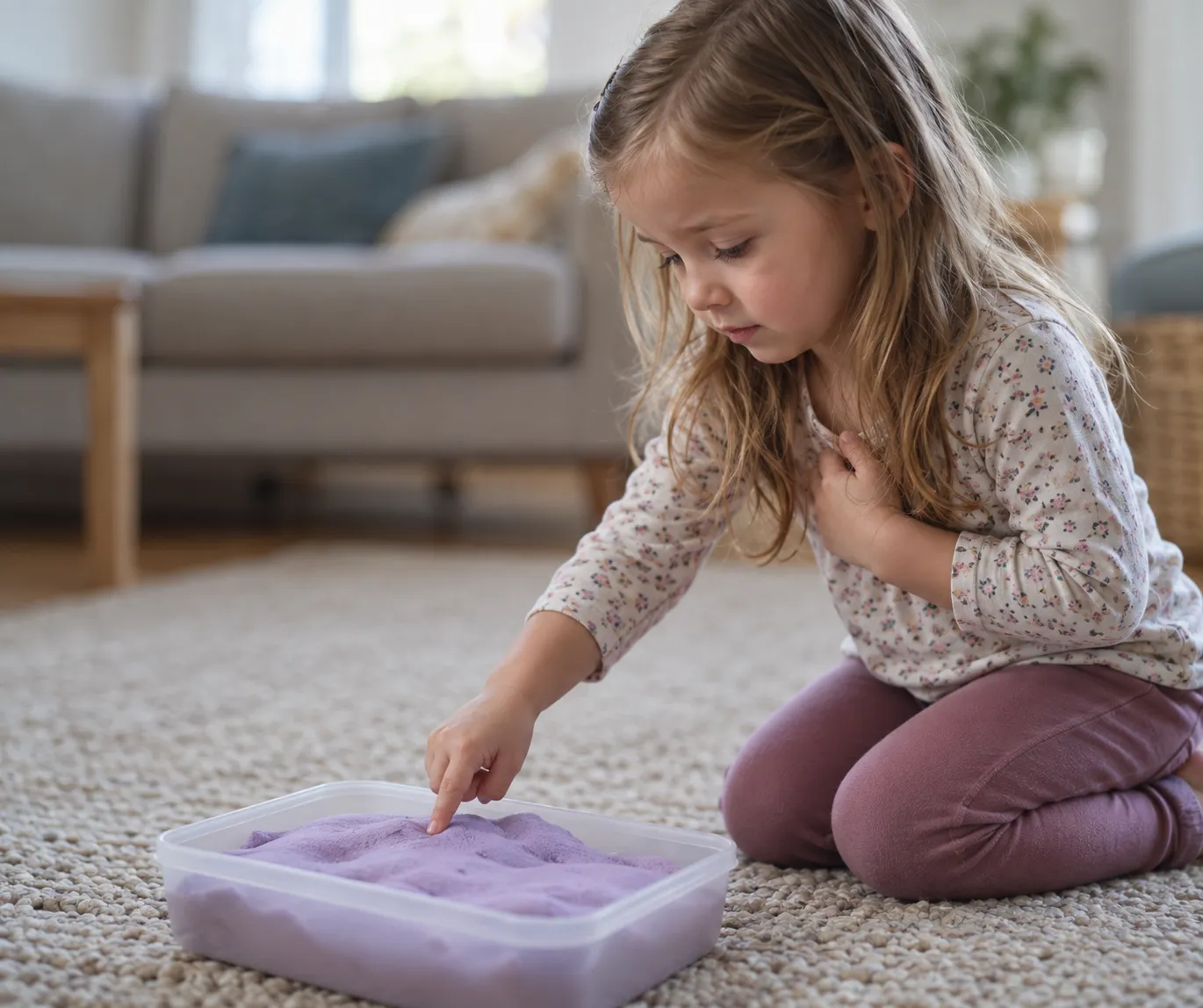
Some children are tactile avoiders. Textures that feel normal to you register as threat to them. The squishy dough the internet swears by can genuinely upset them. If you have ever watched a daycare treat a child’s reluctance to touch wet things as bad attitude, you have seen the failure mode in action.(Parenting, 2023) Forcing contact does not build tolerance. It builds fear memories, and it teaches the child that their own alarm signals are shameful.
The fix costs nothing. Watch which distance the child chooses with a new material: looking, poking with a tool, or one finger. Start from that distance and let it shrink on its own schedule. A child who explores slime with tweezers for three weeks is doing tactile play. The hand goes in when the hand wants to.
Vestibular Play: Movement, Balance, and Benefits That Depend on Progression
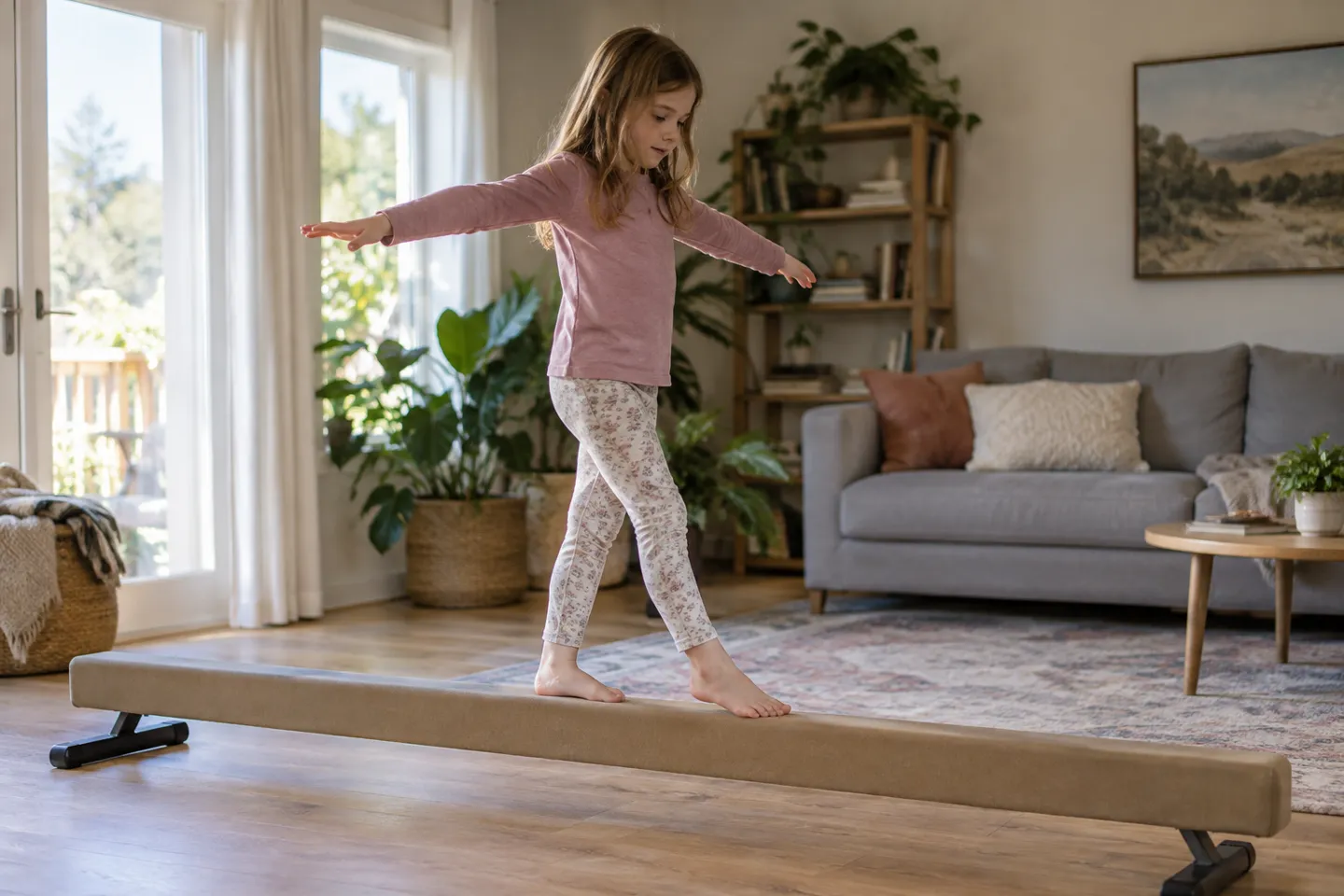
Step into any preschool that takes movement seriously and you will find the vestibular zone: stepping stones on the floor, a balance beam an inch off the ground, a spinning chair in the corner. Teachers put them there because vestibular input, the sense of balance and motion in the inner ear, is what the whole body learns from.
What vestibular input actually trains
The training list is longer than “balance”. Steady vestibular input builds postural control, the endurance to sit upright and pay attention. It builds spatial orientation, the sense of where your body is in space that later powers reading and handwriting. It builds bilateral coordination, both sides of the body doing different jobs in agreement. And when the equipment becomes a group challenge, say a pair of team-walking boards that only move if two children agree on a rhythm, it quietly rehearses negotiation, turn-taking and cooperation. Social skills rarely come from a lecture. They come from activities that physically cannot work alone.
The age-by-age progression most lists skip
Vestibular play goes wrong most often through the wrong difficulty, not the wrong activity. A three-year-old on equipment meant for a six-year-old is not being challenged. They are being scared, or worse.
Vestibular progression: difficulty should climb like a staircase, not a cliff
| Age | Appropriate challenge | Equipment that fits |
|---|---|---|
| 1–2 years | supported stepping, low crawling routes | floor-level paths, firm low platforms, tunnels |
| 2–3 years | static balance close to the ground | flat balance stones and boards with non-slip bases, walking lines |
| 3–4 years | added height and direction changes | low stepping-stone sets of varied heights, gentle wobble boards |
| 4–6 years | combining moves into routes with rules | stone circuits, balance beams, team walkers, controlled spinning games |
The pattern to notice: the ground gets further away and the rules get stricter at the same time. Height without structure is just risk.
Overstimulation: the boundary nobody mentions
Vestibular input is the one sensory diet with a real overdose. Too much spinning or swinging tips a child from regulated to dysregulated in minutes, and the signs are observable if you know to look: color draining from the face, sudden clumsiness after the movement stops, emotional reversal, a child who was laughing and is now crying without an obvious cause.
Three signs to stop a vestibular activity now:
1) Facial color change or glazed eyes. 2) Stumbling or reaching for support after the movement ends. 3) Mood flip that follows the movement, not an event.
Offer water and a quiet, still activity next — the system needs time to re-settle, not a lecture.
None of this makes vestibular play dangerous. It makes it dose-dependent. Check that the base of any balance equipment genuinely grips the floor, place a soft landing zone near anything with height, and cap spinning sessions by time and observation rather than by a fixed rule. The child’s face is the gauge.
Proprioceptive Play and the Seeking–Avoiding Split: Same Toy, Opposite Effect
The third input is the least famous and possibly the most useful. Proprioception is the body’s sense of itself through muscle and joint feedback: the input you get from jumping, crashing into cushions, carrying heavy things and squeezing into tight spaces. Where vestibular play is about motion, proprioceptive play is about force.
Why heavy work calms the nervous system
Here is the mechanism behind every “calming benefits” claim you have read. Heavy muscle work feeds the deep-pressure receptors in muscles and joints, and that input helps an aroused nervous system downshift. This is why a child who spends twenty minutes hauling cushions or doing bear crawls often comes out of it quieter, not wilder. It is why weighted blankets exist. Jumping bags, crash pads, weighted bean bags and climbing shapes are all delivery systems for the same signal: your body is here, and it is strong.

For a classroom, this is the practical answer to the wiggly-afternoon problem. Before you reach for a consequence, reach for heavy work: carry the chairs, push the wall, do ten animal walks. The benefit profile, better emotional regulation and body awareness, shows up in the clinical literature too — a 2024 meta-analysis of 24 studies found sensory integration therapy effective for children with cerebral palsy, autism spectrum disorder, ADHD and related diagnoses, with gains in social skills, adaptive behavior, sensory processing and both fine and gross motor skills(Oh et al., PMC, 2024). Note the word therapy, though. That evidence belongs to structured clinical treatment, which is exactly why the boundary below exists.
Seeking, avoiding, or typical: read the child first
Now the split that changes how you see almost every piece of sensory equipment.
The same balance stone can be a sedative or a startle. For a sensory seeking child, the one who is always climbing and crashing, a jumping bag or a rocking surface feeds a system that is undernourished and asking loudly. Early-intervention teams have a term for these toddlers: proprioceptive seekers. For a sensory avoiding child, the same equipment at the same intensity is an alarm, and being pushed onto it teaches them that play is a place where their boundaries get ignored.
Read the child before you choose the input
| Profile | What you see | What the child needs | What to avoid |
|---|---|---|---|
| Sensory seeking | constant climbing, crashing, chewing, “fearless” movement | legitimately heavy proprioceptive work as an everyday outlet, built into the routine | labeling it misbehavior, or offering only gentle activities and calling it a day |
| Sensory avoiding | resists textures, touch, movement surprises | gradual, self-paced exposure with the child controlling the intensity | forcing contact “to get used to it” |
| Typical development | enjoys variety, recovers quickly | rotating mix of all three inputs through ordinary play | any special protocol — ordinary play is the protocol |
One stone, two children, opposite effects. That is the single fact worth remembering from this entire article, because it kills the myth of the universally “good sensory toy”. Good is not a property of the object. It is a property of the match.
The one-sentence takeaway
One stone, two children, opposite effects.
Good is not a property of the object. It is a property of the match.
When sensory play isn’t enough
Sensory play is a developmental tool, not a treatment, and pretending otherwise delays real help. The red lines are concrete, not fuzzy: when sensory reactions interfere with eating, sleep or participation in daily life; when seeking or avoiding is clearly beyond the range of same-age peers; when the behavior puts the child or others at risk of injury. Those are evaluation signals, and evaluation is a different doorway from a better activity list.
Three signals it is time for a professional evaluation, not another activity:
1) Sensory reactions disrupt eating, sleep, or daily participation. 2) Seeking or avoiding is markedly stronger than in same-age peers. 3) Play routinely crosses into injury risk.
Start with a pediatrician or an occupational therapist — the earlier the referral, the shorter the detour.
Within those boundaries, the everyday stuff works. A household does not need a clinic. It needs the right input, at the right intensity, for the child actually in front of you.
From Activities to Equipment: What Makes the Benefits Real
Everything above has a hidden dependency that market pages prefer you not to notice. The benefits described depend on the activity being survivable, repeatable and safely challenging. That depends on equipment.
“Balance benefits” only exist if the stones do not slide. Calming benefits only exist if a weighted item states its load honestly. The promise is only as good as the material, the grip, the load rating and the paperwork behind it. So before money changes hands, this is what “real” looks like in the three places the equipment lives.
Acceptance conditions by setting: what the same “sensory benefit” requires in each environment
| Setting | Primary input needs | Typical equipment | Acceptance conditions to verify | Where it fails |
|---|---|---|---|---|
| Home | tactile and entry-level vestibular, self-paced | tactile kits, floor-level stones, small boards | food-grade materials with no chemical smell, non-slip base, easy to store | fails when home-grade items get institution-level daily use — foam tears, bases wear smooth |
| Classroom | full input range, group rotation, many users per day | stone circuits, beams, team walkers, spinning chairs | certified compliance files (EN71 / ASTM F963 / CPC / CE), rounded edges, load ratings above the heaviest user in the age group, wipe-clean surfaces | fails when certification is claimed but files are not produced, or when difficulty tiers don’t match the age groups actually enrolled |
| Therapy space | adjustable intensity, clinical durability, precise dosing | weighted items, spinning and rocking equipment, tactile paths | clearly labeled load and age limits, adjustable intensity, certification files, parts that survive disinfection | fails when intensity cannot be dosed — “more” is not a therapy parameter |
Three habits close the gap between a nice catalog and equipment that delivers. First, ask for the certificate files themselves: CE, CPC, ASTM F963 and EN71. Treat a certificate you have not seen as a certificate you do not have. Second, test the two failure points with your hands: the base that should grip, and the surface that should survive a wipe-down. Third, match the difficulty tier to your youngest user, not your average one. Deployment extras round out the picture, such as storage and tables for a sensory corner, or rotomolded pieces if the program extends outdoors, but they are logistics, not inputs.
The pattern across all three settings is the same and worth saying plainly: the boring specifications are where the benefits live. The claim on the box is free; the anti-slip base and the compliance file are not.
If that list is about to become your purchasing checklist, Startinal’s team will send the certificate files before you ask.
Start the sourcing conversationThe Buyer’s Lens: Grouping Sensory Play by Input Type, Not by Toy Category
If you buy for a store, a distributorship or a school chain, the previous sections double as a market map. The parents in section two, the teachers in section three and the therapists in section four are your downstream customers, and they are getting more literate every year. They now arrive knowing whether they need tactile entry items or vestibular workhorses, and they increasingly check for the paperwork before they check the price.
The market behind them is growing on both sides of the ledger. Sensory toys, as a defined category, were valued at USD 1.20 billion in 2024 and are projected to reach USD 2.50 billion by 2032, a 9.6% CAGR(Verified Market Research, 2026). The adjacent special-needs toys market, where sensory toys are the largest revenue segment, was put at USD 3.84 billion in 2024 heading to USD 8.23 billion by 2033 at an 8.9% CAGR(Special Needs Toys Market report via openPR, 2026). Treat both numbers as report estimates rather than measurements; firms in this space differ by billions depending on where they draw category lines. The direction, though, is consistent across reports, and the driver is structural: diagnosis rates and therapeutic adoption keep expanding the base.
Sensory toys category
9.6% CAGR
USD 1.20B (2024) USD 2.50B (2032)
Verified Market Research
Special-needs toys — sensory = largest segment
8.9% CAGR
USD 3.84B (2024) USD 8.23B (2033)
report via openPR
Against that backdrop, here is the buying position this article has been building toward: stock the category by input type, not by “toy”.
Tactile lines are your traffic. Low unit cost, endless color and theme rotations, impulse-friendly. They earn their place at the front of the catalog. Vestibular and proprioceptive lines are your margin and your loyalty. A stepping-stone set or a spinning chair costs more to make well, with real load ratings, real grip and real certification. That is precisely why it holds price and why the kitchen drawer cannot substitute for it. And because sections three and four showed that the same product serves different children differently, the sellable question shifts from “is this toy good” to “which input does it feed, and for which child”. Your listings can answer that question. A generic catalog cannot.
Three lines, three jobs in your catalog
The traffic line
Entry price points, constant theme novelty, impulse placement at the front of the catalog.
The margin and loyalty line
Costs more to build well — load ratings, grip, certification — which is exactly why it holds price and the kitchen drawer cannot substitute.
Which input, for which child
Answer it in the listing itself; a generic catalog cannot.
The last implication is the least negotiable. Downstream buyers now verify what sections three to five taught them to verify: compliance files, grip, load labels, originality. So treat certifications, anti-slip design and patent documentation not as premium features but as the entry ticket, the point at which a supplier becomes listable at all. Sourcing goods that cannot show those papers in a category growing at these rates does not save margin. It converts growth into returns and takedowns, and hands the compounding segment to whoever brought the files.
Tender buyers complete the same map from the institution side. Public budgets score category completeness and product conformity ahead of price, because a tender rewards the range, not the single deal.
If you are weighing suppliers against that checklist: Startinal’s sensory play lines, from stepping stones and balance boards to tactile beams and spinning chairs, ship with verifiable CE, CPC and ASTM F963 documentation, plus the 60+ global patents that keep your listings safe(sensory play equipment catalog).
Bring certified sensory play lines into your catalog
Stepping stones, balance boards, spinning chairs and tactile lines, with verifiable CE, CPC and ASTM F963 documentation and 60+ global patents behind every listing.
References
- Cleveland Clinic. “What Is Sensory Play? The Benefits for Your Child and Sensory Play Ideas.” 2022. clevelandclinic.org
- Oh S., et al. “Effectiveness of Sensory Integration Therapy in Children, Focusing on Korean Children: A Systematic Review and Meta-Analysis.” 2024. ncbi.nlm.nih.gov
- Verified Market Research. “Sensory Toys Market Report: Size, Growth, Trends & Forecast (2025–2033).” 2026. verifiedmarketresearch.com
- OpenPR. “Special Needs Toys Market Size Propelled by 9.4% CAGR.” 2026. openpr.com
- Reddit, r/Parenting. “Why Is Playing With Squishy Things a Big Deal?” 2023. reddit.com