.png)
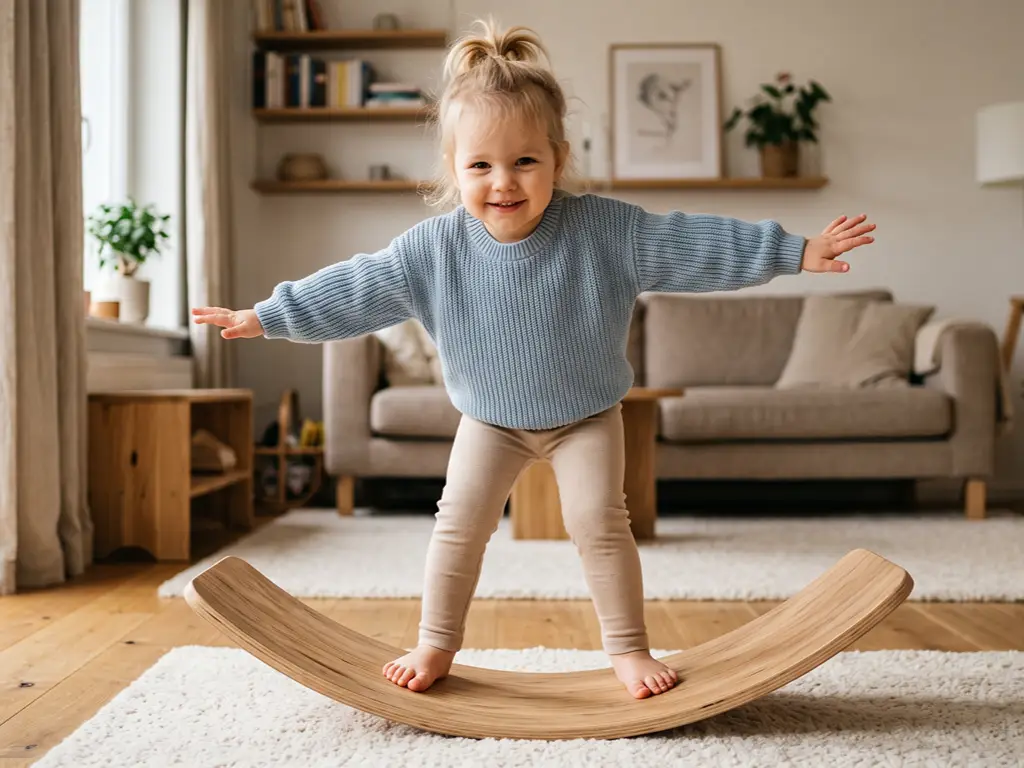
You’ve seen it before: your child walking along the edge of a curb, arms out like airplane wings, completely absorbed. Or spinning in circles until they collapse giggling. Kids are hardwired to seek out balance challenges. They’re not just playing; they’re building the neurological foundation for every physical skill they’ll ever learn.
A balance board takes that instinct and gives it a safe, indoor home. Behind the simple curved plank of wood is a surprisingly powerful developmental tool. Pediatric occupational therapists point to three systems that balance boards activate simultaneously: the vestibular sense (how the inner ear detects motion and head position), proprioception (the body’s awareness of where its limbs are in space), and core muscle engagement (the trunk stability that underpins everything from handwriting to sitting still at a desk).
The World Health Organization recommends that children aged 3–4 get at least 180 minutes of total physical activity daily, with 60 of those minutes at moderate-to-vigorous intensity (WHO, 2020). For children 5–17, it’s a minimum of 60 minutes of moderate-to-vigorous activity every day. A balance board won’t replace outdoor play, but it fills a critical gap: the rainy afternoon, the winter evening, the 10-minute burst between homework and dinner when a child needs to move.
But here’s the problem: not all balance boards are created equal. The market is flooded with options at prices ranging from $25 to $150, and price doesn’t always track quality. Choosing the wrong board means, at best, a dust-collecting corner ornament. At worst, a safety hazard. This guide will walk you through exactly what matters so you can make the right call the first time.
Types of Balance Boards — Which One Matches Your Child?
Before you compare brands or prices, answer two simple questions: how old is your child? and what kind of play are you hoping for? The answer to those two questions will point you to one of three main board types. You don’t need to understand every variation on the market — just the ones that matter for your situation.
Curved (Rocker) Boards — The Open-Ended Play Champion
Curved boards are what most parents picture when they search for a “balance board for kids.” They look like a wide wooden bridge arch: a single piece of curved plywood that rocks side to side, flips over to become a ramp or climbing slope, and doubles as a prop in imaginary play.
These boards earn their reputation honestly through versatility. In rocker mode, a child stands or sits and shifts their weight to create a gentle side-to-side motion. The effect is calming for some kids, energizing for others. Flipped upside down, the board becomes a bridge to crawl across, a slide for stuffed animals, or an obstacle in a living-room agility course. The open-ended design is why brands like Kinderfeets and Wobbel have near-cult followings among Montessori and Waldorf families: the board doesn’t dictate how to play. The child does.
Curved boards are generally appropriate from around 18 months (with hands-on adult supervision) through about age 8. The key quality marker is the plywood construction. Look for boards made from multi-layer birch or beech plywood, ideally 13 layers or more, with thickness in the 15–18mm range. Thin, 5-layer plywood boards are lighter and cheaper but prone to delamination — the layers literally peel apart, especially in humid environments.
Wobble Boards and Maze Boards — For Focus and Active Sitting
If curved boards are about open-ended play, wobble boards and maze boards are about targeted challenge. These two types serve different needs but share a common strength: they’re unbeatable for channeling restless energy into focused movement.
Wobble boards feature a flat platform atop a rounded base, allowing 360-degree tilt in any direction. Unlike a curved rocker that moves predictably along one axis, a wobble board demands constant micro-adjustments from the ankles, knees, and core. This makes them excellent for older kids (6+) who need a “movement break” at a standing desk or between study sessions. The 360-degree freedom also means they require significantly more core strength than curved boards. They’re not suitable for children under 6 without close supervision.
Maze boards add a layer of cognitive engagement that no other balance board type offers. The board surface contains a built-in labyrinth track with a small ball; the child stands on the board and shifts their weight to guide the ball through the maze. The tilt angle is typically limited to about 15 degrees, keeping the ball speed controllable. For children with ADHD or attention challenges, maze boards offer a rare combination: physical movement that requires focus rather than competing with it. Instead of “sit still and pay attention,” the message becomes “move and steer. Your body is the controller.” Products like the Oranmew 2-in-1, with swappable maze plates of increasing difficulty, are designed to grow with a child from ages 3 to 12.
How to Choose — Key Features That Actually Matter
When you’re staring at ten nearly identical product listings, it’s easy to get lost in marketing language. Here’s a filter that cuts through the noise. For a children’s balance board, three hard indicators determine quality: materials, weight capacity, and surface grip. Everything else (color options, carrying case, brand story) is secondary.
Materials — Wood vs. Plastic, and Why Plywood Layers Matter
The single biggest driver of price difference between two similar-looking boards is what they’re made of. Specifically, how the wood board was constructed.
Wood boards dominate the “best balance board for kids” category for good reason: they’re heavier, more stable, and have a natural warmth that fits into a living room without screaming “gym equipment.” But wood quality varies enormously. The gold standard is birch plywood: multi-layer cross-grain birch or beech plywood where each veneer layer is glued with the grain direction alternating. More layers equal more strength. A 13-layer birch plywood board can support 200 kg (440 lbs) or more, allowing parent and child to use it together. A 5-layer board, by contrast, typically tops out around 60 kg (130 lbs) and is far more vulnerable to warping when humidity changes. If a listing just says “wood” without specifying the species or layer count, that’s a yellow flag.
Plastic boards have their place too. They’re lighter, waterproof, and can go outdoors without worry. The material marker to look for is HDPE (high-density polyethylene), which is food-grade, odorless, and durable. Cheaper PP (polypropylene) boards sometimes carry a mild industrial smell and may become brittle over time, especially if exposed to sunlight. For families who want a board that lives in the backyard or gets dragged between rooms by a toddler, a quality HDPE board is a practical alternative to wood.
Weight Limit, Non-Slip Surface, and Edge Finish
Safety on a balance board comes down to three checkpoints, all of which you can verify from product photos and specifications before buying.
First: weight limit. Look past the printed number. A board labeled “max 100 kg” sounds reassuring, but that number typically refers to static load — a stationary weight placed gently on the center. Your child won’t use the board that way. When a 20 kg child jumps, rocks, or shifts abruptly, the momentary force on the board can be 1.5 to 2 times their body weight. As a practical rule, look for a board whose stated capacity is at least three times your child’s current weight. This isn’t paranoia; it’s accounting for the physics of active play.
Second: non-slip grip, which goes both ways. The top surface needs texture. That could be a natural wood grain with a non-slip treatment, a grip-tape layer, or molded treads on plastic boards. Smooth lacquered tops, while aesthetically beautiful, are accidents waiting to happen. Meanwhile, the bottom of the board needs felt pads (for hardwood and tile floors) or rubber strips (for carpet). Counterintuitively, on smooth hard floors, felt actually grips better than rubber. Rubber can skate across polished surfaces.
Third: edge finish. This is the silent safety test. Every edge on the board should be rounded over with no sharp corners. On a wooden board, run an imaginary finger along the rim in the product photos. If corners look crisp and square, that board hasn’t been properly finished. On plastic boards, check for visible mold lines — the seam where two halves of a mold meet. Raised or sharp mold lines signal cheap manufacturing.
What Safety Certifications Actually Mean (and Why They Matter)
Here’s something most buying guides won’t tell you: those little certification badges on a product page aren’t marketing fluff. Each one represents a specific, expensive, lab-verified promise about what won’t happen to your child. Once you know how to read them, you’ll never look at a product listing the same way.
The Three Certifications Every Parent Should Check
ASTM F963 is the United States’ mandatory toy safety standard, currently in its 2023 edition. It covers physical and mechanical hazards — sharp edges, small parts that could become choking hazards, the structural integrity of the toy under “reasonably foreseeable abuse” — plus chemical limits on heavy metals like lead and cadmium, and phthalates in plastics (ASTM International, 2023). For a balance board, the most relevant sections are the material quality standards, the accessible edge and point requirements, and the heavy metal migration limits. A product claiming ASTM F963 compliance has passed independent lab testing on all of these fronts.
CPC (Children’s Product Certificate) is the legal document that backs up the ASTM claim. It’s not a test itself. It’s a formal certification, issued by the manufacturer or importer, stating that the product has been tested by a CPSC-accepted third-party laboratory and found compliant with all applicable federal safety rules. A manufacturer’s own in-house testing does not satisfy the CPC requirement. Without a valid CPC, a children’s product cannot legally be sold in the United States. If you’re buying from a marketplace listing that makes vague “safe for kids” claims but shows no certification, you’re trusting an unverified product with your child’s safety.
CE / EN71 is the European equivalent. The CE mark on a children’s product signals conformity with the EU Toy Safety Directive, enforced through the EN71 series of standards covering mechanical and physical properties, flammability, and migration of certain elements. While the testing protocols differ between ASTM and EN71, both frameworks aim at the same outcome: this toy, used as intended and abused within reason, will not injure your child.
For reference, manufacturers who take certification seriously — such as Startinal, a B2B educational toy manufacturer that supplies balance boards to major retailers and school programs — typically maintain ASTM F963, CE, and CPC certification alongside a factory-level BSCI social compliance audit and a decade-long safety track record. That combination of product-level and factory-level verification is the industry benchmark. If you’re evaluating a brand and want to understand what comprehensive quality commitments look like in practice, their quality framework provides a useful reference point. Even if you’re buying retail, knowing the standards that reputable manufacturers adhere to helps you spot the ones that don’t.
Red Flags — How to Spot a Poorly Made Board Before You Buy
You don’t need to be a materials engineer to filter out bad products. Here are four signals you can check from your couch.
No certification mentioned anywhere on the listing. This is the single biggest warning sign, especially on marketplace platforms where unvetted sellers abound. If the product page makes no mention of ASTM, CE, CPC, or any other recognized standard, assume the board hasn’t been independently tested for safety.
A price that doesn’t add up. A full ASTM F963 test suite costs roughly $300–800 per product model, before manufacturing costs, materials, and shipping. A wooden balance board selling for under $25 or a plastic board under $10 simply cannot cover the cost of legitimate safety testing. At that price point, corners are being cut somewhere. Usually it’s materials or testing, and often both.
Photos that hide the details. Quality manufacturers are proud of their edge finishing, surface texture, and underside construction. If the product images are all wide shots from flattering angles with no close-ups of the edges or bottom surface, there’s likely something they’d rather you didn’t see.
Reviews that mention smell, splinters, or cracks. A balance board should have no chemical odor (plastic) or rough patches (wood). User reviews mentioning “strong chemical smell,” “splinters after a week,” or “cracked along the edge” are not one-off quality issues. They’re evidence of fundamental material or manufacturing failures. Move on.
Best Balance Boards by Age and Use Case
Rather than stack-ranking products that excel at different things, here’s a match-by-need table. Locate your child’s age group, and the recommendation follows.
| Age Group | Best Board Type | Representative Products (Category Reference) | Key Consideration |
|---|---|---|---|
| 1.5–3 years (toddler) | Curved board, low arc | Kinderfeets Kinderboard, Wobbel Original | Adult supervision required at all times; choose the lowest arc available for easier mounting; felt base essential for hard floors |
| 3–6 years (preschool) | Curved board + maze board | PLAY-IN-JOY, Oranmew 2-in-1 Maze Board | Peak imaginative play years; curved board’s open-ended versatility shines; if attention is a challenge, a maze board gamifies balance time |
| 6–12 years (school-age) | Wobble board + curved board | StrongTek Professional, Yes4All Wobble Board | Can handle higher difficulty; wobble board works as an excellent between-homework movement reset; curved board stays relevant for lounging, reading, and creative play |
| Sensory/ADHD needs | Maze board + textured curved board | Oranmew 2-in-1, textured-sensor boards | Prioritize boards with a clear goal (maze navigation) over open-ended designs; the cognitive component sustains engagement longer than pure balance |
These age brackets aren’t rigid rules. They’re developmental guidelines backed by a real physiological timeline: the vestibular system undergoes its most rapid development between 18 months and 3 years, while proprioceptive refinement and motor planning accelerate through the preschool years. A balance board that grows with your child across multiple developmental stages delivers far more value than one they’ll outgrow in six months.
Getting Started — Setup, Safety, and Making It a Habit
The most common outcome for a new balance board isn’t injury or breakage. It’s neglect. The board arrives, gets used enthusiastically for three days, and then migrates permanently under the sofa. Here’s how to make it stick.
Where to put it. Place the board in a lived-in room — the living room, not a designated “playroom” that gets visited twice a week. Put a yoga mat or low-pile rug underneath to protect both the floor and the board while reducing noise. Visibility drives use.
How to start. The first session should feel like discovery, not a lesson. Put the board on the floor near a wall or couch the child can hold onto. Let them approach it on their own terms. If they climb on and immediately wobble, the nearby support prevents a scare that could kill their confidence. Aim for 5–10 minutes per session, aligned with the typical sustained attention span of preschool-age children. Stop before they’re bored, not after. Multiple short sessions beat one long one.
How to keep it going. Call it anything except “exercise time.” The board becomes a bridge for toy cars, a seesaw for stuffed animals, a pirate ship deck, a reading nook flipped upside down. The moment it’s framed as play rather than training, resistance vanishes. For school-age kids, a wobble board near the homework desk becomes a self-regulated movement tool. They’ll stand on it for five minutes between math problems without being told.
When to upgrade. Your child can now stand on the board with stable balance for 30 seconds or more and has started experimenting: trying to squat, shifting weight abruptly, going one-footed. That means they’re ready for a more challenging board type or more complex movement patterns. It’s a good sign. It means the board is doing its job.