.png)
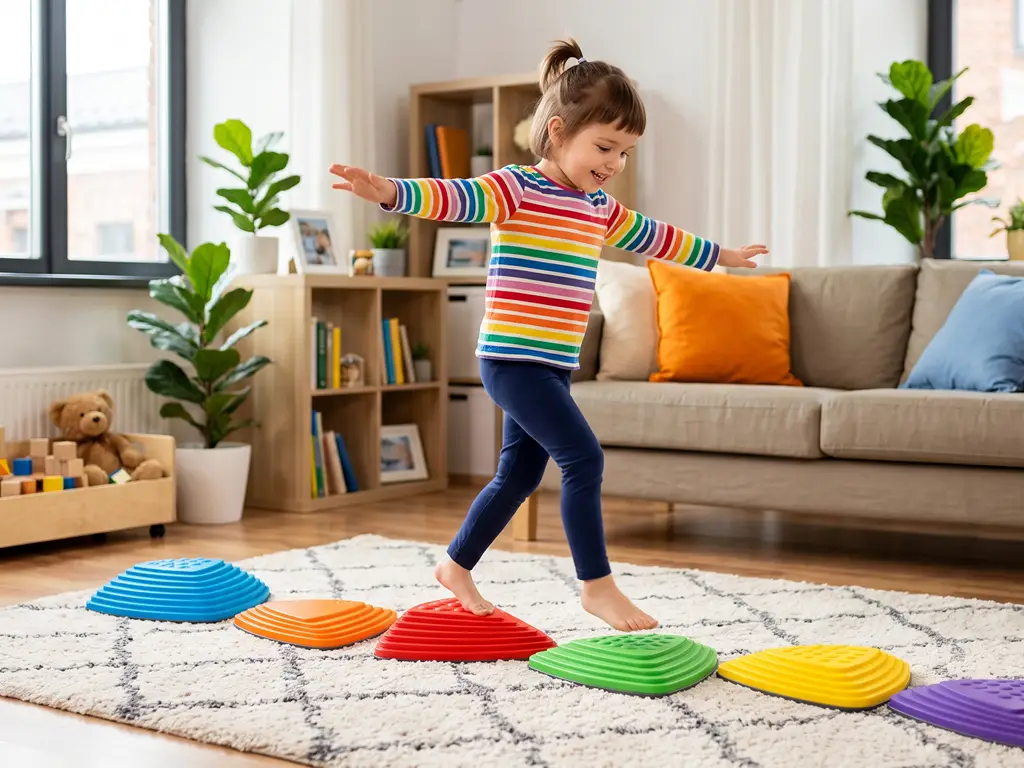
It’s a rainy Saturday afternoon. Your five-year-old has been bouncing off the walls for two hours straight, and you’re out of ideas. Screens are reaching their daily limit, and the energy in the room is approaching critical mass. Then you remember the stepping stones tucked away in the closet — within five minutes, the living room transforms into a lava-filled volcano crossing, and suddenly the afternoon is saved.
This is the magic of stepping stones. They’re not just brightly colored plastic domes — they’re open-ended tools that build balance, coordination, and body awareness while feeling like pure play. But not all stepping stones are created equal. The difference between a set that lasts through multiple kids and one that ends up cracked in a landfill after six months comes down to how they’re made, what they’re made of, and whether anyone bothered to test them for the very real forces a child will subject them to.
This guide walks you through exactly what to look for — from material quality and safety certifications to choosing the right set for your specific situation. Whether you’re a parent outfitting a playroom, a teacher building a classroom movement corner, or a therapist selecting sensory tools, the framework here will help you buy once rather than replace twice.
Why Stepping Stones Are Worth the Investment
Unlike single-function toys that serve one narrow purpose and then collect dust, stepping stones are fundamentally open-ended infrastructure for movement. Their value comes from what children do with them — and that turns out to be a lot.
Physical development is the most obvious benefit, but it runs deeper than parents often realize. When a child steps from one stone to another, they’re not just practicing balance — they’re developing proprioception: the body’s ability to sense its position in space without looking. Close your eyes and try standing on one foot. That subtle, constant adjustment your ankles are making right now? That’s your proprioceptive system at work. Stepping stones train this system better than most playground equipment because they demand continuous micro-adjustments across changing heights and distances.
The vestibular system — the inner-ear mechanism that governs balance and spatial orientation — gets engaged every time a child steps up, steps down, or leans to adjust footing. Together, proprioceptive and vestibular input form the foundation for everything from handwriting (which requires stable postural control) to reading (which depends on the eyes maintaining a steady horizon).
Cognitive benefits are less visible but equally real. Setting up an obstacle course requires motor planning — the ability to conceptualize, sequence, and execute a movement plan. A child has to think: “I’ll step here first, then there, then jump to the tall one.” This is the same cognitive architecture used for math problem-solving and essay writing later in life. The creativity that turns six plastic domes into a pirate ship crossing or a river of lava is not “just pretend play” — it’s divergent thinking, one of the strongest predictors of creative problem-solving in adulthood.
And here’s a practical angle worth considering: stepping stones are one of the few active toys that genuinely grow with a child. A two-year-old uses them as a supported walking path. A five-year-old turns them into an obstacle course. An eight-year-old incorporates them into elaborate imaginary worlds. That’s five to six years of daily use from a single purchase — a longevity-to-cost ratio few other toys can match.
All of this, of course, depends on one thing: the stepping stones you buy need to be built well enough to last. The next section breaks down exactly what “built well” means in the real world.
The Four Pillars of Stepping Stone Quality
Think of stepping stone quality as a four-legged stool. Each leg supports a different aspect of the product, and if any one of them is weak, the whole thing wobbles. Here’s your framework for evaluating any set you come across — use it like a checklist before you buy.
Material Matters: What Your Stepping Stones Are Made Of
The first thing a child does with a stepping stone is step on it. The second thing — especially for toddlers — is touch it, pick it up, and occasionally mouth it. This is why material quality isn’t just about durability; it’s about chemical safety at the most direct exposure level possible.
Most quality stepping stones on the market today are made from polypropylene (PP) plastic. But “PP plastic” is a category, not a guarantee. The critical distinction is between food-grade virgin PP and industrial recycled PP. Food-grade PP uses high-purity pigments that produce consistent batch-to-batch colors and, crucially, contains no chemical plasticizers or stabilizers that can leach out with skin contact or mouthing. Industrial recycled PP — often sourced from mixed post-consumer waste — can carry residual chemicals whose composition isn’t fully traceable, and it frequently has a distinctive chemical odor that should be an immediate red flag.
How can you tell the difference without a lab? Three practical checks: (1) Smell — open the box and take a close sniff. Food-grade PP has no detectable odor. Any chemical or “new plastic” smell that lingers after 24 hours of airing out suggests lower-grade material. (2) Color uniformity — look across all stones in the set. High-purity pigments produce consistent, rich colors. Dull, uneven, or “muddy” colors across pieces indicate lower-grade pigment mixes. (3) Surface feel — run your hand over the plastic. A smooth, even surface without rough patches or visible flow lines (the wavy patterns from uneven mold filling) signals precision manufacturing.
You’ll also see stepping stones made from EVA foam and wood. EVA is softer and lighter — good for infants and sensory-averse children but less durable under frequent use. Wooden stepping stones offer a natural aesthetic but require treated surfaces for slip resistance and are harder to clean. For most families, high-grade PP plastic strikes the best balance of safety, durability, and maintenance.
Non-Slip Design: The Safety Feature You Can’t Skip
Every parent’s nightmare scenario is the same: a child takes a running jump onto a stepping stone, the stone slides across the hardwood floor, and the child goes down. This isn’t hypothetical — it’s one of the most frequently reported issues in stepping stone reviews across Amazon and parenting forums.
Non-slip design has two components that are often confused but need to be evaluated separately: what touches the floor (the base) and what touches the foot (the top surface).
For the base, the gold standard is a full-coverage thermoplastic rubber (TPR) ring around the entire perimeter of each stone. A full TPR ring provides 360-degree grip, meaning the stone stays planted even when a child’s weight shifts from edge to edge. The cheaper alternative — individual rubber dots or pads glued to the bottom — creates a fundamentally different safety profile: when weight concentrates on one side of the stone, the pads on the opposite side can lift off the floor entirely, eliminating most of the grip at the worst possible moment.
Why does TPR matter specifically? TPR is the same class of material used in high-end shoe soles. It maintains grip across different floor surfaces (hardwood, tile, laminate, linoleum) without leaving marks or residue. Cheap PVC-based alternatives harden over time, gradually losing grip while the parent has no visual indication that the stone has become more dangerous.
For the top surface, look for a textured pattern with real depth — not just a visual pattern printed onto smooth plastic. A proper anti-slip top surface has raised bumps, ridges, or a crosshatch pattern deep enough that you can feel it distinctly when you run a fingernail across it. This matters especially for children wearing socks, which turn smooth plastic into an ice rink.
A practical test: place a stepping stone on a hardwood or tile floor and push it firmly sideways with your hand (simulating about 20–30 pounds of lateral force). If it slides at all on a hard surface with that amount of hand pressure, imagine what happens with a running 40-pound child.
Weight Capacity: Why It Matters More Than You Think
The weight capacity printed on the box — “holds up to 220 lbs!” — is one of the most misleading numbers in the toy industry. Here’s why.
When a child stands still on a stepping stone, the load is static. But children don’t stand still on stepping stones — they jump, they land, they shift weight abruptly. A 40-pound child landing from a 12-inch jump generates a peak impact force of roughly 100–120 pounds — two to three times their body weight. This is the difference between static load and dynamic load, and it’s why a stepping stone needs a far higher weight rating than your child’s actual weight.
The industry standard for safety margin in children’s products under ASTM F963 recommends static load testing at three times the labeled weight capacity. In practice, a stone rated for 100 kg (220 lbs) should have been tested to withstand at least 300 kg (660 lbs) of static load without cracking, deforming, or collapsing. This 3× margin exists precisely because the engineers know the difference between a child standing and a child jumping.
For parents evaluating a purchase, the practical rule is simple: take the weight of the heaviest person who will use the stones (including yourself — parents often demonstrate for their kids), multiply by three, and make sure the product’s rated capacity is at or above that number. A 180-pound dad demonstrating a jump move means you want stones rated for at least 220 lbs. Most quality sets on the market today clear this bar, but budget options often max out at 110–150 lbs — fine for a toddler alone but risky the moment an older sibling or parent joins in.
The plastic wall thickness also matters for weight capacity. Quality PP stepping stones typically have walls 3–5 mm thick at stress points. Stones thinner than 3 mm at the load-bearing edges will flex visibly when an adult stands on them — that flex is the plastic fatiguing, and over time, micro-cracks develop that eventually lead to structural failure.
Stackability and Storage: The Practical Side of Play
Here’s a truth every parent learns eventually: a toy’s storage footprint determines how often it actually gets used. If stepping stones are a hassle to stack and put away, they become “that thing taking up half the living room” — and resentment builds fast.
The best stepping stone designs employ nesting stackability — each smaller stone nests inside the next larger one, like a set of Russian dolls. This reduces the stored height of a 6–10 piece set to roughly the height of the single largest stone, taking up a shelf footprint of about 12 × 12 inches. By contrast, flat-stacking designs — where each stone simply sits on top of the next — multiply the height by the number of pieces, often requiring a dedicated storage bin or floor corner.
One practical consideration: some sets with elaborate rubber bases or irregular shapes sacrifice nestability for design novelty. Before buying, check product photos showing the stones stacked. If the image doesn’t show them stacked, assume they don’t stack well. A set of 6 unstackable stones isn’t a playroom addition — it’s a storage problem.
Safety Certifications: What Those Labels Actually Mean
If you’ve shopped for children’s products online, you’ve seen the alphabet soup: EN71, ASTM, CE, CPC, BSCI. They appear as badges on product pages, often without explanation, leaving you to trust that more badges = safer product. But certificates are not interchangeable, and some of them don’t mean what most consumers think they mean.
Product Safety Certifications: EN71, ASTM F963, CE, and CPC
The four certifications you’ll encounter most often correspond to different markets, different testing protocols, and — critically — different levels of independent verification. Here’s the quick-reference breakdown:
| Certification | Market | What It Actually Tests | Independent Lab Required? |
|---|---|---|---|
| EN71 | European Union | Physical/mechanical properties, flammability, chemical migration of 19 elements (Part 3), experimental sets | Yes — for Parts 1–3 |
| ASTM F963 | United States | Physical hazards, flammability, toxic elements (8 heavy metals), sound pressure, jaw entrapment | Yes — under CPSC rules |
| CE Mark | European Union | Self-declaration by manufacturer that product meets all applicable EU directives | No — manufacturer self-declares |
| CPC | United States | Children’s Product Certificate — must cite each applicable safety rule and identify the CPSC-accepted third-party lab | Yes — mandatory third-party testing |
EN71 deserves its strong reputation. The standard is divided into 11 parts, and Part 3 — covering the migration of 19 specific elements including lead, cadmium, mercury, and chromium — is one of the most rigorous chemical safety tests for children’s products globally. A product that has passed EN71 Part 3 testing by a notified body (an EU-designated independent lab) has undergone genuinely thorough chemical evaluation.
For U.S. buyers, the practical takeaway is straightforward: look for a CPC certificate that explicitly references ASTM F963 compliance and names the testing laboratory. If a seller can’t produce a CPC when asked, the product has not been independently verified to meet U.S. toy safety standards — regardless of what badges appear on the Amazon listing.
Factory Audits: Why BSCI and ISO Matter for Your Child’s Toys
Product certifications test the product. Factory audits test the place where the product is made — and while this sounds like a back-office detail with no relevance to the parent buying on Amazon, it directly affects the quality and safety consistency of what you receive.
The Amfori BSCI (Business Social Compliance Initiative) is the most widely recognized factory social audit system in global manufacturing. A BSCI audit evaluates a factory across 11 performance areas: working conditions, occupational health and safety, environmental management, chemical handling protocols, quality management systems, and more. Audits are conducted by independent third-party firms — typically SGS, Bureau Veritas, Intertek, or TÜV — and the results are logged in a publicly searchable database.
Why does this matter for a stepping stone purchase? Because a factory that passes BSCI audits operates with documented, repeatable processes rather than ad-hoc production. Every batch of plastic runs through the same injection molding parameters. Every rubber base goes through the same bonding quality check. The stones you receive from batch #47 are materially identical to the stones from batch #3. Without this process discipline — common in smaller, unaudited workshops — quality becomes a lottery. One batch may be excellent, the next may have thinner walls or poorly bonded rubber, and you have no way to know which one you’ll get.
This is also where the “10-year zero-accident safety record” claim that some manufacturers make gets its credibility. A zero-incident track record isn’t luck — it’s the statistical output of rigorous process control. When every production step has a defined quality gate, defects get caught before products ship. When quality depends on whether the shift supervisor had a good day, defects reach customers.
How to Verify Certifications Yourself
You don’t need to be a quality engineer to check whether a manufacturer’s certification claims are real. Here’s a three-step verification routine that takes less than ten minutes:
- Ask for the actual certificate. Any legitimate manufacturer or brand should be able to provide a PDF copy of their CPC or EN71 test report within 24 hours of a request. The certificate should be issued by a recognized third-party laboratory — look for names like SGS, Bureau Veritas, Intertek, or TÜV on the letterhead. If the response is evasive or the “certificate” is an in-house document without a lab logo, walk away.
- Verify the report number. Every legitimate test report has a unique reference number. Most major testing labs (SGS, BV, Intertek) offer online portals where you can enter a report number to confirm authenticity. A seller who provides a certificate but whose report number can’t be verified is a bigger red flag than a seller who never claimed certification at all.
- Check what the certificate actually covers. A common trick: the certificate covers one product in a brand’s catalog but is displayed on all product pages as if it applies universally. Confirm that the certificate specifically references the product SKU or model number you’re buying. A CPC for “plastic toys batch 2023-A” doesn’t necessarily cover the stepping stones you’re ordering in 2026.
These three checks filter out roughly 80% of misleading certification claims on e-commerce platforms. The remaining 20% require deeper investigation, but for a consumer purchase, getting past this gate is already a significant safety upgrade over trusting product-page badges at face value.
Choosing Stepping Stones by Use Case: Home, Classroom, or Therapy
The “best” stepping stone for your situation depends entirely on who’s using it, how often, and under what conditions. A set that’s perfect for a family playroom can be dangerously inadequate for a daycare center — and a set built for institutional use can be overkill (and over-budget) for a single child at home.
For Home Use: Versatility and Storage Come First
For families, the sweet spot is 6–10 stones with mixed heights that keep the challenge fresh as children grow. The key criteria, in order of importance:
Number of pieces: Six stones are enough for a single child under five. If you have two or more children — or want obstacle courses that span more than one room — go for 8–10 pieces. The jump from six to ten stones roughly doubles the number of possible course configurations.
Height variety: A set where every stone is the same height becomes boring within weeks. Look for at least three different height levels across the set. The tallest stone should be high enough to require a deliberate step — about 6–8 inches — but not so high that a toddler needs to climb rather than step.
Indoor/outdoor flexibility: The best home sets work equally well on living room carpet and backyard grass. Check that the rubber base is thick enough to grip uneven outdoor surfaces (patio, grass, deck) and that the plastic is UV-stabilized so colors don’t fade after a summer of sun exposure.
Storage: Nestable designs win here. If you can’t nest them, measure your storage space before ordering. A set of 10 flat-stacked stones can easily occupy a 2×2×2 foot cube.
For Classrooms and Daycares: Durability Is Non-Negotiable
When twenty children use the same stepping stones every day, five days a week, the physics change completely. A stone that handles a child jumping on it twice a day at home now faces forty to fifty impacts daily, plus being kicked, stacked, dropped, and cleaned with disinfectant between groups.
The threshold that separates commercial-grade from consumer-grade stepping stones comes down to a single manufacturing process: overmolding. In consumer-grade stones, the rubber anti-slip base is typically a separate piece glued or mechanically fastened to the plastic body. Under high-frequency use, this bond fails — usually within 3–6 months in a classroom setting. The rubber peels at the edges, catches on feet, and eventually detaches completely, leaving a hard plastic edge on a smooth floor.
Commercial-grade stones use overmolding — a two-step injection process where the TPR rubber base is molded directly onto the PP plastic body while both materials are at bonding temperature. The result is a molecular-level bond between rubber and plastic that cannot separate through normal use. The rubber base lasts as long as the stone itself, which in a well-made product means five to ten years of institutional use.
For classroom buyers, the certification depth of the manufacturer also matters in a way it doesn’t for home users. A school purchasing officer needs documentation — not just badges on a website. Factory-direct suppliers with BSCI-audited facilities and full CPC/ASTM/CE certification coverage provide the paper trail that school procurement requires. Startinal (www.startinal.com), a BSCI-audited manufacturer in Zhejiang, China, produces commercial-grade stepping stones with overmolded TPR bases and provides third-party lab test reports on request — the kind of documentation that schools, daycare chains, and therapy clinic procurement officers typically require.
Additional classroom considerations: stones should be sanitizable with standard disinfectant wipes without surface degradation (PP passes this; EVA foam often doesn’t). Colors should be distinct enough for a teacher to quickly direct a child: “Go to the blue stone next.” And bulk pricing — buying 4–6 sets at once for a full classroom — should meaningfully reduce the per-set cost compared to single-set retail pricing.
For Therapy and Sensory Rooms: Texture and Variability Take Priority
When an occupational therapist selects stepping stones, they’re choosing clinical tools, not toys. The selection criteria are fundamentally different from both home and classroom use.
Texture diversity is the top priority. Different surface textures provide different types of tactile and proprioceptive feedback. Raised bumps give intense foot sensory input — useful for sensory-seeking children who crave deep pressure. Subtle ridges provide lighter feedback for children with tactile defensiveness who need gradual desensitization. A single set that offers 2–3 different surface textures allows the therapist to adjust the sensory intensity of each session without switching equipment.
Height gradients are equally important for vestibular work. The classic GONGE River Stones set, long the standard in pediatric therapy, uses three distinct heights that create a natural progression from easy to challenging. This isn’t a design coincidence — it reflects the clinical principle of “just-right challenge”: starting at a level where the child succeeds confidently, then incrementally increasing difficulty to build new neural pathways without triggering a fight-or-flight response.
The distinction between proprioceptive seeking and proprioceptive avoiding is central to therapy-oriented stone selection. A child who seeks proprioceptive input — the one who crashes into furniture, loves bear hugs, and can’t seem to get enough physical contact — needs taller stones with wider spacing and deeper surface textures. A child who avoids proprioceptive input — the one who’s timid on stairs, dislikes being lifted, and walks carefully around obstacles — needs low-profile stones placed close together, with gentler textures and a trusted adult’s hand within reach. The same set should be configurable for both profiles, which is why height-adjustable or multi-height sets are worth the premium for therapy use.
Color considerations also shift in therapy contexts. Bright, high-contrast colors (red, yellow, neon green) increase arousal and engagement — good for low-energy or under-responsive children. Earth tones and muted colors (sage green, warm gray, natural wood) reduce overstimulation — better for children with sensory processing differences who become dysregulated by intense visual input. The ideal therapy set either comes in neutral colors or offers color choice.
Top Stepping Stone Picks for Every Budget and Need
Applying the quality framework from the previous sections — material grade, non-slip design, weight capacity, and certification transparency — here are the sets that earn their place. Every recommendation below comes from a manufacturer with verifiable third-party testing, which eliminates the biggest unspoken risk in the stepping stone market.
| Product | Best For | Pieces | Weight | Material | Price | Standout Feature |
|---|---|---|---|---|---|---|
| GONGE River Stones | Therapy-grade gold standard | 6 | 220 lbs | PP + TPR | $80–100 | Three distinct heights; trusted in OT clinics worldwide |
| National Geographic | Budget-friendly family starter | 6–10 | 150 lbs | PP + rubber | $25–40 | Color spinner game; best value for single-child home |
| VEVOR Balance | Multi-child family workhorse | 12 | 220 lbs | PP + TPR | $45–55 | Highest piece count per dollar; adult-weight rated |
| GONGE Hilltops Combo | Sensory room upgrade | 9 | 220 lbs | PP + TPR | $120–150 | Full balance path system for clinical settings |
| INFANS 20-Piece Set | Large modular obstacle course | 20 | 150 lbs | PP + rubber | $60–80 | Straight + curved + corner pieces; full-room layouts |
| Holyton Light-Up | High-engagement sensory motivator | 6 | 150 lbs | PP + rubber | $50–70 | LED lights on contact; excellent for sensory-seekers |
| Avenlur Majesty Beam | Montessori-style calmer option | 1 beam | 150 lbs | Wood | $70–90 | Folds for storage; natural aesthetic |
A note on GONGE vs. everything else: GONGE River Stones are the reference standard for a reason — they invented the category in the 1970s as therapeutic tools, and their manufacturing consistency reflects decades of institutional procurement feedback. They cost more because they’re built for daily clinical use, not occasional home play. For families who will use stepping stones heavily (daily, multiple kids), the price premium amortizes to pennies per use. For lighter-use homes, the National Geographic or VEVOR sets offer 85% of the quality at 40% of the price.
Setting Up Stepping Stones for Safe, Engaging Play
A great set of stepping stones in the wrong configuration is just a hazard waiting to happen. Here’s how to set them up so your child gets maximum developmental benefit at minimum risk — formatted as a step-by-step checklist for quick reference before each play session.
Step 1: Start with the right surface. Carpet and foam play mats are ideal — they provide natural grip and impact absorption. Hardwood, tile, and laminate are fine if your stones have a quality non-slip base, but consider placing a non-slip rug pad underneath the stones for an extra layer of security. Never place stepping stones on wet or recently mopped hard floors.
Step 2: Begin with close spacing. Place stones 6–8 inches apart for a toddler’s first sessions. The goal at this stage is confidence building, not challenge. As your child masters the close spacing, gradually increase to 10–14 inches. A good rule: if they can complete the course three times in a row without hesitation, it’s time to widen the gaps.
Step 3: Walk before you jump. For the first several sessions, encourage slow, controlled walking. Jumping introduces impact forces that require significantly more balance control — and the joint development to handle those forces safely. Children under four have hip, knee, and ankle joints where the cartilage is not yet fully ossified (turned to bone). High-impact jumping should be limited to soft surfaces and kept to sessions of 10–15 minutes for this age group.
Step 4: Clear the landing zone. Maintain at least three feet of clear space in every direction around the entire stepping stone course. No furniture corners, no coffee table edges, no loose toys on the floor. If a child loses balance and steps or falls off a stone, the consequence should be “they land on carpet” — not “they hit the corner of the TV stand.”
Step 5: Give them a stop signal. Teach your child a simple word or gesture — “pause” or a raised hand — that means “I need help” or “I don’t feel steady.” This gives young children a way to communicate instability before it becomes a fall, which builds both physical safety and emotional confidence. Children who know they can stop at any time take more risks in their movement exploration, which is exactly what you want.
One final thought that’s easy to forget in a guide full of safety warnings and technical specifications: the real magic of stepping stones isn’t the equipment. It’s what happens between you and your child while they’re using it. The “Floor Is Lava” games where you’re both jumping and laughing. The proud grin when they cross the whole course without touching the floor for the first time. The morning when they set up the stones themselves and call you over to watch.
The best stepping stones are the ones that get used. Everything in this guide — the material grades, the certification checks, the weight capacity math — is in service of that single outcome: a set of stones that’s safe enough that you don’t have to hover, durable enough that you don’t have to replace them, and inviting enough that your child reaches for them without being asked.