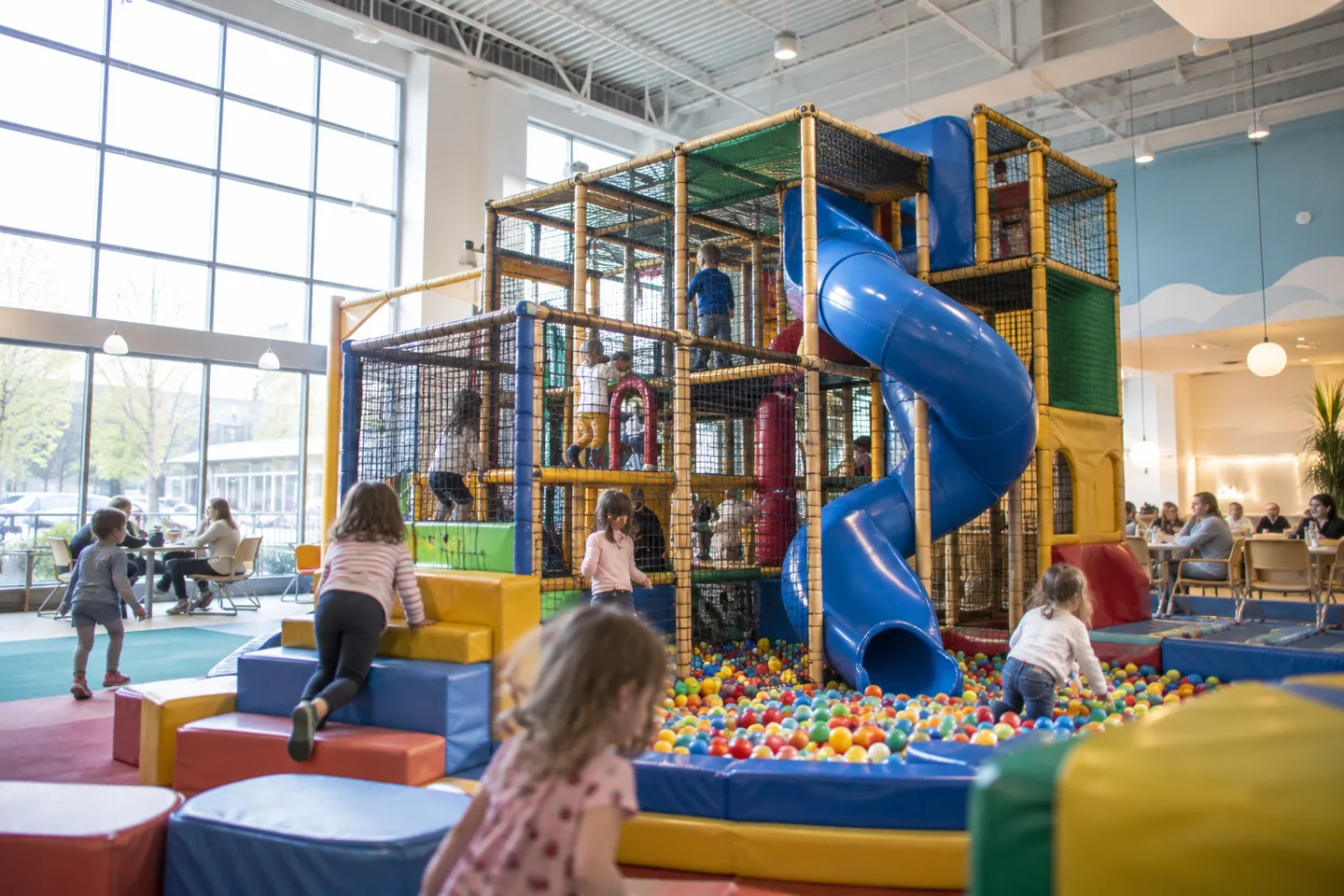
.png)
If you run an indoor play space, maintenance is the difference between a venue that ages quietly and one that closes a play zone mid-season. This guide walks the full loop: what maintenance covers, what to do daily, and how to structure inspections. Then it covers the money: when to repair versus replace, what it all costs, and how the equipment you buy today sets those numbers.
What Indoor Playground Maintenance Actually Covers
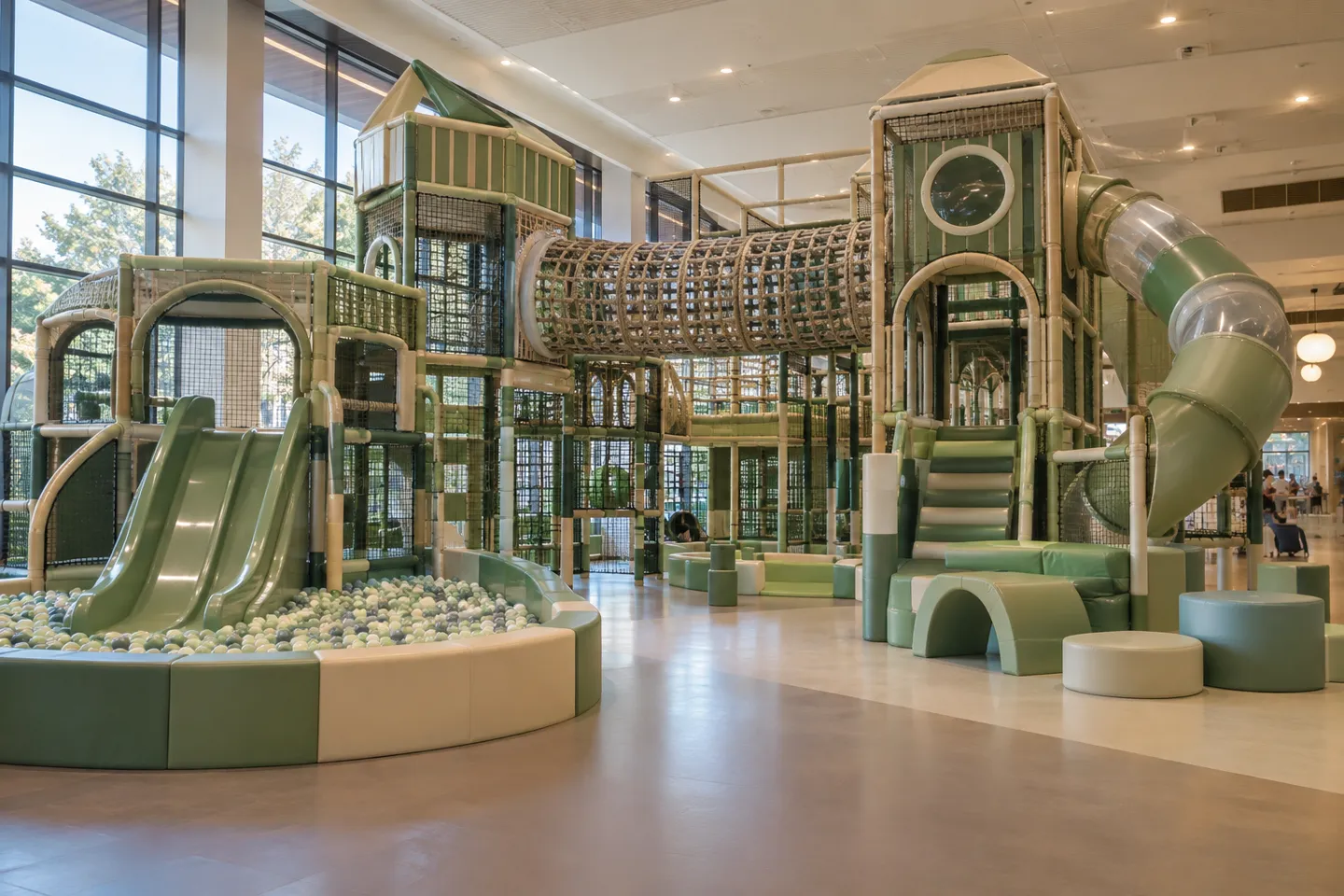
One clarification first. This guide is about commercial indoor play spaces: family entertainment centers, play cafes, preschools, and play areas in malls, churches, and similar venues. Outdoor public playgrounds follow a separate CPSC handbook, and a backyard swing set is a different subject altogether.
The second clarification matters more: maintenance is not cleaning. Cleaning is one of five activities, and the other four are where venues get hurt.
- Cleaning and sanitation keeps illness off the surfaces children mouth and crawl on.
- Inspection finds damage before it finds a child.
- Repair stops small defects from turning into structural ones.
- Replacement retires parts that have passed their safe service life.
- Documentation proves you did the first four, on the day someone asks in a lawyer’s office.
Each activity runs on its own clock. Wiping surfaces is a daily task; checking hidden couplings is monthly; replacing soft play parts is a multi-year budget line. That is why “we clean every night” is not a maintenance program. It is one-fifth of one.
Daily Cleaning and Sanitation: The Non-Negotiable Baseline
Three words get used interchangeably and shouldn’t be. Cleaning removes dirt with soap and water. Sanitizing reduces germs on a surface to a safe level. Disinfecting kills the organisms listed on the product label. You clean first, then sanitize or disinfect, because those chemicals work on clean surfaces, not dirty ones. The Minnesota Department of Health puts the frequency plainly: clean and sanitize play surfaces daily or more often, even when they do not look dirty (Minnesota Department of Health).
A workable day has three passes. Before opening, walk the full route: floors dry, mats flat, no debris, nothing sticky on the high-touch points. During sessions, spot-clean as traffic demands. Treat any body fluid event as an immediate stop: close the area, clean with soapy water, then disinfect. Keep it closed until dry. After closing, do the full clean: sweep and mop, wipe the structure, sanitize the surfaces children touch most.
The step most venues skip is dwell time. A disinfectant only works if the surface stays wet for the contact time on its label. Spray-and-instantly-dry is mostly theater. Use EPA-registered products at the labeled dilution, and give them the minutes they ask for.
Ball pits deserve their own line in the schedule. Surface wiping never reaches the bottom of the pit, so operators commonly bring in a ball-washing machine about four times a year (ELI Play). Beyond that, practices spread across a real cost spectrum: some owners run hospital-grade sanitizing twice a day and shut for a weekly deep clean. Others mop nightly with an all-purpose cleaner and accept the tradeoff. Your foot traffic, not the internet, picks the right point on that spectrum.
One health boundary is worth memorizing: hand sanitizer does not stop norovirus, one of the most common causes of vomiting and diarrhea in children. Soap and water does. A child sick with either symptom stays off the equipment, no exceptions.
The Daily Loop
Opening
- Full-route walk: floors, mats, debris
- Sanitize high-touch surfaces
- Confirm signage visible
During sessions
- Spot-clean busy zones
- Body fluid event: close the area, soap clean, disinfect, keep it closed
Closing
- Sweep and mop
- Wipe down the structure
- Sanitize, then log it
Weekly extras
- Ball-pool machine wash, about 4x a year
- Respect dwell time on every disinfectant label
The Inspection System: From Daily Walk-Throughs to Annual Audits
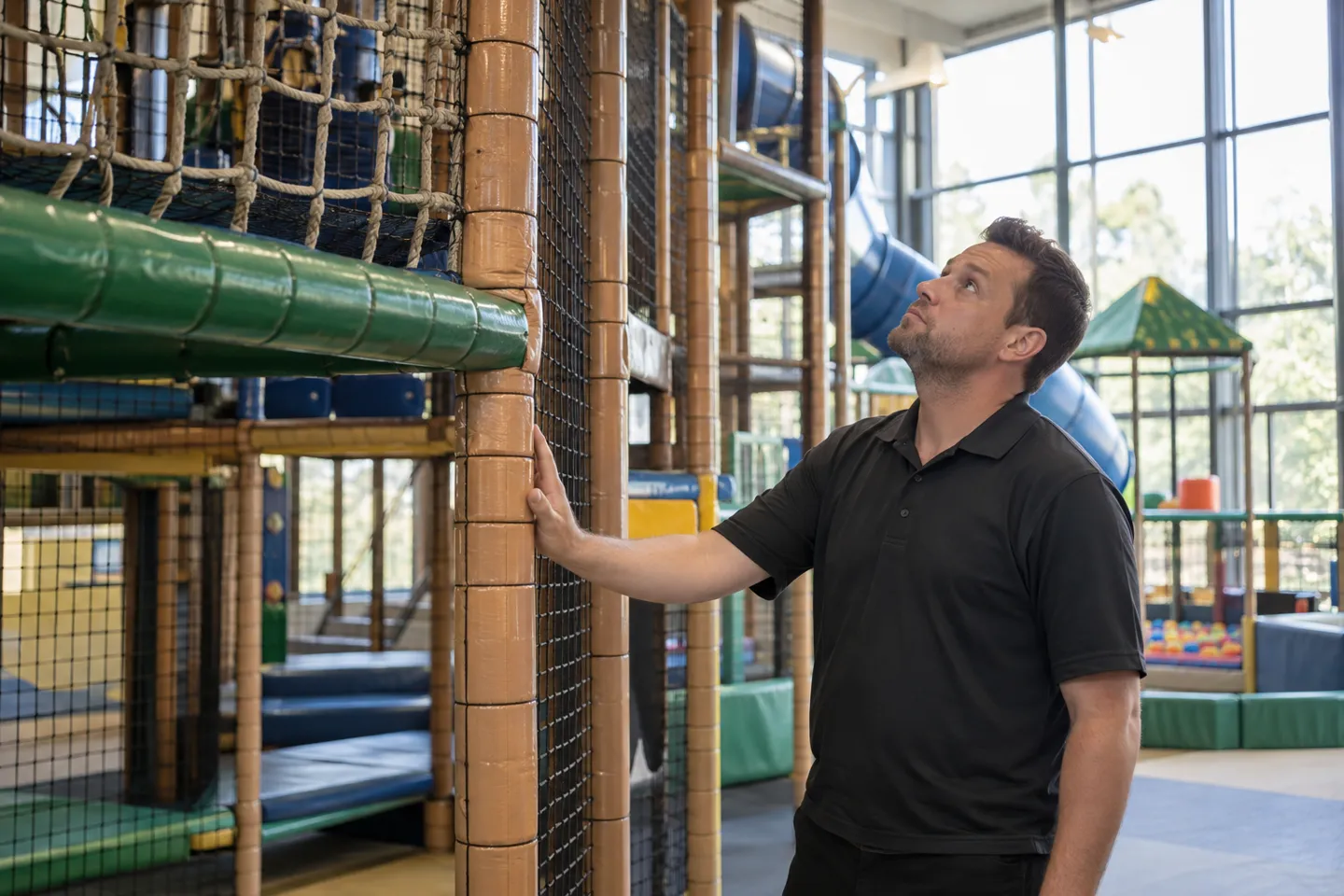
Cleaning handles dirt. Inspections handle the things dirt hides: a bolt working loose, a seam splitting, a net fraying where nobody looks. The operators who run tight venues treat inspection as a tiered system with named owners and written output, not as “keeping an eye out.”
Before you build your own tiers, know that the ground rules changed recently. ASTM published F1487-25 in June 2025. It adds new clearance and crush/entrapment requirements for spinning equipment (SGS, 2025). The CPSC reissued its Public Playground Safety Handbook (Pub 325) on July 30, 2025 (U.S. CPSC; Federal Register, 2025). A lot of older guides still cite the superseded versions. If you operate in the EU, EN 1176-1:2017 and EN 1177:2018 are the companion benchmarks; F2373 covers equipment for children aged 6 to 23 months.
2025 baseline update
ASTM F1487-25 (June 2025) and the reissued CPSC Pub 325 (July 30, 2025) set the current inspection baseline. Check the edition date on any guide before trusting its numbers.
The Five-Tier Inspection Schedule
The framework below synthesizes what manufacturers and public agencies publish into one cadence an operator can actually staff (Didi Play Area, 2026; CY Playgrounds, 2026).
| Tier | Who | Scope | Time | Record |
|---|---|---|---|---|
| 1 · Daily visual | Any trained floor staff | Full route before opening: broken parts, loose anchors, debris, exposed hardware, displaced surfaces | 10–15 min | Signed daily log entry |
| 2 · Weekly operational | Shift manager | All Tier 1 items plus bolt-torque sampling, padding seams, powered modules, surface depth at high-wear zones | 45–60 min | Checklist with photos of flagged items |
| 3 · Monthly | Manager | Concealed connection areas, anchor points, structural movement, drainage and ventilation filters | scheduled, unhurried | Monthly maintenance log |
| 4 · Quarterly detailed | Internal inspector with manufacturer training | Full structural review against the manual, surface depth/density check, fastening audit, record retention review | 3–4 hr | Written report with action items and due dates |
| 5 · Annual audit | Third-party Certified Playground Safety Inspector (CPSI) | Full F1487 + Pub 325 audit, non-conformance list, documentation review | 6–8 hr for a medium FEC | Signed CPSI report — the document insurers and lawyers ask for |
Industry associations publish usable daily versions of Tier 1 if you want a starting checklist; the NRPA’s “Daily Dozen” is the best-known (NRPA).
One boundary here: the tiers are cumulative, not redundant. Your own daily and quarterly checks do not replace the annual third-party audit. Internal staff can miss structural fatigue, and only a qualified inspector’s report carries weight with an insurer or a court.
Wear Patterns by Component
Different parts die differently, so each needs its own eyes.
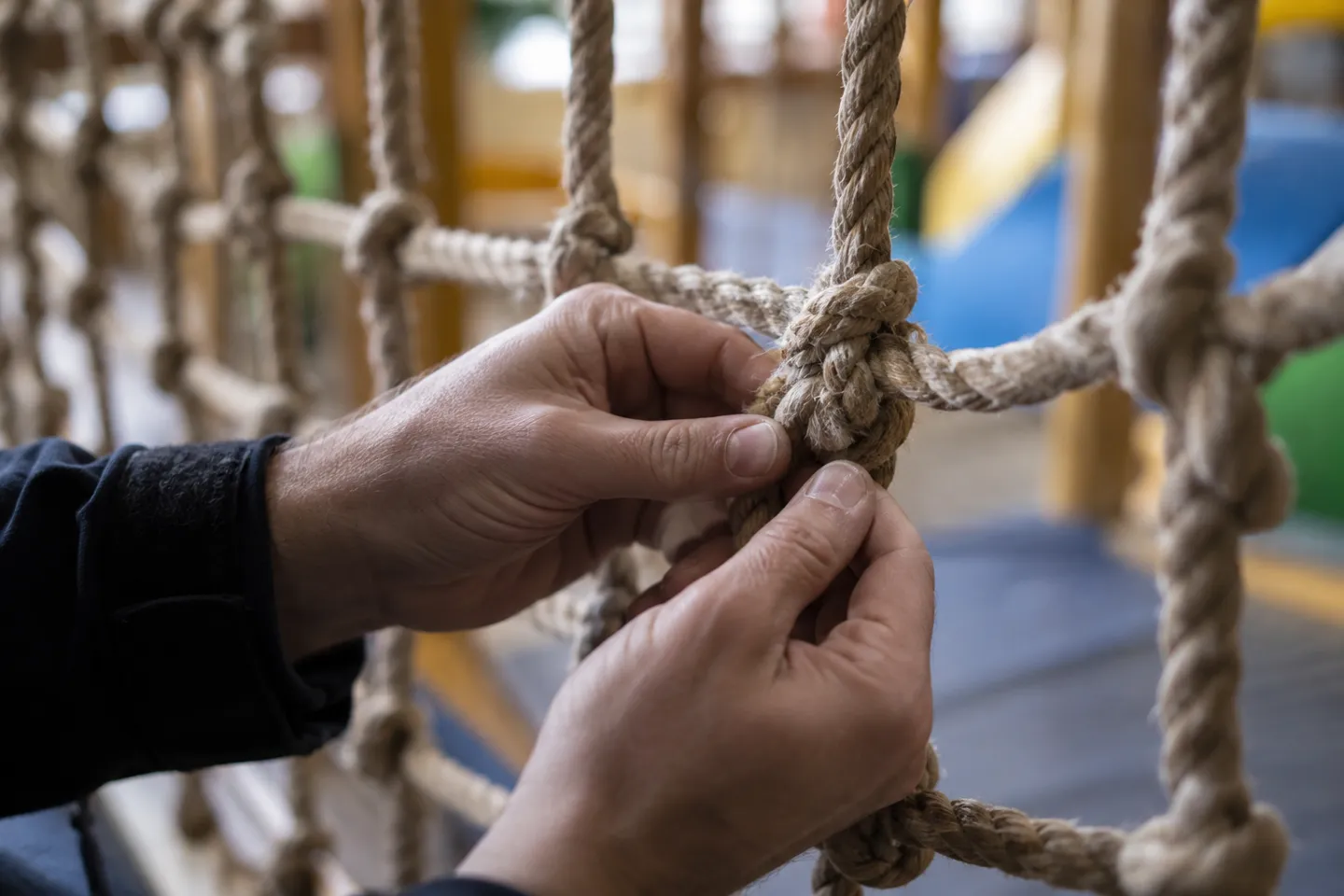
Nets and webbing are the most vulnerable parts of a soft-contained structure. Net care is a skill: knots matter, and the correct knotting technique is worth learning properly (ELI Play). Bolts and concealed couplings loosen with vibration. That is why monthly checks should cover the connections hidden under covering, ideally with two team members verifying each other’s work (Soft Play). Padded elements fail at the seams first, then the foam packs flat. Slides and crawl tubes turn rough in humid halls; a damp cloth without detergent, drying, and an occasional silicone spray keeps them gliding (ELI Play). And frequency should follow traffic. Ball pools, toddler zones, and trampoline borders concentrate impact and contamination, so busy venues patrol those zones more often than the signage suggests.
The Documentation That Defends You
When an incident happens, the question is rarely “did you care about safety.” It is “show me.” The paper that answers it is a compliance binder with roughly seven contents (Didi Play Area, 2026): equipment manuals, inspection logs, repair logs, incident reports, training records, certifications, and surfacing test reports.
A usable maintenance register sorts every finding into four classes. Urgent means close or isolate now. High means a short repair deadline with a named owner. Planned work waits for low season. Monitor items get a review date, not a vague maybe. Photographs, component identifiers, purchase dates, warranty details, and repair invoices turn that binder into something else: a budgeting tool and a supplier-claim file (CY Playgrounds, 2026).
Urgent
Close or isolate the component now.
High
A short repair deadline with a named owner.
Planned
Waits for the low season.
Monitor
Gets a review date, not a vague maybe.
The detail that decides cases is mundane: each log entry carries the inspector’s name, the time, the finding, the corrective action, and who authorized reopening. A log without those fields is decoration.
Repairs, Replacement Cycles, and What Maintenance Really Costs
Sooner or later something breaks, wears out, or both. This is where operators pay for the system they did or didn’t build.
Who Fixes What: The Repair Boundary
Not every fix is a staff fix, and the line is not about skill. It is about what happens when the fix is wrong.
| Task | Who does it | Why the line sits there |
|---|---|---|
| Retightening authorized fasteners, swapping approved consumables | Trained staff | Reversible, low-energy, visible result |
| Isolating a damaged component and posting closure | Any staff member | Removes the hazard without tools; the correct first move every time |
| Structural welding, anchor modifications | Qualified professional or the manufacturer | A bad weld fails by collapse, not by appearance |
| Electrical repairs on powered modules | Qualified technician | Invisible faults with the highest injury stakes |
| Trampoline bed replacement | Manufacturer or qualified technician | Tensioned systems store energy; release is not intuitive |
| Load-bearing changes or fall-zone alterations | Manufacturer only | The equipment’s certification (and its F1292 surface match) stops applying the moment the geometry changes |
(CY Playgrounds, 2026)
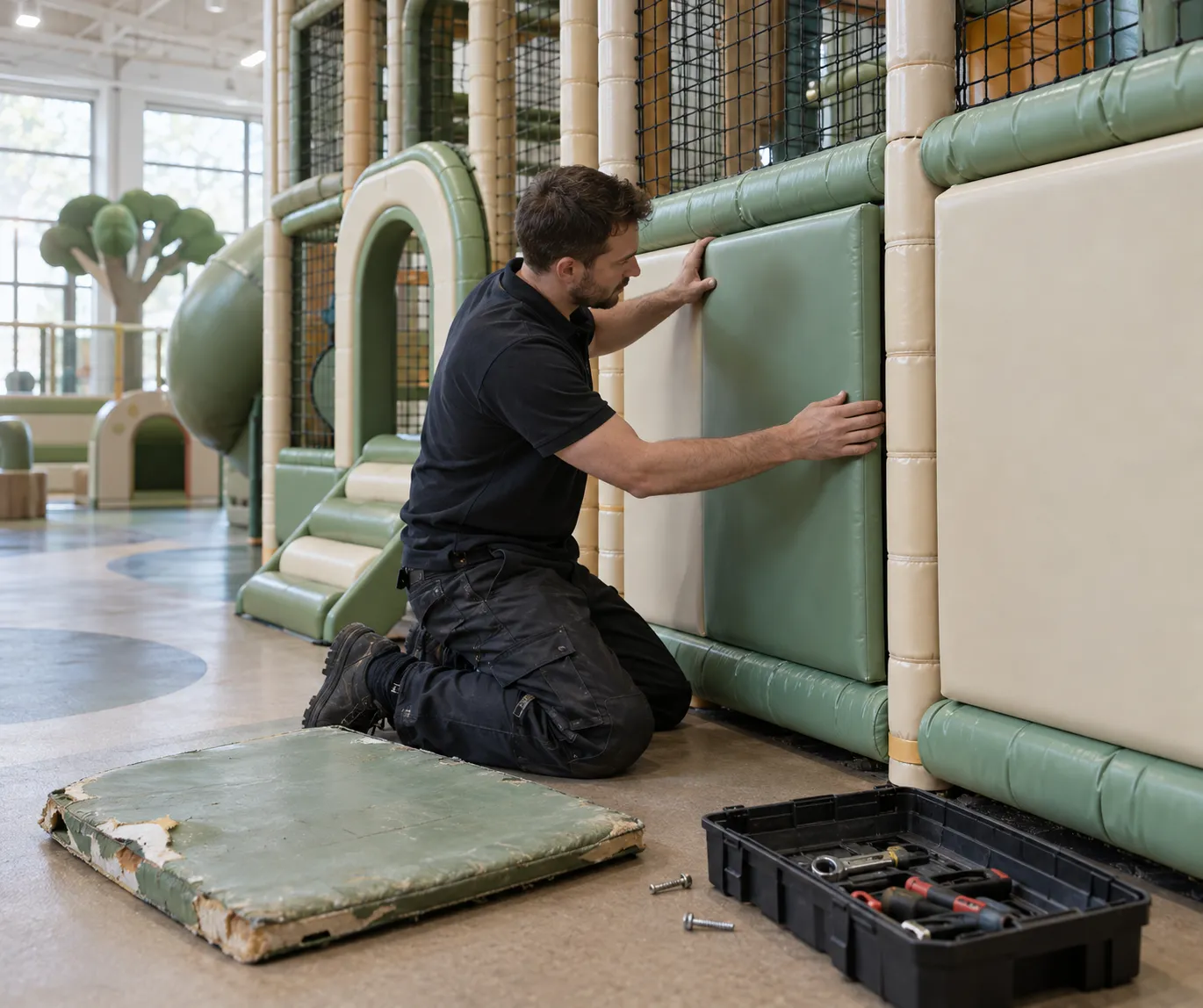
When damage is found, the sequence is the same at every well-run venue: isolate the component, file a written repair request, and reopen only with documented approval. Operators report that a clear closure notice with roughly three days for repairs is the realistic norm for equipment work (Facebook, owner discussions). Plan for that downtime; do not be surprised by it.
Replacement Lifecycles: Two Numbers Owners Mix Up
Under heavy use, soft play elements reach their replacement threshold in 3–5 years. That estimate comes from operators who have run venues through the cycle, not from a brochure (Reddit, r/Entrepreneurs).
The second number describes a different asset. Full play structures have a refresh window of roughly 8–10 years. Disciplined upkeep can stretch service life to 15–20 or more (Didi Play Area, 2026).
Two Clocks, Two Budgets
3–5 yrs
Soft parts · heavy use
Pads, ball-pit balls, mats — the replacement threshold operators report.
8–10 yrs
Full structure · refresh
Stretchable to 15–20+ with disciplined upkeep.
The signals that a part is done are visible if you look. Foam stays flat after decompression. Vinyl seams split. Netting frays at the knots. Plastic fades and turns brittle. Ball pit balls go scuffed and porous. Catching components at the signal point is also what makes the 15–20 year structure life achievable, because the structure only fails early when its worn parts are left in service.
What It Actually Costs
The honest answer on cost is that operators, not brochures, hold the numbers, and they vary with size.
Insurance anchors the fixed side. Small operators report liability coverage around $1,800–$4,000 per year. At trampoline-park scale, owners describe insurance near $7,000 a month and total overhead around $25,000 a month (owner-reported figures, Facebook operator discussions). Treat those as self-reported ranges from working owners, not quotes, then get your own.
Cleaning has a real optimization in it: buying EPA-registered supplies directly runs roughly 20–40% cheaper than a bundled service contract, if you have the storage and ordering discipline to manage it (Didi Play Area, 2026).
The most expensive strategy in the business is reactive cheapness. The operator who replaces “as cheap as I can” after things break pays for the part. Then the freight. Then the second closure. Then the review that says “the toys are broke.” The same operator conversations show the other constraint: when parts start falling apart, finding a qualified technician is genuinely hard, and new owners post publicly hunting for one (Facebook). Every month a worn part stays in service past its signal point, you are borrowing against that scramble.
Before the next breakdown writes your budget, send us your equipment list and get factory-direct pricing on replacement parts and new modules.
Request a Parts QuoteChoosing Equipment That Stays Cheap to Maintain
Everything above says the same thing from the other side: the maintenance bill is largely chosen at the moment of purchase, not discovered afterward.
At the design level, the tells are visible in a catalog photo. Large, continuous, wipe-clean surfaces beat multi-seam assemblies that trap soil. Modular pieces that replace individually beat anything that needs a specialist for a single damaged part. Ball pits, rope nets, and trampolines are the three naturally high-maintenance configurations: they concentrate cleaning labor, specialist repair, and inspection frequency in one attraction. A maintenance manual and a spare-parts catalog that ship with the order are not literature; they are evidence the manufacturer designed for the day something breaks. The same criteria extend down to furniture and loose play purchases.
At the contract level, four clauses are worth the negotiation:
Four Clauses to Put in the Purchase Contract
- 1Spare-parts availability — with the supply window stated in years.
- 2A response-time commitment for after-sales issues.
- 3Modular replaceability — single damaged parts swap without special tooling.
- 4Warranty scope with a fast claim channel — photo-based reporting is the tell of a serious process.
The timing argument got sharper in 2025. F1487-25 and the reissued Pub 325 raised the inspection baseline. Equipment that is easy to inspect and easy to re-certify is drifting from nice-to-have toward compliance precondition.
One boundary on all of this: high-maintenance does not mean never buy it. If the ball pit is your anchor attraction, its revenue can carry its cleaning contract and its inspection time. The rule is not avoidance; it is knowing exactly what you signed up for before signing.
The Operator’s Business Case: Maintenance Is Decided at Purchase
Read the numbers above once more and they organize themselves into a business argument.
The 3–5 year threshold on soft parts means every venue enters a repurchase negotiation around year three, ready or not. The repair boundary means your dependence on after-sales is structural: no amount of staff diligence substitutes for a factory that answers. The three-day closure norm means a supplier’s response speed converts directly into lost revenue, week after week. And the insurance and upkeep ranges are the fixed floor under your profit and loss, whether or not they made it into your opening budget.
So the practical conclusion is short. Maintenance cost is priced the day you sign the purchase contract. A cheap unit with unavailable parts is the expensive unit. Compare equipment on lifecycle cost: purchase price, plus the 3–5 year parts cycle, plus your downtime exposure at the supplier’s real response speed. For playground operators and early-education facility buyers working against the 2025 baseline, putting the four clauses on the table as price-level terms is the most concrete procurement move available.
It also helps to see what factory-backed terms look like in writing. So here is ours: at Startinal, every order ships after pre-delivery inspection, quality issues carry a 48-hour replacement commitment, and support runs 24/7 (what factory-backed after-sales terms look like in writing). We manufacture the soft play and balance equipment lines that venue operators reorder: river stones, balance boards, soft play sets. Everything comes from our own 10,000㎡ factory, so the spare-parts conversation stays with the people who molded the part. We would rather settle your maintenance bill before your doors open than after.
Get Factory Terms on Your Next Equipment Order
Soft play and balance equipment from Startinal’s own 10,000㎡ factory — pre-delivery inspection, 48-hour replacement on quality issues, 24/7 support, and spare parts from the people who molded the part.
Get an Equipment QuoteReferences
- Minnesota Department of Health. “Indoor Play Area Maintenance and Sanitation.” 2025. health.state.mn.us
- U.S. Consumer Product Safety Commission. “Public Playground Safety Handbook.” 2025. cpsc.gov
- Federal Register. “Notice of Availability: Public Playground Safety Handbook Update.” 2025. federalregister.gov
- SGS. “ASTM Publishes Revised Consumer Safety Performance Specification for Playground Equipment (F1487-25).” 2025. sgs.com
- National Recreation and Park Association. “The Daily Dozen: A 12-Point Playground Safety Checklist.” nrpa.org
- Facebook Buyer Answers. “Indoor Playground Maintenance Expenses.” facebook.com
- Facebook Buyer Answers. “Indoor Playground Maintenance Advice.” facebook.com
- Reddit, r/Entrepreneurs. “Thinking About Opening an Indoor Playground. What Am I Not Seeing?” 2026. reddit.com