.png)
Factory homepages, supplier directories, top-ten lists: an importer can collect a long shortlist of plastic toy manufacturers and still have no answer to the only question that matters, which of these factories can actually be trusted with money.
That gap is expensive. Buyers lose deposits to factories that vanish. They wait months for goods that never ship. And they watch their own rejected inventory come back as a competitor’s product. This guide walks the full path: what these companies actually are, where they sit, how to choose a country, and how to verify one factory. It ends with the part no listicle covers: what your contract must lock down before you pay.
What Is a Plastic Toy Manufacturer (and Who You’re Actually Talking To)
The first surprise: not everyone ranking for this term makes anything. The search results mix three kinds of businesses that look identical in a directory listing.
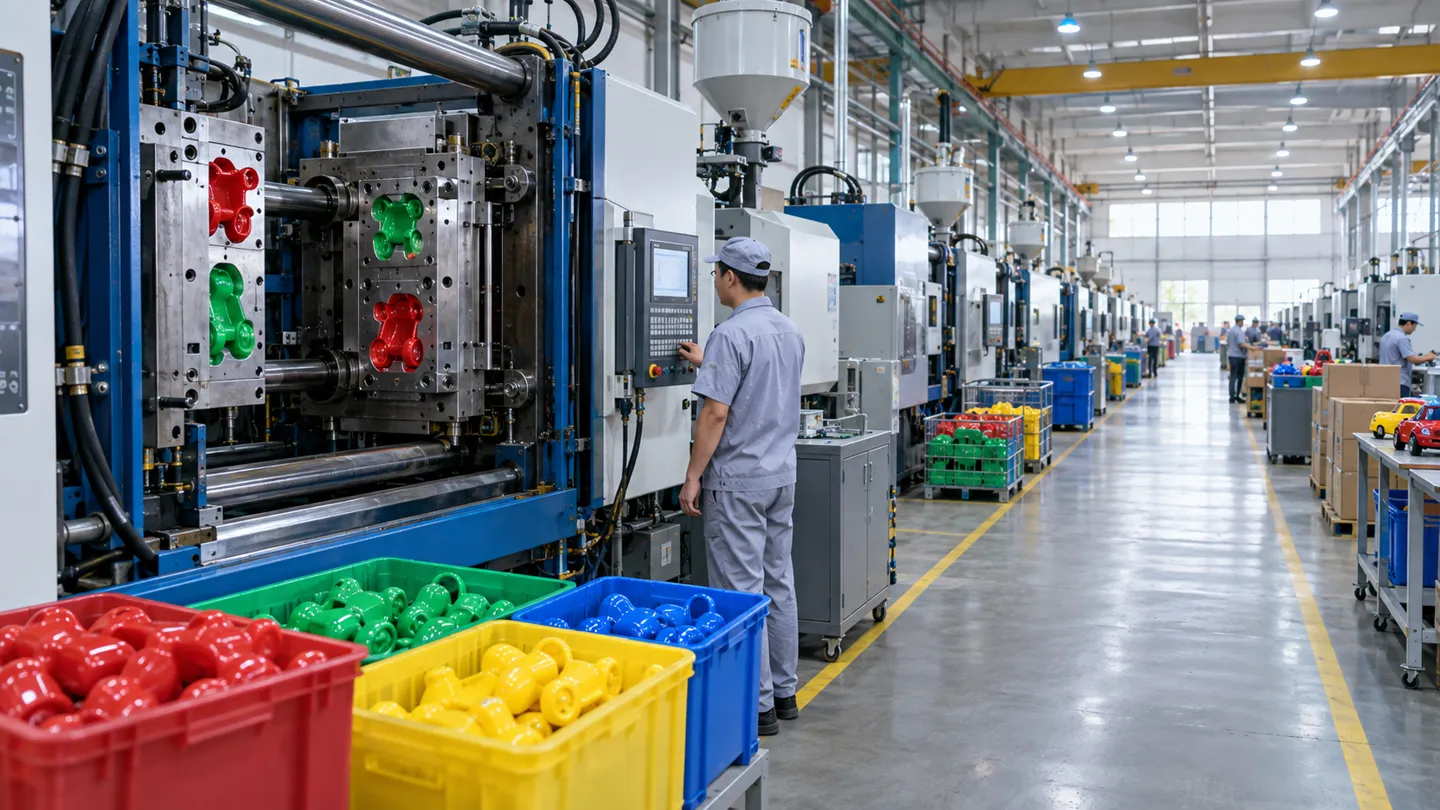
A toy brand company designs and markets products, then outsources production. A plastic toy manufacturer runs the machines (injection presses, rotational molds, packing lines) and sells that capacity. The usual forms are OEM, meaning your design and their production, or ODM, meaning their design and your brand. A trading company owns no machines at all; it buys from factories and resells the relationship. None of the three is automatically bad, but each one changes who is accountable when something goes wrong.
Brand company: owns the design, outsources the making.
Manufacturer (OEM/ODM): owns the machines and the QC process.
Trading company: owns neither; it owns the relationship, and takes a margin for it.
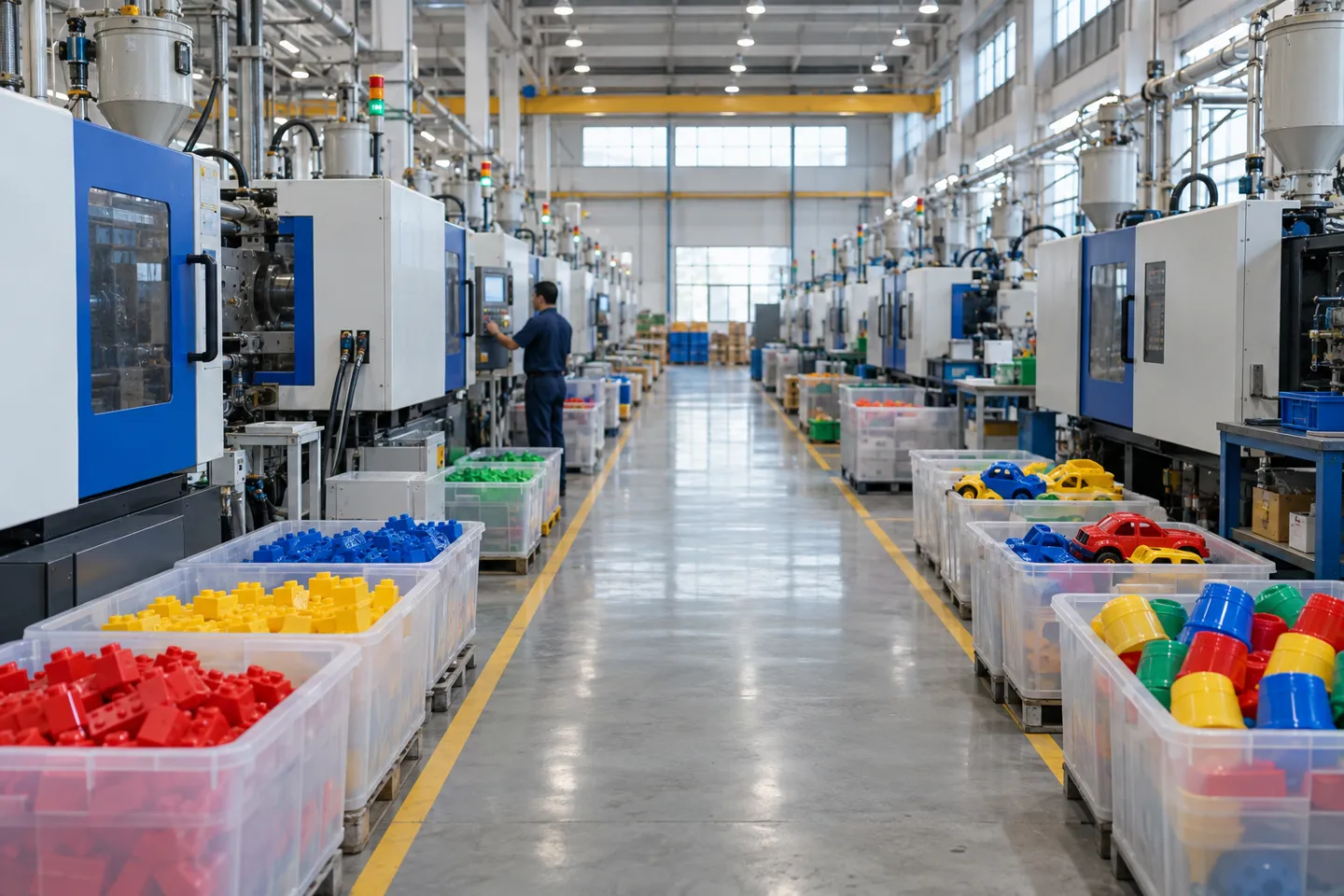
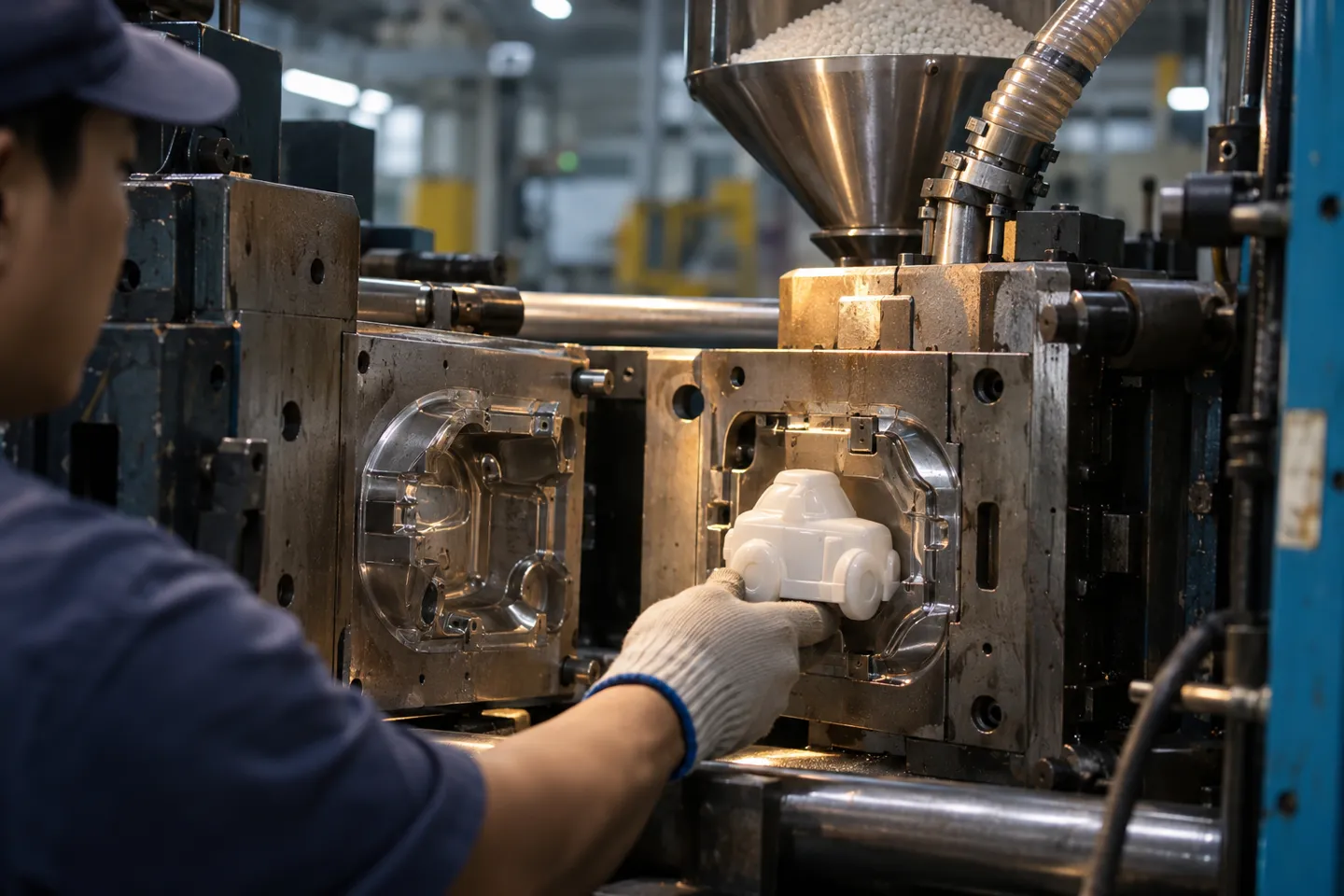
The manufacturing itself splits into two processes worth knowing by name. Injection molding melts plastic pellets and injects them into a steel mold; it produces most hard plastic toys, from stepping stones to building blocks. Rotational molding heats plastic powder inside a slowly rotating mold and produces large hollow items such as slides and rockers. On materials, the line that matters for toys is virgin polypropylene (PP) and polyethylene (PE) versus recycled feedstock. Virgin resin gives predictable strength and passes chemical testing far more consistently, which is why serious buyers ask about it before anything else.
Where you go next depends on who you are. If you want to understand the industry, the rest of this map is enough. If you intend to actually buy, whether a first sample order or a full season’s program, the next two sections are your shortlist of hunting grounds.
The Global Manufacturing Map: Where Plastic Toys Are Actually Made
China produces roughly 70% of the world’s toy supply (US-China Business Council, 2017), and that capacity is not spread evenly across the country. It clusters in industrial belts where mold makers, resin suppliers, and accessory vendors sit within a short drive of the molding presses. Two belts matter most for plastic toys.
China’s Toy Industrial Belts
Chenghai, a district of Shantou in Guangdong province, is the densest plastic toy cluster on earth. Guangdong alone accounts for about 70% of China’s toy exports (HKTDC Sourcing), and Chenghai is where much of that volume is molded. If your product is a die-cast-style vehicle, a block set, or any injection-molded item, the suppliers here will quote you fastest and deepest.
Wenzhou, in Zhejiang province, plays the same role for educational and sensory play equipment. Qiaoxia town in Yongjia county is known as China’s educational toy capital and the home range for balance stones, balance boards, soft play, and classroom furniture. Buyers sourcing for kindergartens, therapy centers, and e-commerce brands in the gross-motor category usually end up here whether they planned to or not.
Chenghai (Shantou, Guangdong)
Injection-molded plastic toys of every category; deepest supplier pool, fastest tooling iteration.
Wenzhou (Qiaoxia, Zhejiang)
Sensory integration, gross motor, and classroom equipment; the educational toy cluster.
The practical advantage of both belts is the same: the supply chain is local. A mold revision, a color match, or a component swap gets done in days because the mold shop is twenty minutes away. That speed is hard to replicate anywhere else, and it is the real reason clusters dominate. Cheap labor is only part of the story.
The US and Near-Shore Option
American plastic toy factories exist and serve a real niche. Companies like American Plastic Toys (founded 1962) and Green Toys (100% recycled domestic plastic) mold domestically, buy resin locally, and pass US testing with familiar paperwork. The trade-off is price and flexibility: unit costs run higher, tooling options are narrower, and most US plants favor long runs of their own catalog over custom OEM projects. Near-shore options such as Vietnam, India, and Malaysia are growing as brands diversify. Toy-specific supply chains there are still thin, though, and many still import components, and often tooling, from China.
Rule of thumb
U.S. factories
Domestic-material stories; fast replenishment of standard items.
China’s belts
Custom work, category depth, price.
Near-shore
A second source, once volumes justify qualifying one.
Directories, Trade Shows and Marketplaces — and How to Use Them
Three channels produce most first contacts. ThomasNet works for North American suppliers. Trade shows like the Canton Fair and the Hong Kong Toy Fair let you touch products and meet the sales team face to face. Alibaba and Made-in-China give you instant reach into the Chinese belts, thousands of listings deep.
Each channel has a failure mode. A directory listing proves a company exists, not that it runs a factory. Before any money moves, run three checks. Verify the business license and export track record. Ask for a live video walk-through of the production floor. And confirm whether you are talking to the factory itself or a trading company presenting itself as one. Ask a question only a workshop can answer, such as “which machine brand are your injection presses?”, and the answer tells you which side of that line you are on.
The map narrows your search. It does not make the choice between regions for you. That is the next fork, and it has five dimensions.
Domestic or Overseas: The First Fork in Toy Sourcing
Buyers debate this as a single question (“US or China?”), but it is five questions wearing one coat. The table below separates them.
US vs China sourcing across five dimensions
| Dimension | US manufacturer | China industrial belt |
|---|---|---|
| Unit cost | Higher: domestic resin and labor | Lower: cluster economics at scale |
| MOQ | Often high; favors long runs of standard items | Flexible: stock items can go out with no MOQ, custom lines carry minimums |
| Certification paperwork | Domestic testing, familiar process | Complete on export-grade lines (CPC, CE, ASTM) but you must verify it yourself |
| Lead time and logistics | Days domestically, no ocean freight | Stock 1–7 days to ship, custom 15–25 days, plus ocean transit |
| Oversight cost | Low: visit in person cheaply | Real: video audits, third-party inspections, or a trip |
On tariff math, most toys land in HTS Chapter 95 with MFN rates of 0–6.5%. Chinese-origin toys carry an additional 7.5% Section 301 List 4A duty, which puts many lines at an effective 7.5–14% (Camtom China Tariffs Guide, 2026). Further increases were finalized in recent rounds (White & Case, 2024). The bigger story is volatility itself: Bloomberg reporting follows US toy companies rebuilding supply chains from scratch under tariff pressure (Bloomberg via YouTube, 2025). When rates can move a double-digit percentage in a season, the sourcing decision stops being a pure cost calculation and becomes a risk decision.
Which is why the honest answer to “US or China?” is: it depends on which failure you can least afford. Small-batch, differentiated e-commerce products usually still pencil out in China, because cluster speed and category depth outweigh the duty. Bulk standard items for a risk-averse retailer may justify paying US unit prices for a shorter, quieter chain. What the fork never tolerates is choosing on unit price alone, because the cheapest quote and the reliable factory are often not the same factory. Verifying which one you are talking to is the work of the next section.
While you’re shortlisting
Shortlisting factories right now? Send your product spec and get straight answers on MOQ, tooling, and certificates — before any deposit moves.
Vetting a Toy Manufacturer: From Certificates to the Contract
Verification runs in sequence: paper first, then samples, then process, then contract. Each stage filters out a different class of problem. Skipping a stage does not save time; it relocates the discovery of that problem to a point where it costs more.
Hard Credentials: Certificates, Patents and the Factory Behind Them
For the US market, children’s products designed for ages 12 and under need a Children’s Product Certificate. The certificate must cite testing to ASTM F963, currently version F963-23, run by a CPSC-accepted third-party lab (CPSC Toy Safety Guidance). For the EU, CE marking under the Toy Safety Directive with EN 71 testing is the entry ticket. A social-compliance audit such as BSCI is not legally required, but large retailers increasingly ask for it. Its presence tells you the factory has survived an outside inspection of its labor and facility practices.
Trust the paperwork only after you check it. Certificate numbers can be verified with the issuing lab. An audit report comes with a date and an auditor, so ask for the latest one rather than a certificate scanned years ago. For e-commerce sellers, patents matter as much as certifications: listing a design that infringes someone’s registered pattern or utility model invites takedowns and claims on the platform. Factories that design their own products usually hold their own patents and will say so; the strong ones treat it as a selling point.
Sampling and Tooling: Where the Real Cost Lives
A disciplined sampling sequence looks like this. You send a Pantone reference. The factory returns a color card. You approve the card, they produce the sample, you approve the sample, and mass production starts. Factories that quote mass production before a signed sample exist, and they are telling you how they will handle your quality problems later. Free samples with freight collected are a normal, low-signal-cost way to start; a factory confident in its product does not need to charge you $50 to prove it.
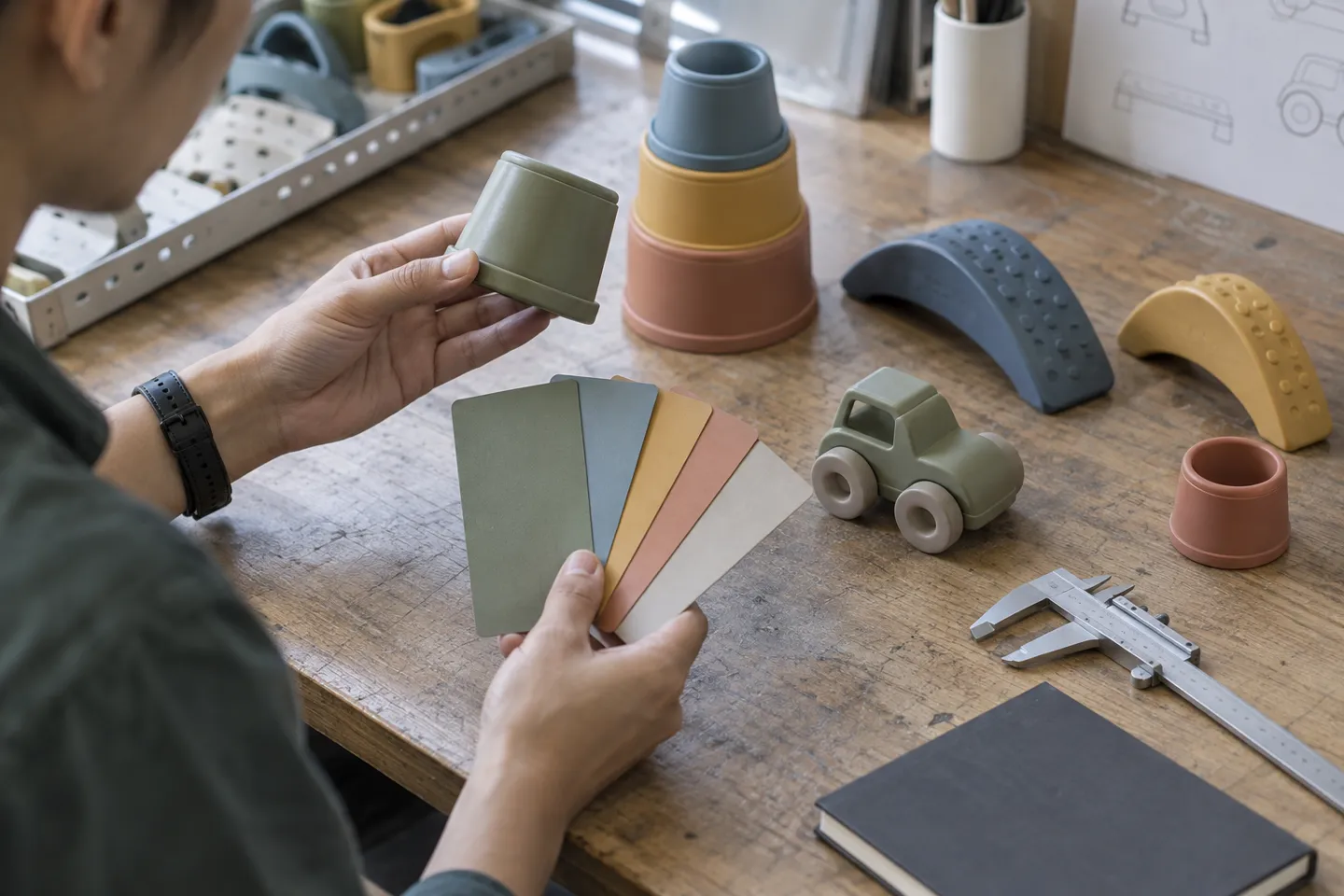
Tooling is where budgets die quietly. Buyers report quotes for the exact same design ranging from $3,000 to $30,000 (r/manufacturing, 2022).
One design, two quotes: the tooling spread
A 10× spread on the same design — not a 10% one. Four unbuilt assumptions sit behind every tooling quote.
Cavity count
Per-unit cost and upfront cost move in opposite directions.
Steel grade
How many shots the mold survives.
Part complexity
Undercuts, wall thickness, texture depth.
Mold ownership
Who keeps the tool when the program ends.
The spread exists because “a mold” is not a specification. Cavity count sets your per-unit cost and your upfront cost in opposite directions. Steel grade sets how many shots the mold survives. And ownership is the clause everyone forgets: if the factory owns the tool, you cannot move your production, a fact that turns every future negotiation against you. Ask for an itemized tooling breakdown and put ownership in the contract. Tooling choices shape part quality, cycle time, and durability for the life of the product (Gembah). That is why this line item deserves more negotiation time than unit price.
QC, Inspections and the Terms That Protect You
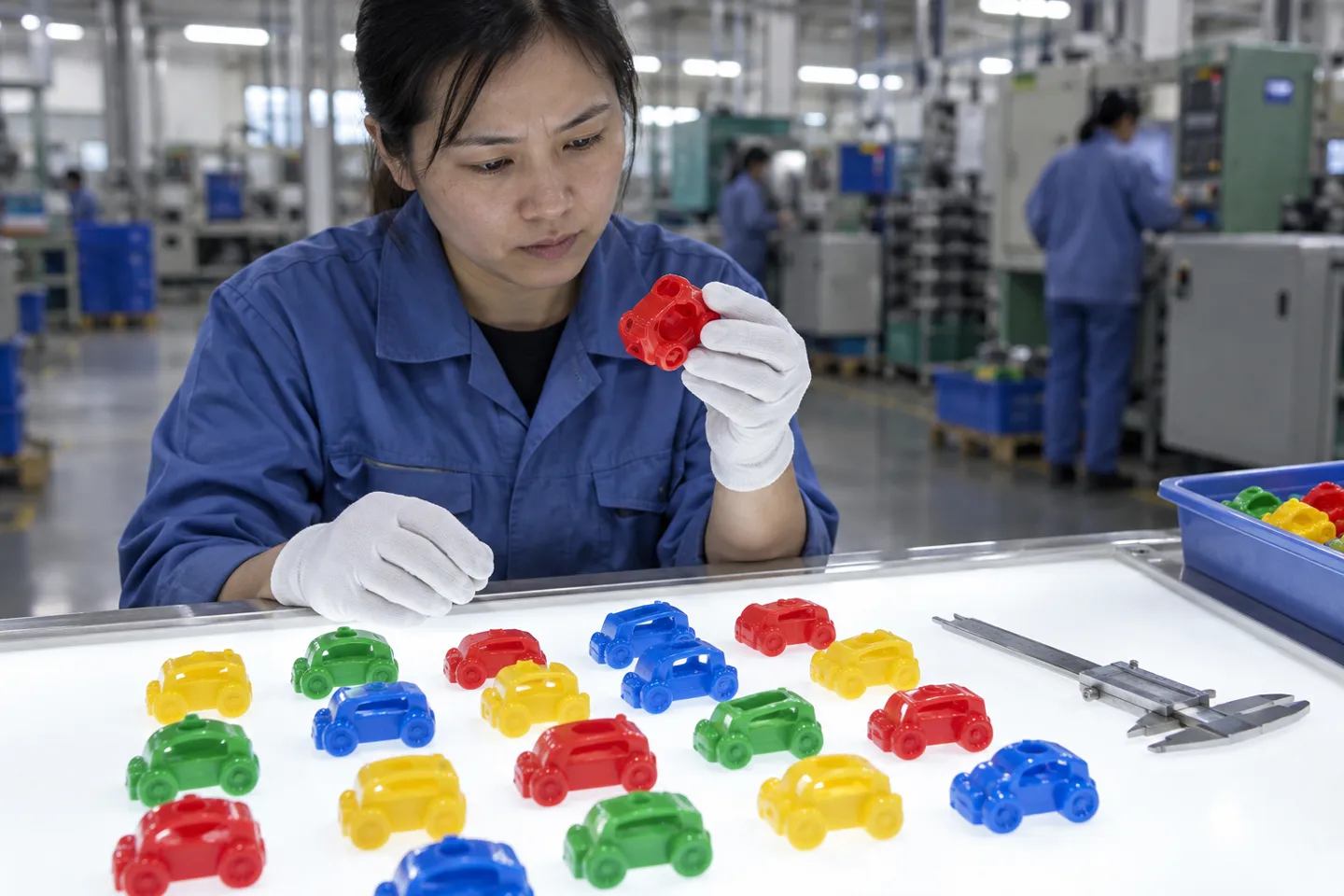
Process capability shows up in small, checkable habits. Does the factory inspect incoming resin by batch? Does it run in-process monitoring with traceable records? Will it accept a pre-shipment inspection, by you or by a third-party inspector you hire, and rework what fails? Export-grade factories answer yes to all three and can describe their internal gates: sampling plans on finished goods, drop tests for carton strength, color-fastness checks where it matters. If a sales team bristles at the mention of third-party inspection, you have learned something more valuable than any audit report.
Then the contract. Standard payment terms in China run 30% deposit with production and 70% balance before shipment (Advanta Sourcing, 2023). Treat that structure as the baseline, and treat requests for 100% upfront as a walk-away signal. Push the protection into writing: inspection rights before shipment and a delay penalty that has real teeth, on top of the tooling ownership discussed above. On MOQ and lead time, the two lines behave differently: stock items move in days with no real minimum, custom programs carry minimums and 15–25 day production windows. Judge each factory on the line you will actually buy.
Credential checklist before any deposit
- CPC with ASTM F963-23 cited, number verifiable (US) or CE + EN 71 (EU).
- Latest BSCI or equivalent audit report, dated within the year.
- Patent status of the design confirmed.
- Itemized tooling quote with ownership clause.
- Written inspection rights, delay penalty, 30/70 payment terms.
One vetting sequence, four buying scenarios. The weight you give each check depends on which buyer you are:
| Your scenario | Capability to prioritize | What to confirm, concretely |
|---|---|---|
| Small trial order (e-commerce seller) | Stock availability, low MOQ, valid certificates | Get the stock list and certificate numbers; order small and check the samples match production |
| Custom tooling (founder, brand) | Mold engineering, sample iteration, IP terms | Itemized mold quote; ownership and transfer conditions in the contract |
| Long-term volume (importer, wholesaler) | Audit history, QC system, delivery penalties | Latest BSCI report; inspection rights and delay compensation written in |
| Tender / bulk procurement (institution) | Category breadth, sample-to-order fidelity | Pre-production samples against the tender spec; certificates per category |
What a Qualified Supplier Looks Like in Practice
Run every factory through the stages above and a shape emerges: the profile of a supplier that survives a long program, not just a first order.
The qualified-supplier portrait
- Certificates verifiable at the issuing lab, not just attached as PDFs.
- A production floor it will show you live, with its own injection and rotational lines.
- A sampling process with a color-card stage before a signed pre-production sample.
- Pre-shipment inspection accepted in advance, failed goods reworked at the factory’s cost.
- Contract terms it already works with: trial-order minimums, delay penalties, clear mold ownership.
- After-sales handling that starts with photos, not arguments.
No factory scores perfectly on all six, and small workshops can be excellent partners with two of the boxes empty. A third-party inspector can substitute for an in-house QC department on modest volumes. Weight the list for your scenario using the matrix above.
Some factories, though, check the boxes as a matter of routine rather than effort. Startinal is a Wenzhou educational-toy manufacturer built that way. Our river stones and balance boards ship from a 10,000 sqm plant running 36 injection machines across plastic, metal, and textile lines. CPC, CE, and ASTM certificates plus a BSCI audit back every claim (Startinal’s certifications and factory standards). Because we hold stock year-round, standard items ship in 1 to 7 days and light customization in 15 to 25, so a trial order tests our consistency instead of our promises. That is what the portrait looks like when a factory has nothing to hide: the verification gets faster every time you repeat it.
Fast, repeatable verification is the goal. But even good processes break, and the failures worth studying are the ones that were preventable on day one.
When Sourcing Goes Wrong: Failure Modes and the Checks That Prevent Them
Every horror story below is a real pattern, documented by inspection firms, law blogs, and buyers themselves (Quality Inspection, 2024). None of them happened to careless people. They happened to buyers who skipped one check.
| Failure mode | What it looks like | The check that prevents it |
|---|---|---|
| Deposit scam | Factory collects a large deposit, then stalls or disappears (Harris Sliwoski, 2021) | Verify business license and export record before paying; keep deposits inside the 30% norm |
| Refusal to ship | Goods paid for, production “delayed” indefinitely | Written delivery date with a delay penalty; stage payments against production milestones |
| Forced acceptance of defective goods | “Ship as is or lose your deposit” | Pre-shipment inspection rights in the contract, third-party if needed |
| Rejected goods resold as clones | Your failed QC lot reappears as a rival’s listing | Contract clause on disposal of rejected goods; trademark protection |
| Design or mold misuse | Your custom product quoted to other buyers | Mold ownership written into the contract; exclusive-supply terms |
| Endless failed supplier search | Months of trial and error, no qualified source | Two or three parallel small trial orders, screened with the vetting sequence |
The most expensive failure is the quietest: a factory that collects a bigger deposit than the industry norm and then shuts down. Owners vanish; recovery is theoretical. The 30/70 payment structure exists precisely because it caps what any single failure can cost you.
Notice that every prevention is an action you can take before the first payment: license checks, written penalties, staged payments, inspection rights. None of it depends on trusting your instincts on a video call. Also notice what the list does not include: a guarantee. These checks lower the odds sharply; they do not reduce them to zero. The cheapest remaining insurance is keeping early orders small enough that a total loss is a lesson, not a casualty.
Prevention, done this way, looks like a stack of costs. The last question, the one that decides how you run sourcing for years, is whether that stack actually costs more than the failures it prevents.
The Buyer’s Economics: Buying Verified Stability, Not the Lowest Quote
Start from what the earlier sections established. Quotations for identical tooling can differ tenfold. Six failure modes can each cost more than any audit trip. Tariff volatility keeps re-pricing entire supply chains mid-season. Now do the arithmetic a professional buyer does.
An audit report, a third-party inspection, a paid sample, an itemized tooling quote: the whole verification stack costs hundreds, at most a few thousand dollars. One failure from the table above costs a missed selling season, a re-tooled order, a claim from your own customer, or all three. Spread across an annual program, the verification stack is a rounding error; a single unrecovered deposit or rejected container is not. That asymmetry is the whole argument: paying for verified stability is not a premium on top of the real price. It is the real price. The lowest quote is the one with the verification bill deferred to a date the factory chooses.
For a trading company or wholesaler, this converts into a supplier strategy rather than a slogan. Write the four protections into your standard contract: audit documentation, inspection rights, delay penalties, mold ownership. Treat any resistance as information. Then concentrate volume. Two or three factories that pass the full sequence deserve your consolidation far more than eight factories split across a spreadsheet. Depth of relationship is what gets your rework done first when a season gets tight. Verified capacity, not the widest supplier list, is what a competitor cannot copy from you.
The stance has one honest boundary. A low-value, trial-tolerant item, a giveaway or a one-season experiment, can afford a total loss. For those orders the lowest quote remains a rational choice. Professional buying is not the refusal of cheap; it is knowing precisely which orders can afford it.
Find the real factories, verify them in sequence, contract the risks, then concentrate your volume. That discipline is the entire difference between buyers who source once successfully and buyers who source reliably. The factories that welcome that kind of scrutiny are, not coincidentally, the ones worth your next order. If you want to see how one Wenzhou manufacturer answers these questions about its own operation, Startinal’s team publishes its certifications, capacity, and sourcing terms openly at startinal.com.
Put a Verified Factory on Your Shortlist
Startinal publishes its certificates, capacity, and sourcing terms — send your spec and get answers on stock programs, light customization, and mold ownership in one reply.
Start the VerificationReferences
- US-China Business Council. “Child’s Play: Opportunities in China’s Toy Industry.” 2017. uschina.org
- HKTDC Sourcing. “Guangdong: a global leader in toy making.” sourcing.hktdc.com
- White & Case. “United States Finalizes Section 301 Tariff Increases on Imports from China.” 2024. whitecase.com
- Camtom. “China Tariffs Guide for US Importers.” 2026. camtomx.com
- Bloomberg (via YouTube, The Big Take Asia). “An American Toymaker Struggles to Break Up With China.” 2025. youtube.com
- CPSC. “Toy Safety Business Guidance.” cpsc.gov
- r/manufacturing. “Manufacturing Toy in China.” 2022. reddit.com
- Harris Sliwoski (China Law Blog). “China Factory Scams.” 2021. harris-sliwoski.com