What Soft Play Material Actually Is
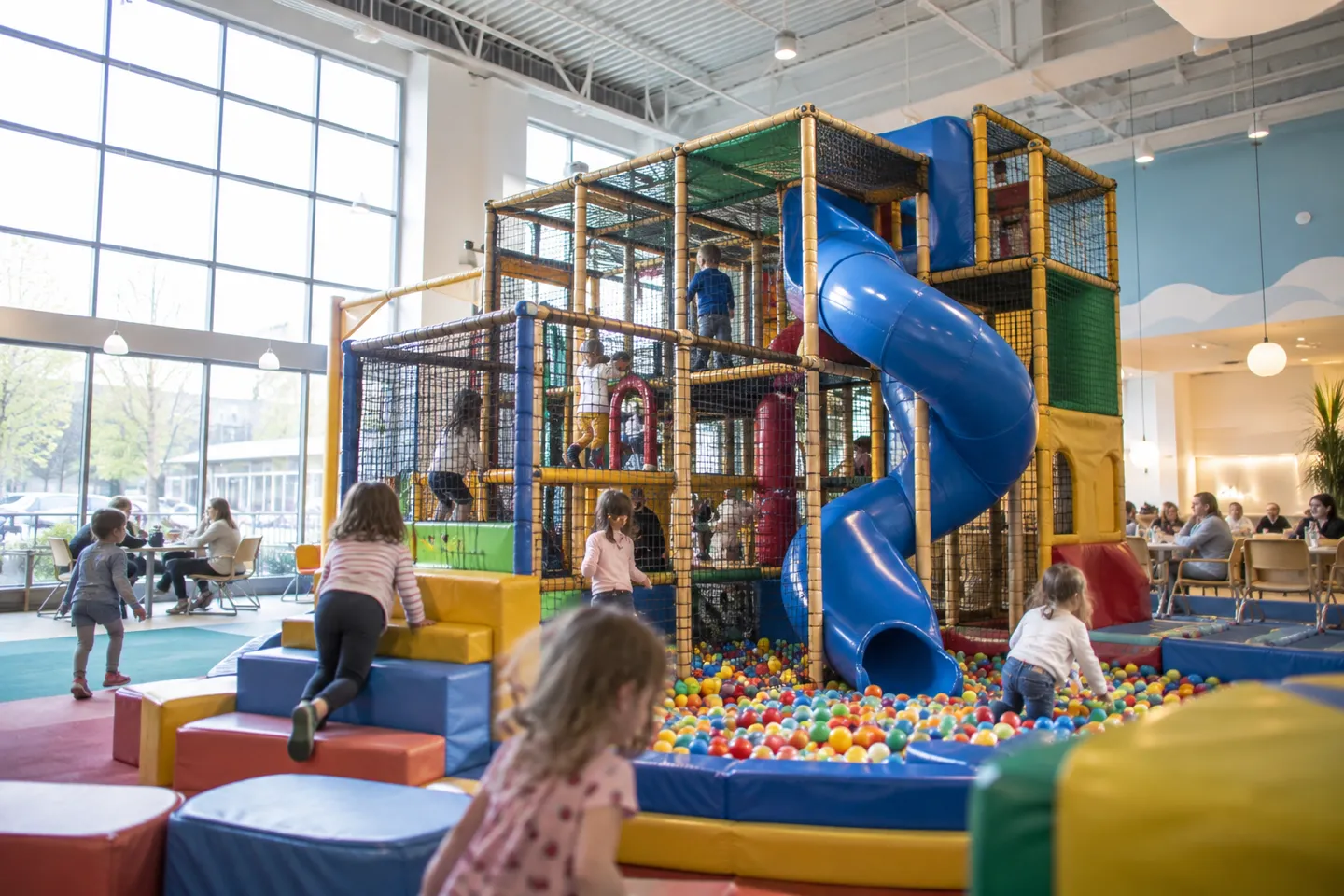
The ball pits, climbing blocks and padded shapes in play centres and living rooms are all built from one material system, and that system is what most buyers of soft play equipment are actually shopping for. Early-years teaching circles sometimes use the same name for craft supplies, playdough, sensory rice, that world; this guide is about the equipment kind. If you arrived chasing the craft kind, stay anyway: the same three layers explain why one padded block survives a decade and another dies in a season.

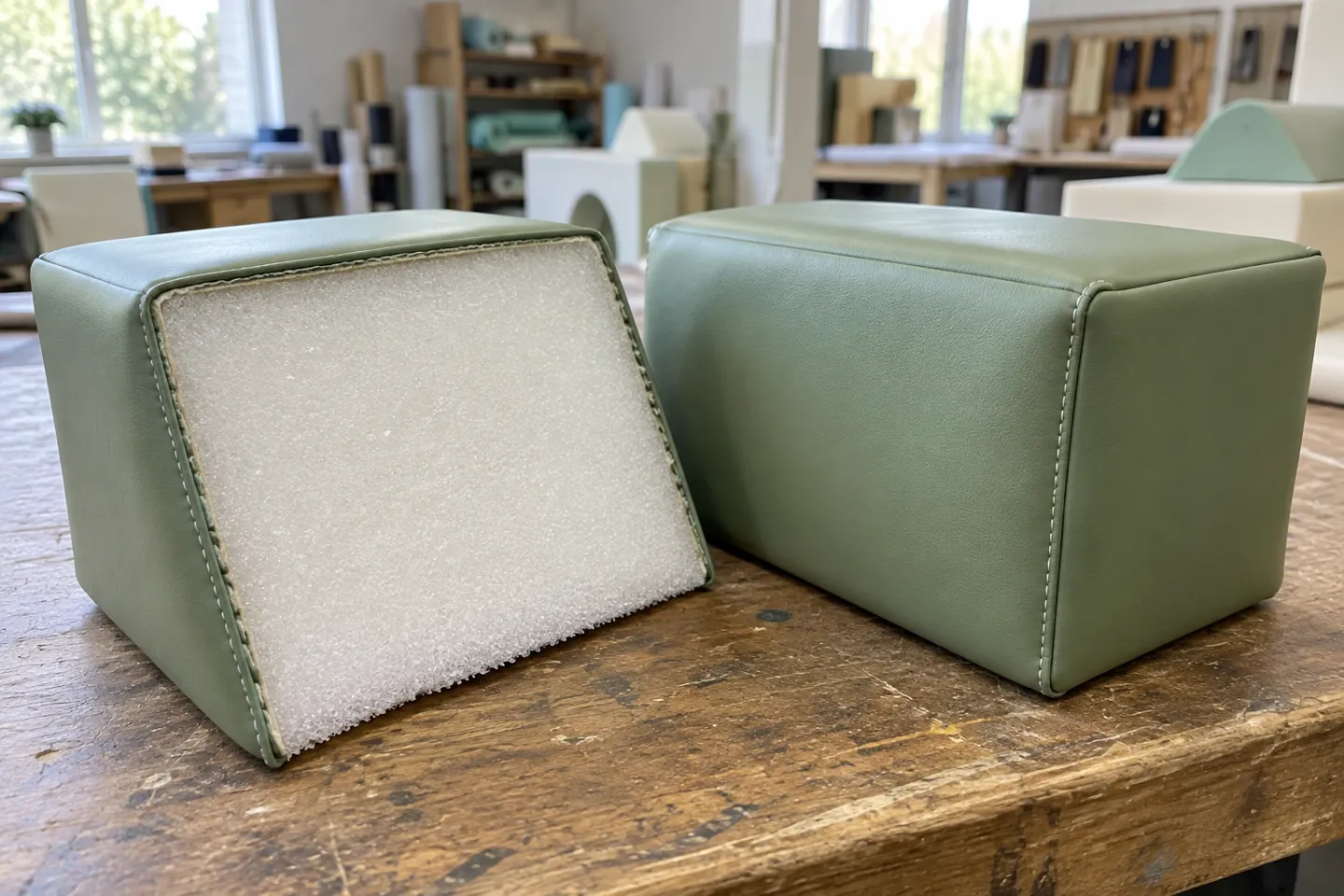
Strip the cover off almost any soft play item and the anatomy never changes. A foam core does the cushioning: it absorbs the bump and springs back. A cover, usually a leather-look vinyl, takes the scuffs and wipes clean. Stitching binds the two together, and it quietly absorbs more daily abuse than either layer it holds.
Foam core
The cushion. Absorbs impact and recovers its shape. Density decides how long that recovery lasts.
Cover
The work surface. Takes scuffs, spills and disinfectant. Weight and coating decide how many cleaning cycles it survives.
Stitching
The structure. Double-needle lines and sealed zip mouths keep the whole object together under daily drag and drops.
For a parent, the safety question lives mostly in the cover and whatever sits behind it. Three marks do most of the work. EN71 is the European toy safety standard and the reason most EU-market items carry a CE mark. CPC, the Children’s Product Certificate, is the American paperwork that sits on top of the ASTM F963 toy standard. None of these marks tells you how long the block will last. They tell you the materials are cleared for children to chew, hug and fall on. For something you already own, a missing mark is a closed question; for anything new, it is the first one to ask.
Here is the part most buying guides skip. The same three layers exist at every price point. What changes is the specification of each one: how dense the foam is, how heavy the cover, how the seams are built. Learn to read those specs and the price differences between lookalike products stop looking random. They start looking like a quote sheet.
The Material Spectrum: Foam Cores, Covers and Equipment Types
Materials are not one thing; they are a menu. Four core foams, four cover families, and a set of equipment shapes that stress each part differently. If you are fitting out a play corner or judging a supplier’s range, this is the map.
The two numbers behind every price
kg/m³
Foam density — kilograms of foam per cubic metre. Higher number, slower collapse under years of bouncing.
gsm
Cover weight — grams per square metre of fabric. Higher number, more abrasion and cleaning cycles survived.
Foam Cores: EPE, PU and the Fire-Rated Cousin
Most commercial soft play blocks and pit shapes are built on EPE, expanded polyethylene. It is closed-cell, so a split cover does not automatically mean a ruined block, it is light enough for a toddler to push around, and it recovers from compression instead of slowly flattening. PU, polyurethane, is the soft-hand alternative: plusher under the palm and common in padded panels and upholstered play pieces. It is open-cell, which means it holds water if the cover breaches. There is also a fire-rated version of PU called CMHR, combustion-modified high-resilience foam. UK and Irish buyers run into the name often, and the acceptance checklist below explains why. A rarer fourth option, EPP, recovers from hard impacts better than any of them and shows up in premium impact pieces. Most buyers will never need to leave the first three.
Density is the number that separates them in practice, and it is measured in kg/m³, kilograms of foam per cubic metre. More density means more material in the same volume, which means slower collapse under years of bouncing. Domestic and commercial builds aim at different points on that scale, and the exact commercial numbers belong in the acceptance checklist below rather than in a general tour.
Covers: What the Cover Is Wearing
PVC and vinyl are the commercial default for a simple reason: they wipe clean and they tolerate the alcohol-based disinfectants that commercial floors spray daily. PU leather covers feel softer and photograph beautifully, and they trade a little abrasion life for that hand feel. Textile covers belong mostly at home, where comfort wins and nobody is sanitising twelve times a day; frequent washing is exactly what they are worst at. A newer TPU option is creeping into eco-leaning ranges and remains uncommon enough that you will usually be choosing between the first three.
Cover weight has its own unit, gsm, grams per square metre. Heavier gauge takes more scuffs and more disinfectant cycles before it gives up. As with foam, the numbers that matter for commercial buying come later; what matters here is that cover weight exists as a spec at all, and that “vinyl cover” without a number is a sentence missing its ending.
Equipment Shapes: What Each Form Stresses
The same materials wear differently depending on what shape they are built into. Ball pits and floor mats live and die by their covers, because friction is constant and spread across every surface. Climbers, steps and rocker shapes load their cores instead: every landing is a compression test. Blocks do both. One boundary is worth stating plainly: textile covers do not belong in rental or commercial service, because daily disinfection destroys them no matter how good the foam inside is.
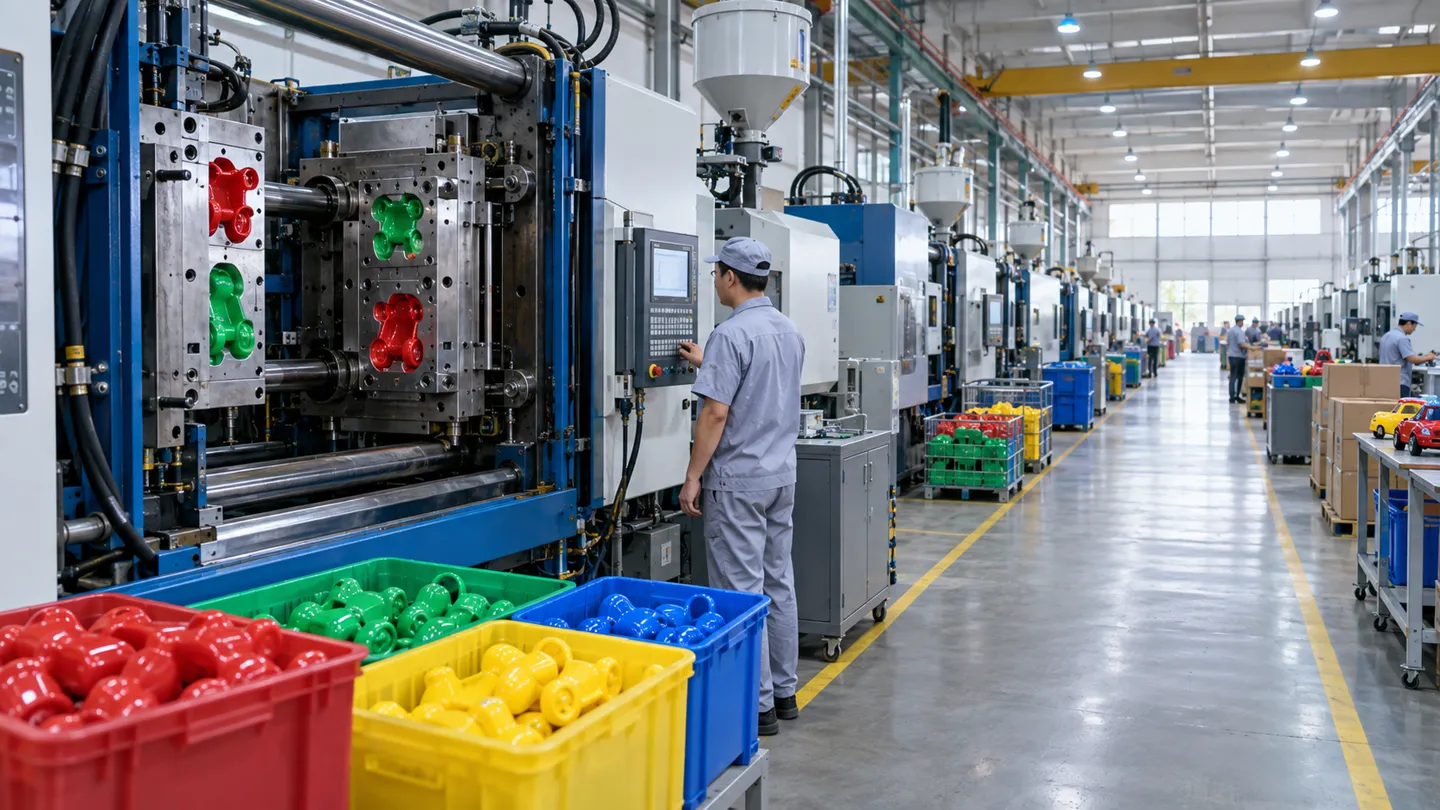
A footnote so the map has no holes: balance stones, stepping beans and similar sensory gear often share the floor with soft play, but they are injection-moulded plastic, not foam-and-cover. They are judged by hardness, grip texture and fade resistance, which is a different spec sheet entirely.
Foam cores at a glance
| Core foam | Hand feel | Moisture behaviour | Where you meet it |
|---|---|---|---|
| EPE (star of commercial builds) | Light and firm-springy | Closed-cell; shrugs off spills | Most commercial blocks, mats and pit shapes |
| PU (high-resilience) | Soft and plush | Open-cell; holds water if the cover splits | Padded panels and upholstered play pieces |
| CMHR (fire-rated PU) | Like PU | Plus flame-retardant treatment | UK and IE commercial specs asking for BS 5852 |
| EPP | Firm and poppy | Closed-cell | Premium impact pieces; uncommon in standard ranges |
Home, Rental or Commercial: Picking Your Grade
The material itself does not change between a living room and a play centre. The specification does, and it follows three usage levels. Home use means a few hours a day, one or two children, gentle cleaning: lighter foam, a lighter cover, even textile, all fine. Rental service, the party-hire business, runs on builds close to home grade, but handling becomes the extra wear source: van loading, stairs, storage crates, setup after setup. Commercial floor service is the top level: all-day use, rotating crowds, disinfection every closing time. At that level foam density and cover weight stop being details and become the product.
This is also why identical-looking quotes can sit far apart on price. A block that photographs the same can carry half the foam density and a cover half the weight. The gap is not a mystery and usually not a markup; it is the spec sheet nobody showed you. Two buyers comparing pictures are comparing the wrong thing.
Home grade
A few hours a day, one or two children, gentle cleaning. Lighter foam and lighter covers are fine.
Rental service
Builds close to home grade, with transport as the extra wear source: vans, stairs, storage, setup after setup.
Commercial floor
All-day use, rotating crowds, disinfection every closing time. Density and cover weight become the product.
Commercial demand is also heading one direction. The global indoor playground equipment market reached about USD 5.8 billion in 2024 and was growing at roughly 8.1% a year (Growth Market Reports, 2024). More venues are opening and refreshing, which means more buyers are shopping at the commercial grade, and the material spec is what decides whether stock survives in those rooms.
Three signals tell you home grade will fail early in your situation, and any one of them is enough: user count climbing past a household, cleaning that includes daily disinfectant, or regular transport. Spot any of the three and buy the next grade up. The upgrade costs less than buying twice.
Which grade are you actually buying for?
- Count users per day: household numbers point home grade, rotating crowds point commercial.
- Check cleaning routine: wipes at home, disinfectant spray in business.
- Count moves per week: stays in one room, or travels to every party?
Two or more business signals means quote the commercial spec.
The Commercial Acceptance Checklist: Specs That Separate Good Stock From Trouble
If you are buying for a floor, or reselling to people who do, acceptance comes down to four checks. None of them needs a laboratory. All of them need the supplier to write numbers down, which is exactly what separates a manufacturer from a trader with a catalogue.
Core Check: Density and the Three-Second Press
Commercial builds cluster around a minimum core density of 35 kg/m³ in EPE for blocks and pit shapes; that figure is a commercial manufacturer’s published baseline for exactly this equipment class (Didi Play Area, 2026). On the floor there is a low-tech version of the same test: press hard into the block for three seconds and let go. Sound foam springs back immediately. Foam that returns slowly, or holds a shallow print of your hand, is already travelling toward compression set, the permanent flattening that no cover can hide.
The three-second press
Push hard into the block, hold for a three-count, release. Fast rebound is a healthy core; a sluggish return is one already flattening.
Cover Check: Weight, Fire Rating, and the Market You Sell To
Cover specs move in the same direction as cores. Commercial soft play commonly specifies leather-look covers around 0.55 mm thick with fire-retardant and antibacterial treatment (Didi Play Area, 2026). In the adjacent world of inflatable and play equipment fabrics, commercial PVC lands in the 18–20 oz/yd² band, about 610–650 gsm, a range rental operators converge on because lighter fabric fails years sooner in the same service (LY TRUSTLINK, 2026). Fire rating is where target market decides the answer. UK and Irish buyers most often require foam and fabric assemblies to meet BS 5852 Crib 5, the requirement that makes CMHR foam worth its premium in those markets (Johanson Design). US buyers meet flame and chemical requirements through the toy-standard paperwork instead, which is the next check.
Seams: The Part Nobody Photographs
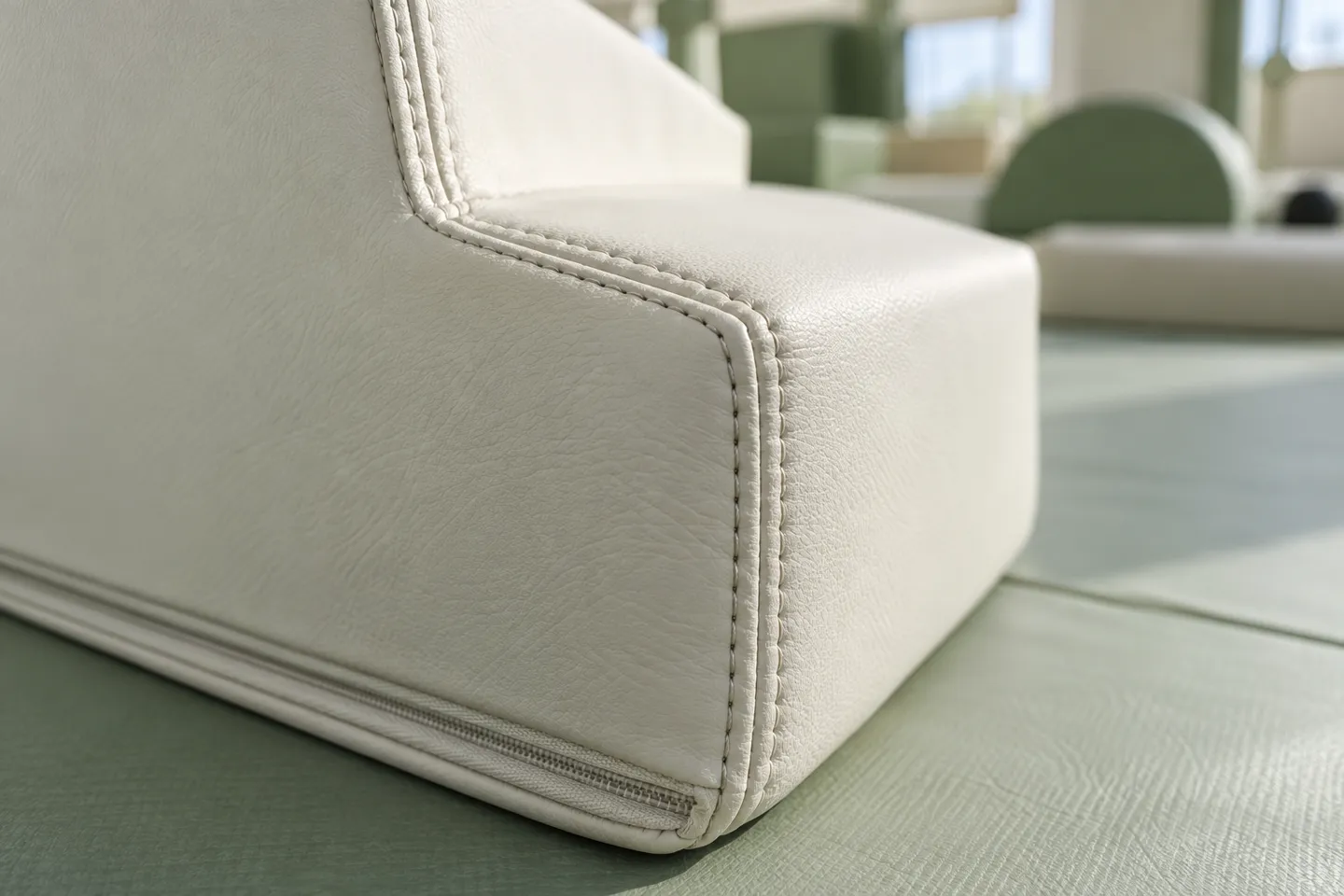
Three seam details predict most of the lifespan difference between similar-looking blocks. Double-needle stitching holds load lines far longer than a single row. Seams placed away from corners and high-stress edges survive dragging; a seam running across the corner of a step block is a scheduled failure. Hidden zippers change the economics of the whole purchase: a cover you can unzip and replace turns an end-of-life block into a maintenance item, while a closed or glued closure turns the same tired cover into a scrapped block.
Paperwork: Chemical Compliance You Can File
For the US market, CPSIA Section 108 caps eight regulated phthalates at 0.1%, one thousand ppm, in accessible plasticized parts of children’s toys (CPSC). EU buyers look for EN71-3 element migration results instead. The acceptance action is identical either way: request the test report files, matched to the product you are actually buying, and file them. A certificate that exists only as a logo image, or a verbal “all compliant, no problem”, is not a spec. It is a maybe with good manners.
The four checks compress into one matrix you can hold next to any quote:
Grade boundaries: what to check and where each grade fails
| Grade | Typical setting | Must-check specs | Fails when |
|---|---|---|---|
| Home grade | Living rooms and home nurseries | EN71 or ASTM F963 mark; cleanable cover | Daily disinfection or all-day multi-child use arrives |
| Rental grade | Party-hire fleets | Abrasion-tough cover with hidden zipper; handling-proof seams | Weekly van runs are asked of home-grade builds |
| Commercial venue grade | Play centres and family entertainment rooms | Near 35 kg/m³ EPE core; 0.55 mm-class fire-retardant cover; double-needle seams | The quote carries no density or gsm numbers at all |
| Institutional procurement | Schools and therapy centres | Commercial checks plus batch-matched CPC or EN71-3 test files | Certificates exist only as images and cannot be produced |
Keep that table beside the quote requests, because most sourcing mistakes happen at the comparison step, not the buying step. Two quotes with no stated density are not two prices for one product; they are two different products that happen to share a photo. The whole subject compresses to a single habit worth keeping:
The two numbers
Same look, different price.
35 kg/m³
Minimum commercial EPE core density for blocks and pit shapes
610 gsm
Commercial cover class — the 18 to 20 oz/yd² band rental operators converge on
Ask for both numbers before you compare anything.
Maintenance and Failure Modes: What Actually Kills Soft Play Material
Spend ten minutes in soft play business groups and you will find two cleaning religions. One sprays everything with degreaser and scrubs with melamine sponge; the other warns never to soak a block or touch it with anything abrasive. Both camps are half right, because the answer depends on the cover material and the seam quality, not on cleaning philosophy.
Cleaning methods vs covers: what is safe where
| Method | PVC or vinyl cover | Textile cover | The catch |
|---|---|---|---|
| Neutral soap and damp cloth | Routine and safe | Fine if barely damp | None; this is the default |
| Alcohol or quat disinfectant spray | Tolerated by fire-retardant leather covers | Discolours and degrades fibres | Seams and zip mouths wick liquid into the core |
| Abrasive pad or melamine sponge | Last resort for stains only | Destroys the surface | Shaves the coating; cracks follow within months |
The real failure route is rarely the flat surface you scrubbed. It is liquid reaching the core through seams and zipper mouths, which is why wipe-downs should finish with a pass along the seams, drying rather than soaking. Foam that takes on water slowly loses its resilience and, in open-cell PU, can grow things you cannot clean out.
Failure, when it comes, follows three visible routes. The core collapses first as a slow flattening under the busiest landing spots; the three-second press from the checklist above catches it early. Covers crack first along fold lines and sun-facing sides as plasticiser migrates out. Seams let go at load lines first, usually where a single row of stitching was asked to do a double row’s job. Each failure has the same first response: look at the busiest spot, not the average one.
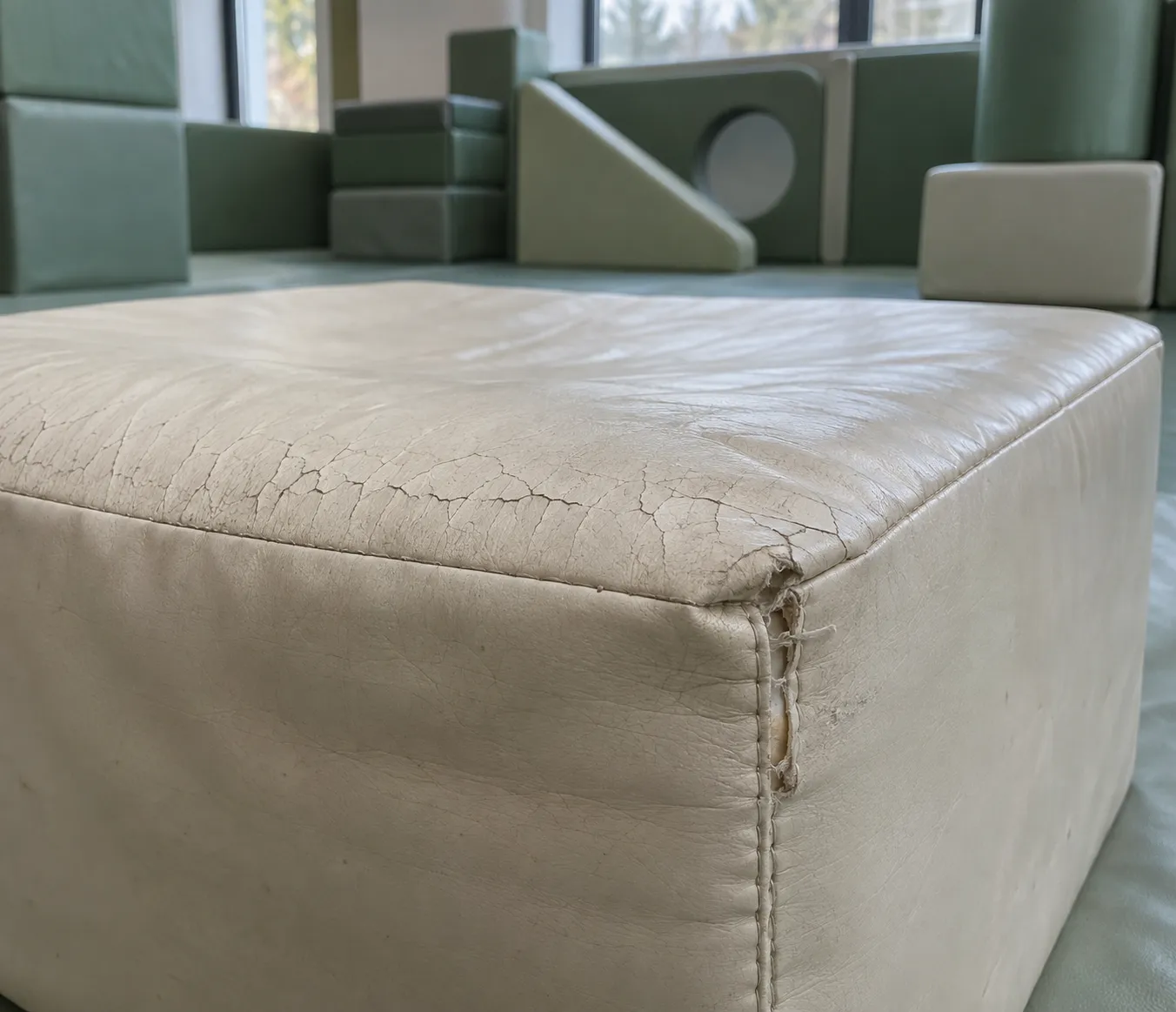
Replacement economics depend on a decision made at purchase time. A build with hidden zippers and replaceable covers re-covers for a fraction of replacement cost; a fully closed or bonded build turns a tired cover into a complete write-off. That is why the seam check belongs in buying and not just in maintenance.
Water in the core is the unrecoverable failure. Surfaces can be cleaned and covers can be replaced; a soaked foam block is a replacement. Dry the seams after every wet clean.
Buying Smart: Where to Source and What to Ask
Sourcing runs through three channels, and each fits a different stage. Brand manufacturers sell direct, which is where certification files, custom work and volume pricing live. Distributors and wholesalers consolidate pallets and shorten small-order friction, at the cost of a layer between you and the factory. Marketplace stock is the fastest way to test a product idea, and the weakest place to verify grade or compliance files. Early exploration tolerates layer two and three; scale needs layer one.
Price comparison only works between equals, and equals means same spec. Before comparing any two quotes, confirm both state core density and cover weight; a quote missing those numbers is not a price, it is a placeholder. The acceptance checklist above is the comparison filter: same grade, then compare money.
The questions that separate suppliers from catalogue traders fit on one card:
The five questions for any soft play quote.
- 1What is the core density in kg/m³, and which foam?
- 2What cover material and weight, and is it fire-rated for my market?
- 3Which compliance files come with the shipment: CPC, CE, EN71, and BS 5852 for UK or IE?
- 4What is the customization offer on colour, logo and packaging, and where does MOQ start?
- 5What is the lead time for stock items versus custom production?
Run a small batch before you scale. A sample order tells you whether the goods match the files: density that matches the quote, covers that match the spec, documents that match the shipment. Suppliers who welcome that check are telling you something useful; suppliers who resist it are telling you something more useful.
One red flag pattern covers most of the rest: certificates that arrive as logo images, quotes that answer every question with yes, and documents where density and gsm should be. Each one is cheap to avoid before wiring money and expensive to discover after.
Send your five questions to Startinal and get a quote with density, cover weight and compliance files stated up front.
Request a Spec-First QuoteThe Seller’s Read: Material Grades as a Product Mix
Everything above reduces to a single axis: grade. Grade decides lifespan, cleaning tolerance, compliance cost and price together, because all four are the same spec sheet seen from different chairs. That has a direct consequence for anyone building a catalog rather than furnishing one room.
Structure the catalog the way the material actually splits. Home-grade SKUs move in volume and compete on price and look; commercial-grade SKUs carry the margin and compete on spec. The failure pattern is the mixed listing: a product page that cannot state density or cover weight cannot answer the buyer’s real question, and it pays for that in returns and one-star postmortems. Listings that write the two numbers in the title answer the question before it is asked.
The demand side justifies tilting the mix. With indoor playground equipment compounding at roughly 8.1% a year (Growth Market Reports, 2024), commercial-grade stock is the portion of a catalog that rides a growing market instead of a flat one. And the compliance files are not overhead; they are the entry ticket that keeps listings alive in markets that check.
This is the standard we build to on our own soft play line. At Startinal, every item ships with its CPC, CE and ASTM F963 compliance documentation in the carton, alongside EN71 for EU orders, because the files your listing needs should not arrive in a follow-up email. When you separate a catalog into grades, we quote each grade with its density and cover weight stated up front, so the two numbers are never a surprise.
Run your next quote through the five questions, and let the two numbers decide the price.
Soft Play Stock With the Numbers in Writing
CPC, CE and EN71 documentation ships in the carton, and every grade is quoted with its density and cover weight stated.
Start Your QuoteReferences
- Growth Market Reports. “Indoor Playground Equipment Market Research Report 2033.” 2024. growthmarketreports.com
- U.S. Consumer Product Safety Commission. “Phthalates Business Guidance.” cpsc.gov
- Johanson Design. “Fire Requirement: CMHR Foam and BS 5852.” johansondesign.com
- LY TRUSTLINK. “PVC Inflatable Fabric Specifications and Sourcing Guide.” 2026. ly-trustlink.com