.png)
What counts as an educational toy depends on who you ask, and most of the answers come back shaped by packaging. The category matters to more than parents, though. Teachers outfitting a classroom, therapists stocking a sensory room, and resellers building a product line all end up asking the same question from different sides of it. This guide answers it in one pass: what the label actually means, and how the category is structured. Then it shows how to judge a claim before money changes hands. Last, where the profit sits for anyone buying these toys by the pallet rather than the piece.
What Are Educational Toys? The Design-Intent Definition
An educational toy is a play object designed to build a specific capability in a child: balance, fine motor control, number sense, language, emotional regulation, or creativity. The operative word is designed. A ball is a toy. A ball with a textured surface and a weight tuned for small hands is another matter. Someone made deliberate design decisions around a developmental goal, and that makes it an educational toy.
That is the test worth carrying through this whole article. Ignore the packaging first. Ask instead: which capability does this toy target, and what structural choice serves it? Older catalogs sometimes say “instructive toys,” and retail shelves prefer “learning toys.” Same category, same test.
The age band printed on the box is a regulatory convenience, not a capability statement. It assumes a typical child at a typical pace. Two three-year-olds can be a year apart in balance or language. That is why this guide sorts toys by what they do, not by who they are nominally for.
One honest caveat before the taxonomy: nothing on a toy aisle is certified as “educational.” The word is unregulated marketing language. What separates a real educational toy from a decorated one is the design intent behind it, and that you have to judge yourself. The next two sections give you the framework for doing exactly that.
The Types of Educational Toys: Skill Areas and Play Structures
Sort the category by skill area first, then by how the toy actually plays. Both axes matter, and they answer different questions. The first tells you what a toy trains; the second predicts whether the child will still be playing with it in three months.
By Developmental Skill: Six Areas That Matter
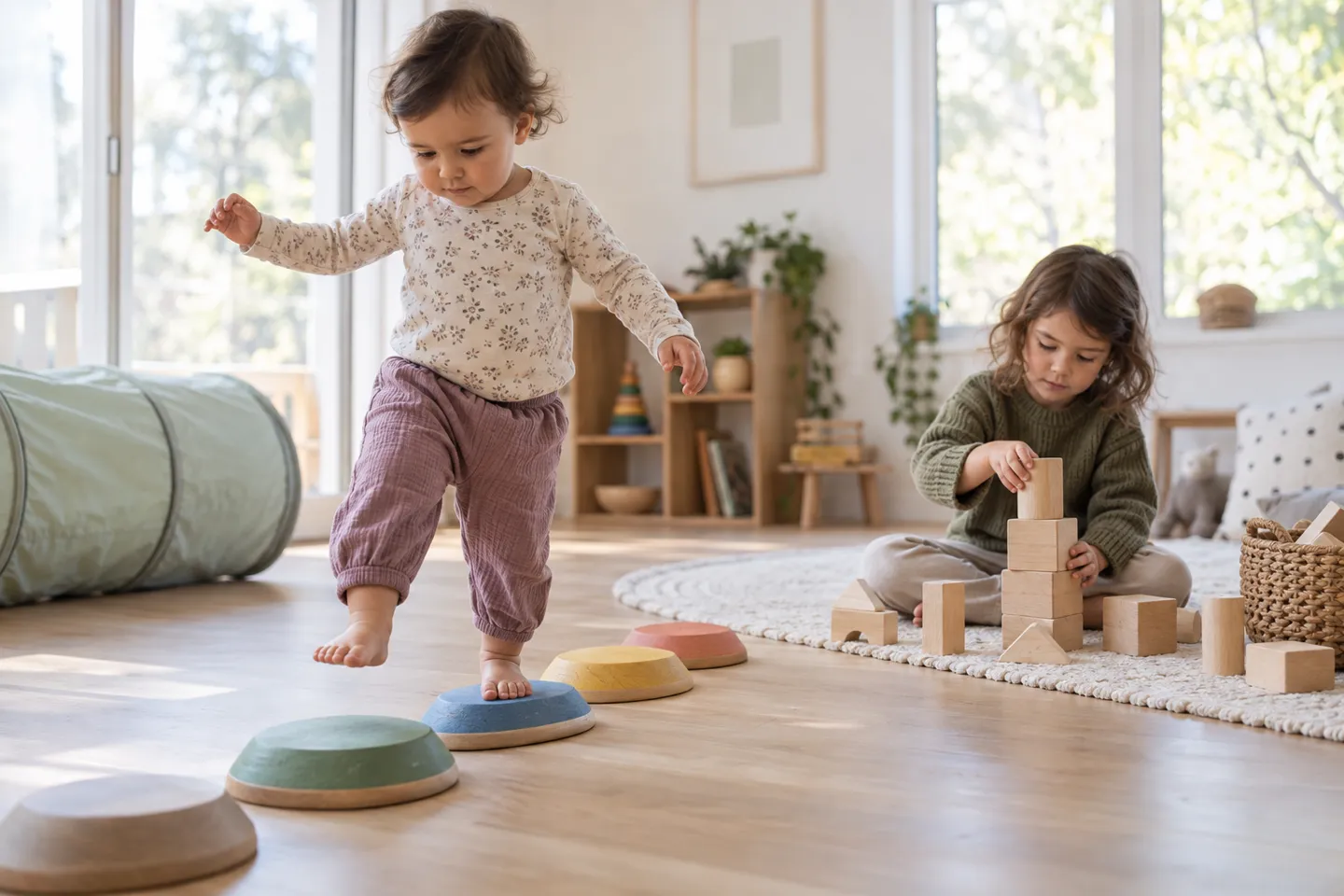
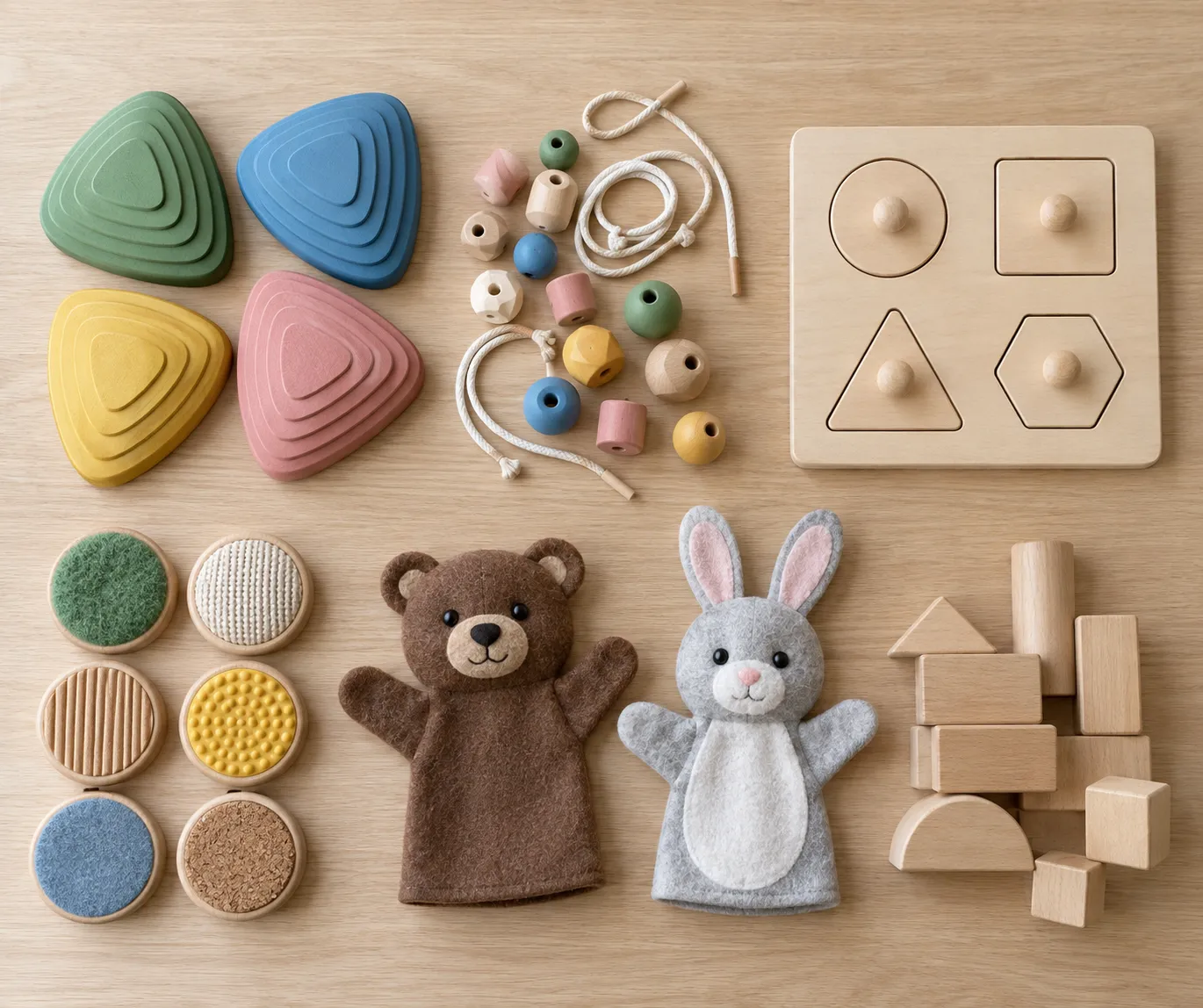
Gross motor. Equipment that moves the whole body: balance stones and river stones, balance beams, wobble boards, tunnels, jumping bags. These target coordination, spatial awareness, and the confidence that comes from physical mastery. A set of stepping stones does not teach letters; it teaches a child where their body is in space, which is its own school subject.
Fine motor. Threading beads, stacking blocks, lacing cards, snap-together construction. Small muscle groups, hand-eye coordination, and the finger strength that later makes pencils manageable.
Cognitive and STEM. Puzzles, counting sets, pattern games, simple building kits with a problem to solve. These train sequencing, cause and effect, and early logic.
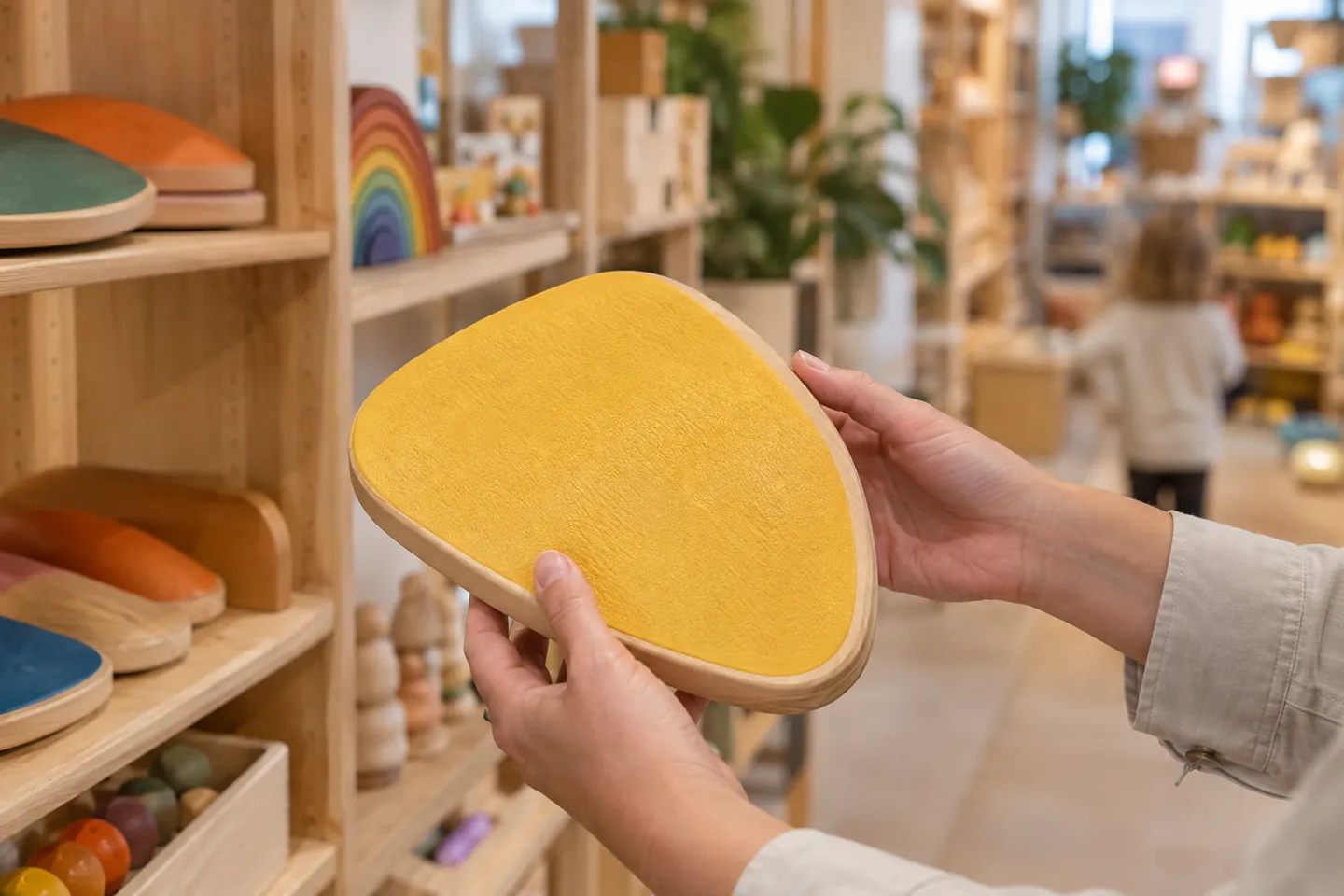
Sensory integration. Textured pads, tactile stones, weighted or swivel seating. Occupational therapists use this equipment with children who process sensory input differently; classrooms use it as movement breaks that help regulation. The design language is in the surfaces and the motion, not the features.
Social-emotional and language. Puppets, role-play sets, cooperative board games. These create scenarios where children practice negotiation, empathy, and vocabulary with each other rather than with the toy.
Creative and open construction. Blocks, play silks, art materials, mix-and-match sets. Less a skill than a stance: the child decides what the object becomes.
Every one of these areas shows up in the research-backed benefits list you have probably read: cognitive growth, motor development, social skills, emotional regulation. The skill taxonomy is simply that benefits list, made concrete enough to buy against.
By Play Structure: Open-Ended, Closed-Ended, and Electronic
Skill tells you what a toy trains. Play structure predicts how long the training lasts, and this is where the category quietly splits.
Open-ended toys have no single solution. River stones become a floor-is-lava game, then a shop counter, then dinosaur islands. Because the child generates the play, the toy grows with the child. Parents notice which toys survive the toy-box audit; the ones that get kept playing with are rarely the ones with the most functions.
Closed-ended toys have one right answer. A jigsaw puzzle is finished when it is assembled, and its value decays with each completion. That is not a flaw; puzzle number forty still teaches persistence. But a shelf of closed-ended toys is a shelf of expiry dates.
Electronic toys with lights, sounds, and scripted responses sit in their own quadrant. They feel educational because they talk and quiz. The evidence points the other way. In one study of parent-infant play sessions, electronic toys produced fewer adult words, fewer conversational turns, and fewer parental responses than traditional toys or books. The author’s conclusion was blunt: where early language development is the goal, electronic toy play should be discouraged (Sosa, JAMA Pediatrics, 2016). The mechanism is uncomfortable but simple: when the toy does the talking, nobody else has to.
Educational toys at a glance
| Type | What it trains | Typical examples | Play value over time |
|---|---|---|---|
| Gross motor | Balance, coordination, spatial awareness | River stones, balance beams, tunnels | Stays high: play is child-generated |
| Fine motor | Hand-eye control, finger strength | Beads, stacking blocks, lacing sets | Stays high with variety |
| Cognitive/STEM | Sequencing, logic, cause-effect | Puzzles, counting sets, pattern games | Decays per puzzle; refreshable |
| Sensory | Regulation, tactile processing | Textured pads, tactile stones, swivel seats | Stays high; therapist-grade by design |
| Social-emotional | Empathy, negotiation, language | Puppets, role-play sets, co-op games | Stays high with peers |
| Creative/open | Imagination, decision-making | Blocks, silks, mix-and-match sets | Stays highest: no ceiling |
A note on materials and formats, for completeness: wood, plastic, and fabric each have a place, and app-connected toys are their own micro-category. None of that changes the two-axis logic. If a toy trains a named skill and survives the play-structure test, the material is a preference, not a criterion.
Marketing Claim or Real Learning: How to Tell the Difference
Between the definition and the shopping decision sits an uncomfortable gap. “Educational” sells, so the label gets stamped on everything, and claims like “boosts IQ” or “builds young brains” have no consistent evidence behind them. What research does support is narrower and more useful. Interactive, child-led play is tied to language growth and self-regulation. The toy’s role is to scaffold that interaction, not replace it.
Three checks separate the claims worth paying for from the ones worth ignoring.
First, find the design intent. One named skill, visibly engineered for: a texture that exists to be felt, a weight that exists to be balanced. If the box lists six benefits and the toy has one button, the box is doing the education.
Second, count the second games. Ask what the toy becomes after the first game. Open-ended toys answer with a list; scripted toys answer with silence.
Third, check who works during play. The learning lives in the interaction between child and adult, so a toy that monopolizes attention works against its own label (Sosa, JAMA Pediatrics, 2016).
The five-line shelf checklist
- Names one skill honestly — one capability, visibly engineered
- Has a second game once the first is mastered
- The child leads the play, not the toy
- Carries a real safety certification for your market
- Scales with ability instead of expiring at a birthday
Five yeses is a genuinely educational toy. Three means it is a toy, which is fine, as long as that is what you are paying for.
Choosing by Context: Home, Classroom, Clinic, or Shelf
The same stepping stone plays four different roles in four different places, and the buying criteria change more than the product does. This is where most buying mistakes happen. People carry home standards into professional settings, or professional standards into a marketplace listing. The mismatch surfaces months later as cracked plastic, a rejected shipment, or a shelf of unsold stock.
How Each Context Changes the Rules
At home, the buyer controls the environment. One or two children use the toy, an adult is usually nearby, and gentle use is the norm. Criteria skew toward fit with the child’s current interests and abilities, because replacement is cheap.
In a classroom or preschool, everything scales up. Thirty children a day, five days a week, none of them gentle. Home-grade plastic that survives a family can crack in a term, and institutions buy against that reality: thicker walls, reinforced edges, materials that survive disinfectant. Curriculum fit is the second gate; a sensory path is not a toy here, it is equipment for a gross-motor lesson plan.
In a therapy room, age labels stop mattering entirely. Therapists select by ability: a four-year-old with low tone may need equipment boxed for sixes, and a developmentally typical two-year-old may be past it. Sensory and motor equipment in these rooms gets chosen the way clinical tools get chosen, by what the child presents with.
On a retail shelf or a marketplace listing, the buyer is a reseller, and the criteria turn structural. Does the product carry the compliance documents the destination market demands? Can the supplier support mixed-SKU orders and reorders? Is the design defensible against the patents already out there?
Certifications: What the Documents Actually Guarantee
Two regulatory systems cover most of the world’s toy trade. In the United States, children’s products must be certified as meeting CPSIA requirements based on third-party testing, and the written Children’s Product Certificate must accompany the product into commerce (16 CFR Part 1110, eCFR). In the European Union, toys must carry CE marking under the Toy Safety Directive, with the EN 71 standards series behind it.
Treat the paperwork as a practical filter, not a formality. Before committing to any supplier, ask for the certificate numbers and verify them against the issuing scheme. A certificate you cannot look up is a certificate you do not have. Missing documentation is what turns a good product into detained customs cargo or a taken-down listing.
The Context Matrix
Educational toy buying criteria by context
| Context | First standard | Must-have documents | Common failure point | Action before you buy |
|---|---|---|---|---|
| Home | Fit to the child’s ability and interests | Safety certification for your market | Buying ahead of ability because of a printed age label | Check the second game, not the box |
| Classroom / preschool | Durability under multi-child daily use | Compliance certificates the institution can file | Home-grade materials cracking within a term | Ask for institutional-grade construction specs and a sample to stress-test |
| Therapy / clinic | Ability match, not age match | Same safety documents, plus material specs for sanitizing | Selecting by age band instead of presentation | Specify by skill target and request material and dimension specs |
| Retail shelf / marketplace | Compliance and differentiation | CPC for US, CE for EU; patent clearance | Missing paperwork blocking launch; patent complaints freezing stock | Verify certificate numbers and run a design search before the PO |
Read the matrix by rows for one purchase, or by columns when setting a supplier standard. Either way it says the same thing. “Is this a good educational toy” is never the whole question. “Good for whom, used how hard, sold where” completes it.
Whichever context you are buying for, the fastest shortcut is a factory that already passes the matrix — Startinal answers compliance, durability, and customization questions from the production floor, not a catalog.
What to Require from an Educational Toy Manufacturer
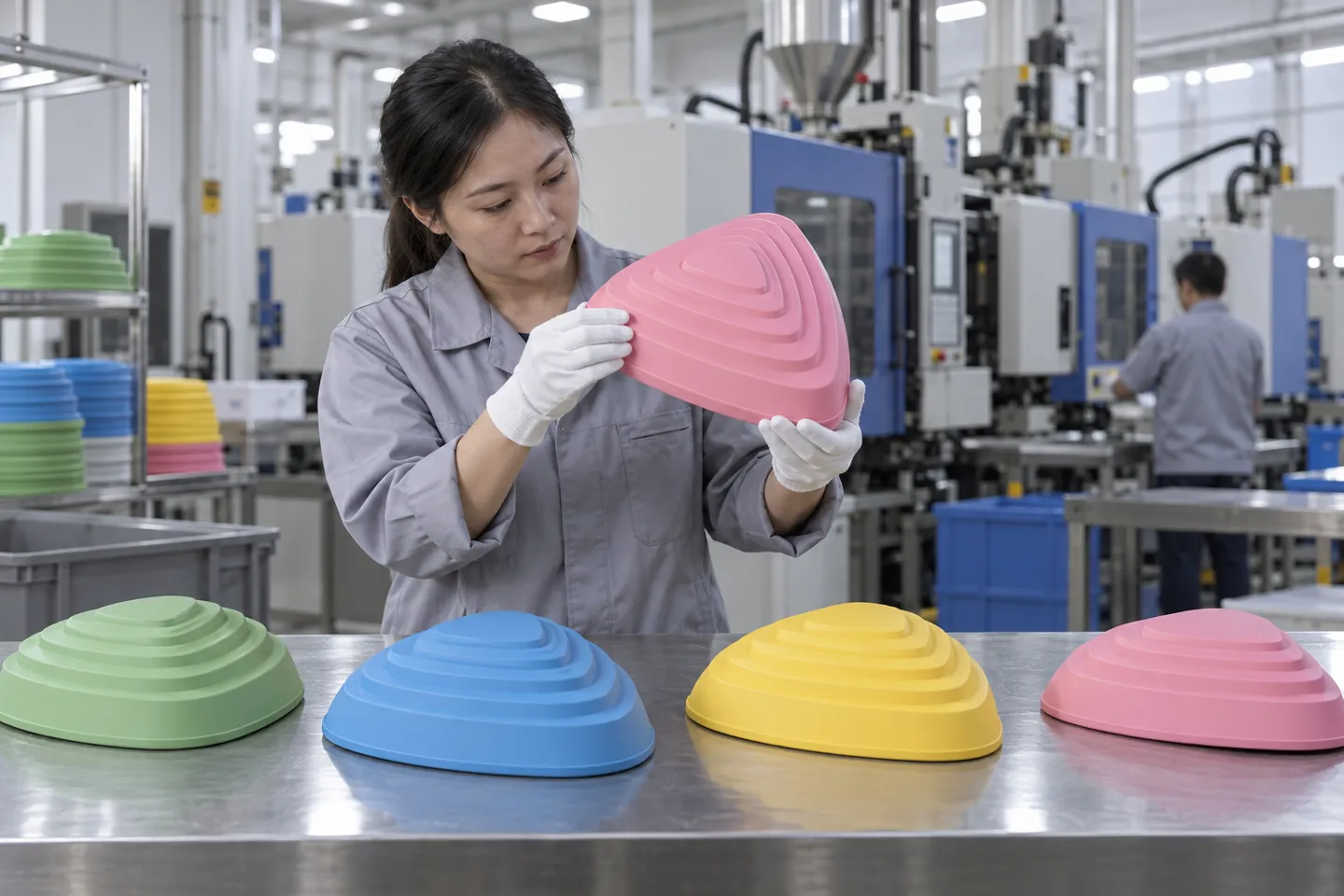
Sooner or later, the context matrix points the same direction for institutions and resellers alike: at the factory. Whether you are equipping a nursery chain or building a product line, the questions to put to a manufacturer are the same six. Each comes with its own way to verify the answer.
Own production, first. A factory that runs its own injection, rotomolding, metal, and sewing lines controls quality in-house. A trading company forwards your specification to whoever is cheapest that month. Ask which processes happen in their building and which go out to other workshops.
Second, a real design and patent list. Original molds registered in the destination markets protect you from the single most expensive surprise in this category: an infringement complaint that freezes your inventory. Ask to see the patent portfolio, not just the catalog.
Third, certification you can verify, as covered above; fourth, order flexibility. Stock items available at low minimums let you test a design before committing capital. Light customization with a realistic threshold is the difference between “OEM” as a logo on a price list and OEM as a service. Fifth, mixed-category loading, so balance equipment, sensory items, and soft play ship in one container on one invoice, not three vendors and three freight bills.
Sixth, after-sales terms in writing. Ask for pre-shipment inspection rights, a set response time for replacement parts, and a remedy clause for late delivery. A 48-hour parts commitment is an attainable benchmark in this industry. A manufacturer that accepts these terms has told you something no product photo can.
The six-point manufacturer scorecard
Own production lines
Ask which processes run in their own building
Original designs and patents
Request the patent portfolio, not the catalog
Verifiable certification
Ask for certificate numbers and look them up
Low-minimum flexibility
Test with stock items before committing capital
Mixed-category loading
Balance, sensory, and soft play on one invoice
Written after-sales terms
Inspection rights, parts response time, late-delivery remedy
One boundary worth naming: the thickest catalog is not the deepest factory. Ask by production line, not by page count.
Where Educational Toy Businesses Go Wrong
The failure modes in this category are few, well-documented, and almost always procedural. They cluster at three moments in a product’s journey.
Before ordering
Compliance: request certificate numbers and test reports with the quote, not after the PO. No documents, no order.
Before listing
Patents: run a design search on every SKU before it lists; demand the factory’s original-design and patent documentation in writing.
After launch
Reviews: test open-ended structural lines first; watch return reasons for “stopped playing” signals; write replacement-parts response times into the contract.
Before ordering, paperwork is the pit. Children’s products entering the US need that third-party-tested Children’s Product Certificate (16 CFR Part 1110, eCFR), and the EU needs its CE file. Buyers who find the gap after production have already paid for goods they cannot import.
Before listing, the pit is intellectual property. Educational toys are a heavily patented category, and marketplace complaints move faster than lawyers. The checklist item is unglamorous: patent search every design, and buy original or licensed only.
After launch, the pit is the abandoned toy. A scripted electronic toy earns its first bad review the week the novelty fades, and in this category the review is the inventory. Resellers who lead with open-ended structural products, the balance lines and the sensory sets, see steadier review profiles than those chasing gadget features. That is one reason the margin conversation below is not only about price.
The ordering shifts with the channel: platforms amplify the compliance and patent risks, institutions amplify durability, direct-to-consumer amplifies the abandonment signal. Same three pits, different depths.
The Economics: Where the Margin Lives
For everyone buying this category by the pallet, the question underneath all the others is simple: where does the money actually sit? The honest answer is that the category has split into two speeds, and the split follows the structure versus script line from earlier in this article.
Generic educational items, the plastic learning gadgets and scripted electronics, have commoditized. Big brands own the shelf space, price competition is brutal, and the patent thicket makes “me-too” listings a liability. The wholesale end of that segment is a volume game that favors whoever has the least imagination about margins.
The structural side, gross-motor equipment, sensory lines, open-ended construction, still rewards differentiation. Certification, durability engineering, and original design are defensible precisely because they cost effort to copy. A working benchmark from the trade: buy a learning toy wholesale at $15 and sell it at $45. That returns a 66% gross margin before platform fees, and sellers typically net around 30% after them (Worldwide Brands, 2025). Independent stores that bundle related items, a stone set with a balance beam, say, report net margins of 45 to 55% on the same logic.
The margin, in numbers
$15
Wholesale
$45
Retail
66%
Gross, before fees
≈30%
Net, after fees
The margin is real — and it accrues to the seller who chose the structure, not the one who chased the gadget.
Benchmark: Worldwide Brands, “Market Analysis: Learning Toys,” 2025.
So the stocking stance writes itself. Weight the assortment toward the structural, open-ended lines that pass the context matrix and survive classrooms; use scripted electronics, if at all, as low-depth traffic bait rather than profit lines. Q4 will amplify whichever choice you made, in both directions. The season concentrates demand and competition at once. The sellers who hurt most in January are the ones who bought the commodity layer for the rush.
There is a boundary on the stance, to be fair. A pure volume operation with fulfillment advantages can live in the commodity layer; a brand builder cannot. Know which business you are running before the first container.
Every requirement in this article, verified certificates, original designs, low-minimum flexibility, written after-sales terms, doubles as a supplier scorecard. If you want to test a manufacturer against that scorecard, Startinal’s OEM and low-MOQ program is one place to start. Our balance, sensory, and soft-play lines are built in a 10,000㎡ factory, stock ships at low minimums, and samples are free aside from freight.
Put your next toy line on steady ground
OEM and low-MOQ programs on balance, sensory, and soft-play equipment — original designs, verifiable certificates, and written after-sales terms, straight from a 10,000㎡ factory floor.
Request samples and a quoteReferences
- Worldwide Brands. “Market Analysis: Learning Toys.” 2025. worldwidebrands.com
- Sosa, A. V. “Association of the Type of Toy Used During Play With the Quantity and Quality of Parent-Infant Communication.” JAMA Pediatrics, 2016. pubmed.ncbi.nlm.nih.gov
- Electronic Code of Federal Regulations. “16 CFR Part 1110—Certificates of Compliance.” Current edition. ecfr.gov