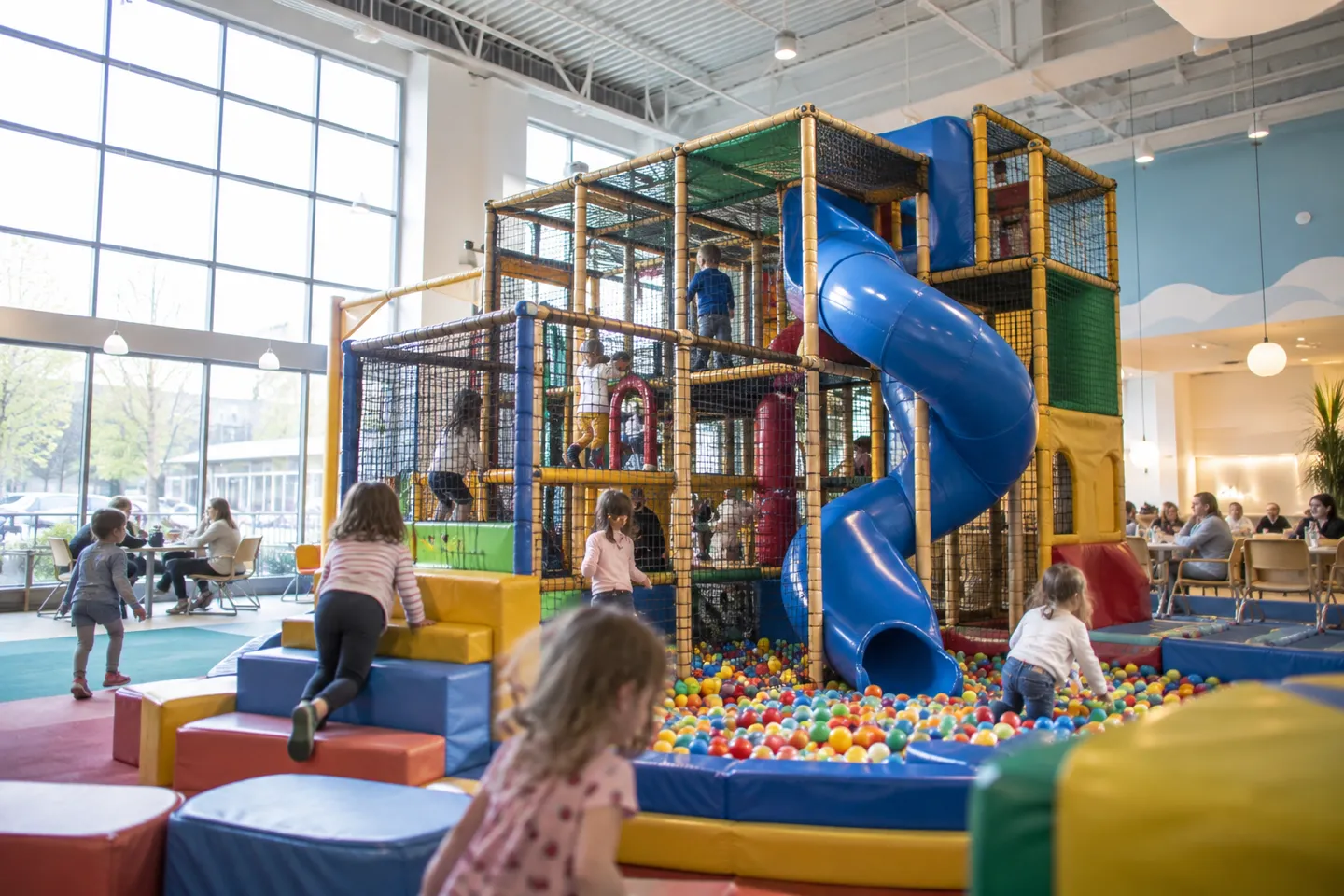
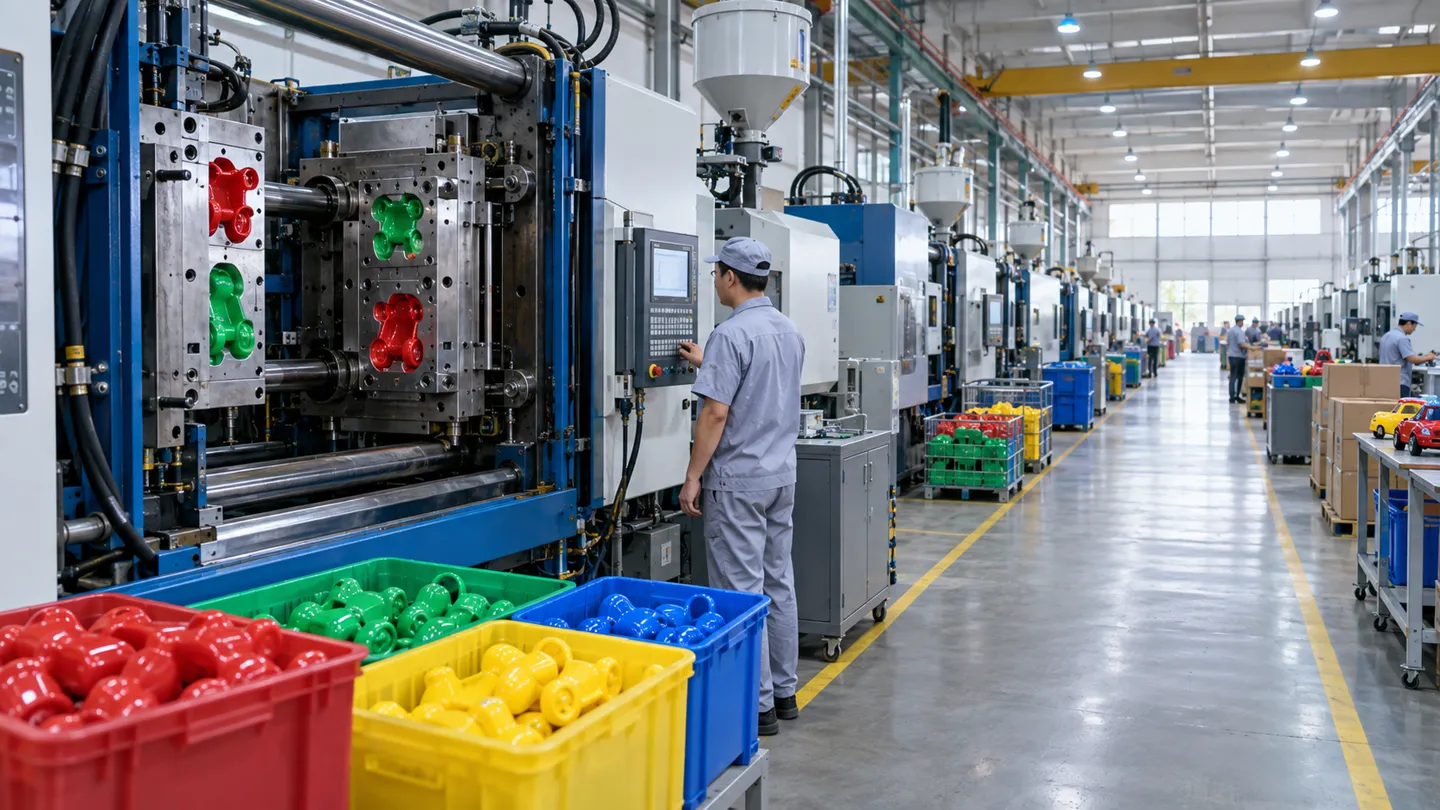
A toy store, a factory, a dealer, a marketplace: every one of them will happily sell you indoor playground equipment. That is not because the question is simple. The same phrase covers a $300 foam block for a playroom and a $300,000 play system for a family entertainment center. Every seller hopes you land on them.
The useful version of this question is narrower: which of the five places you can buy from actually fits your space, your budget, and your tolerance for risk. This guide walks the full spectrum, from a single climber to a full container. It ends with the checks that keep a cheap-looking purchase from becoming an expensive one.
What Counts as Indoor Playground Equipment (and the Home/Commercial Line That Decides Everything)
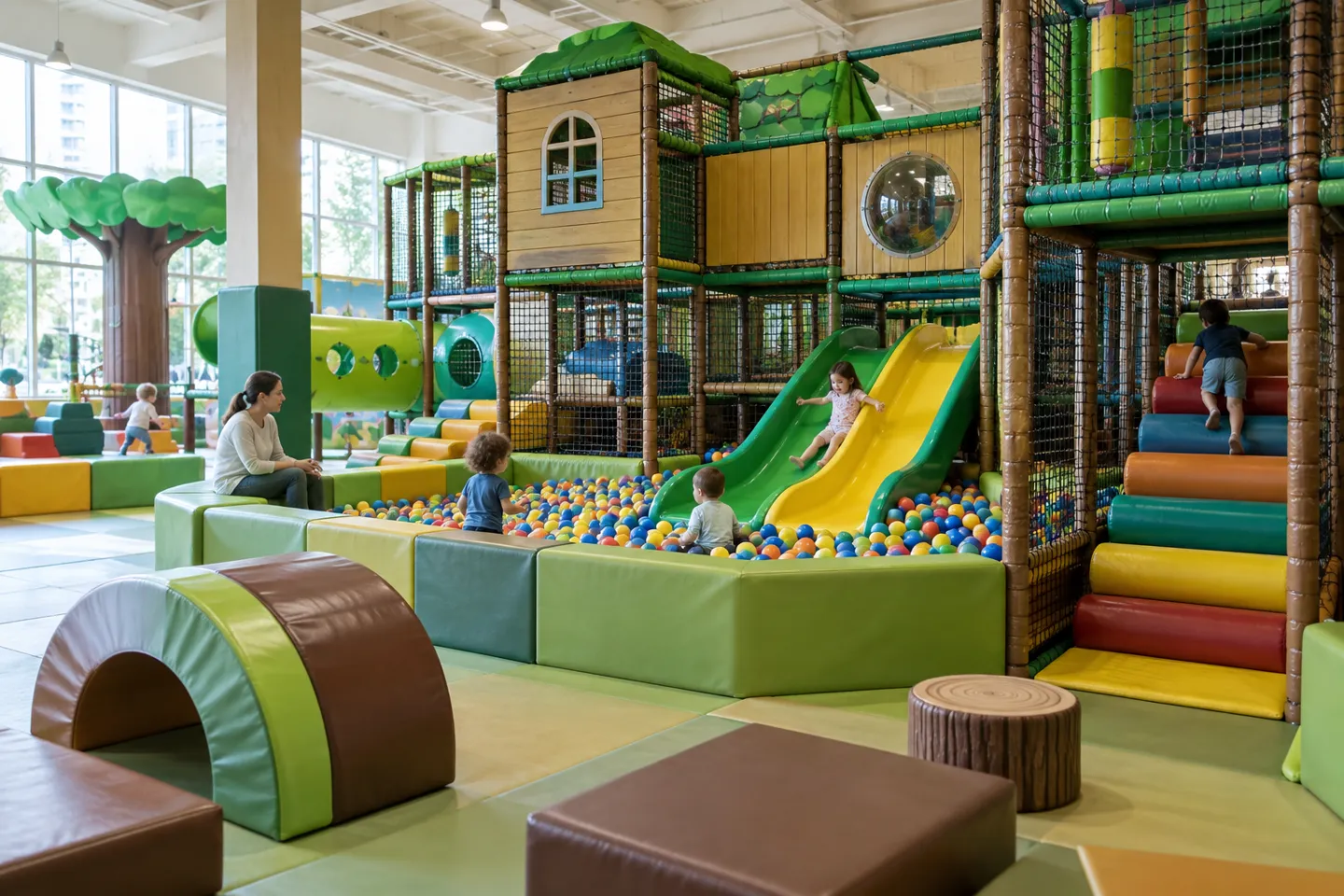
The term is an umbrella. Under it sit soft play items such as cushioned climbers, ball pits, foam blocks, and tunnels. It also covers modular climbing structures, trampolines, playhouses, and the sensory items that often share the same room. Retailers and factories use the phrase loosely, so two products that share a name can sit on completely different levels of the market.
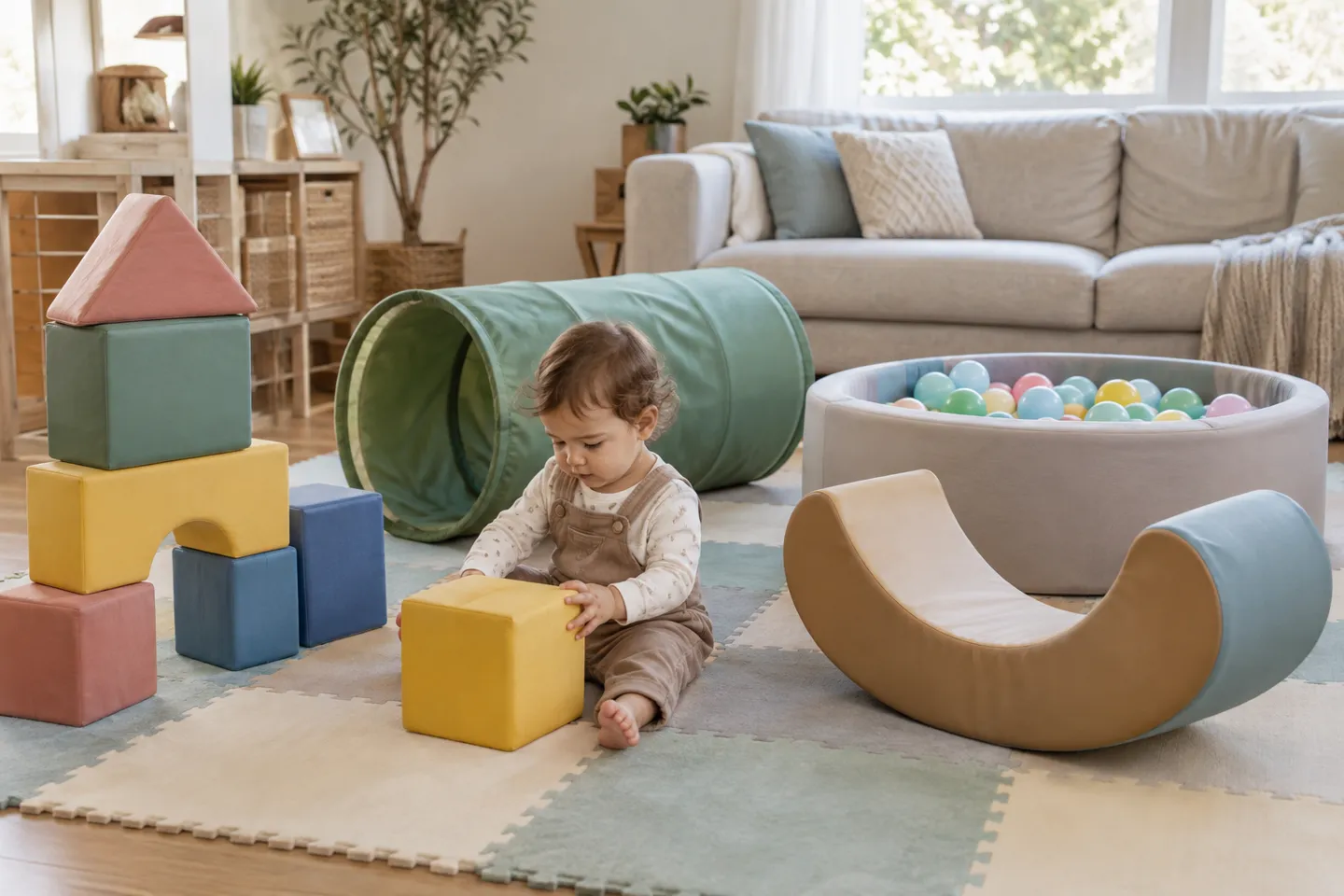
That level is the first thing to settle, before you choose a store or a supplier. In the United States, regulators draw this line explicitly. Playground equipment built for homes is judged under ASTM F1148, the home playground equipment standard. Equipment for public and commercial settings is held to different, more demanding requirements (CPSC, 2026). Toys and small play items fall under ASTM F963, the mandatory federal toy safety standard (CPSC, 2024). The paperwork follows the intended use, not the product’s looks.
The boundary has a practical edge. A home-grade climber survives two children a few hours a day. It will not survive thirty children every day. Foam densities, seams, connectors, and anchoring are all specified differently at commercial grade. If you are equipping a business, even a small play café, insurance and liability push you firmly onto the commercial side of the line. Your budget does not get a vote here.
So the real question behind “where to buy” is “which channel sells for my scenario.” There are five. Each exists for a reason, and each fails in a predictable way.
The Five Places to Buy Indoor Playground Equipment
Think of the market as five channels stacked by project size. Retail serves a room. Commercial dealers and manufacturers serve a venue. Direct import serves a project or a container. The used market cuts across all of them.
Online Retail and Specialty Stores
Marketplaces and specialty web stores are where families, and to a lesser extent preschools, actually shop. Catalogs lean home-grade: Montessori climbers, wall bars, foam blocks, soft tunnels, typically from roughly $50 to $2,000 per item. Specialty retailers such as Playgrounds Etc and Fun and Function curate this layer with better filtering than a general marketplace. That filtering matters: product pages rarely state which side of the home/commercial line an item sits on.
This channel is right when you are furnishing a playroom, a classroom corner, or a home. It fails quietly in commercial settings. An item marketed as “commercial” at retail pricing rarely carries the foam density, connector hardware, or test documentation for daily public traffic. And no marketplace listing will settle an insurance inspector’s questions.
Commercial Dealers and Stocking Manufacturers
Once the space is a business, the market reorganizes around project-based suppliers. North American stocking manufacturers and commercial dealers sell designed play systems, and they publish real prices. Go Play Systems lists in-stock commercial systems from about $25,600 to $317,000 (Go Play Systems, 2026). Distributors such as Indoor Playgrounds International work consultation-first, bundling design, delivery, installation, parts, and an industry warranty into the deal (Indoor Playgrounds International, 2026).
What you are buying here is accountability. Design drawings, installation crews, replacement parts, and a service desk all come from one contract. That is why churches, daycares, schools, and family entertainment centers default to this lane. The trade-offs are budget and pace: this is the most expensive channel per unit of play value, and custom builds wait in a production queue.
Importing Direct from Overseas Manufacturers
The third channel is factory-direct import, dominated by manufacturing clusters in China. Factories sell complete themed playground packages, and they publish prices too. Angel Playground lists themed indoor playground packages from about $23,960 to $140,700 (Angel Playground, 2026). Manufacturers such as Dreamland Playground state ASTM and TUV/EN compliance as a core selling point (Dreamland Playground, 2026). A typical deal includes free design, production, ocean freight, and remote installation guidance, sold as a turnkey package.
This is the natural lane for importers, distributors, and experienced venue founders, and it is where the deepest price advantage sits. The cost of that advantage is responsibility. In this channel, nobody hands you a turnkey trust package. Verification of certificates, of the factory, and of the whole landed cost becomes your job. Section four covers how to do it.
The Used Equipment Market
Liquidations, resales, and secondhand listings round out the map, often at half price or less. Used equipment comes without warranty, without compliance documents, and with unknown wear on the components that fail first. It only makes sense when you can inspect it in person and your use case does not depend on paperwork. For a licensed commercial venue, the missing documents usually cost more than the discount saves.
Each channel has a buyer it fits and a way it fails. Before comparing quotes, find your row:
Five Buying Channels at a Glance
| Channel | Best for | Typical spend | Where it fails you |
|---|---|---|---|
| Online retail & specialty stores | Families, playrooms, classroom corners | ~$50–$2,000 per item | Home-grade items lack the density and documentation for daily public traffic |
| Commercial dealers & stocking manufacturers | Venues needing design, install and service (daycares, schools, FECs) | ~$25,600–$317,000 per system (published US list prices) | Highest cost per play value; custom builds queue |
| Direct import from manufacturers | Distributors, wholesalers, experienced venue founders | ~$24,000–$141,000 per full package (published factory prices) | Verification duty shifts to you; freight and after-sales radius |
| Used market | Budget buyers able to inspect in person | ~50% or less of new | No warranty, no compliance documents, unknown wear |
The Real Fork: Local Supplier or Direct Import?
For a commercial project, the five channels collapse into one genuine fork: buy from a domestic dealer or manufacturer, or import factory-direct. This is not a quality verdict. Competent and careless suppliers exist in both lanes. It is a trade-off structure. Four variables decide it: your budget band, your timeline, who carries the verification work, and how far away your service partner can afford to be.
Put the two published price lines side by side and the fork gets its shape. US stocking manufacturers list commercial systems from roughly $26,000 to $317,000. Chinese factories list complete themed playground packages from roughly $24,000 to $141,000. Work those lists against floor area, then add ocean freight and duties. The direct lane lands at a fraction of the domestic lane: commonly 2–5× less for a comparable footprint. Shipping costs narrow the spread. They never close it.
Same footprint, two price lines
2–5× less
The same indoor playground that costs a mid five-figure sum from a domestic stocking manufacturer is quoted by factories, freight added, at roughly 2–5× less per comparable footprint.
US stocking$26,000–$317,000
Factory direct$24,000–$141,000
The gap is why the import lane exists — and the same gap is why verification is not optional in it.
Timeline and paperwork often decide what the price gap cannot. A factory-direct build means production plus ocean transit, typically measured in months from deposit to first bolt. A stocking manufacturer can deliver from inventory. Schools, churches, and publicly funded projects usually need insurance certificates, documented compliance, and procurement-compliant invoicing. A bare import rarely clears those gates. And a solo buyer opening in under six months is gambling with a channel whose verification workload they have no time to perform.
If the import lane fits your project, Startinal quotes factory-direct on its soft play and indoor lines — certificates published, OEM/ODM terms open.
Request a factory quoteVet the Supplier Before Any Money Moves
Whichever lane you choose, verification has a natural order. Run three steps, in sequence, before the wire transfer. The first step starts with the documents themselves.
Step 1: Verify the Certifications (and the Standards Behind Them)
Two families of standards get confused constantly, and asking for the wrong one wastes weeks. ASTM F963 is the US toy safety standard, federally mandatory for children’s toys under 16 CFR part 1250 (CPSC, 2024). EN 1176-10:2023 is a European design standard covering fully enclosed play equipment, indoors and out, for children up to 14 (iTeh Standards, 2023). A toy certificate does not certify a play structure, and an EN design certificate does not substitute for US toy compliance on items that are legally toys.
When a certificate arrives, check four things before you trust it. First, which standard and version it names. Second, which testing body issued it. Third, whether the company named on the report is the company you are paying. Fourth, whether the report covers the products you are buying rather than “similar items.” Then make the verification mechanical instead of hopeful:
Document failure modes to check for: a certificate number that returns no record with the issuing body; a report whose tested entity differs from your supplier’s legal name; a toy standard (ASTM F963) offered in place of a play-structure design standard (EN 1176-10), or the reverse. Each is a two-minute check against the issuing body’s public records — do it before the deposit, not after.
Step 2: Audit the Factory and Run a Trial Order
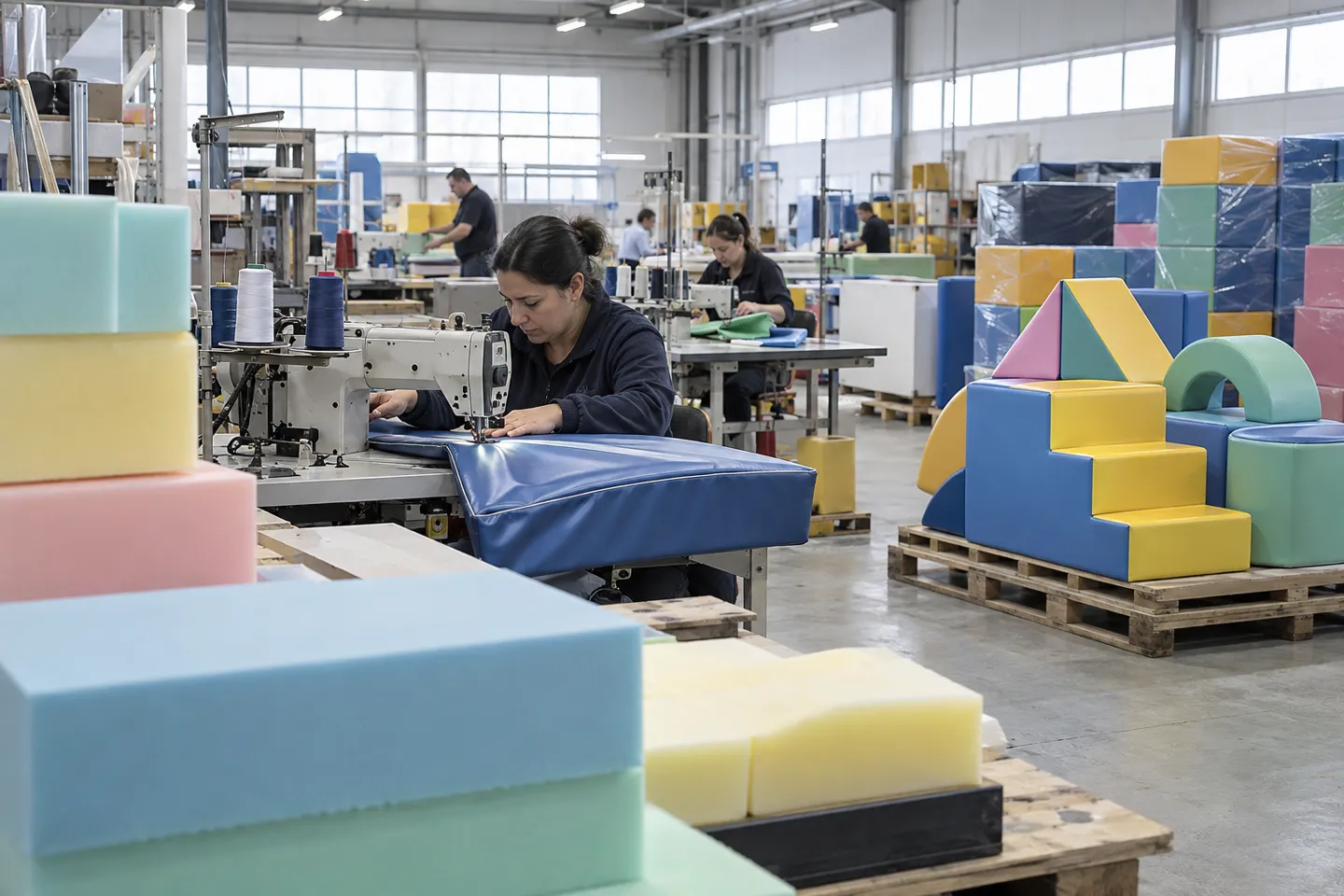
Certificates describe products; the factory question is about capacity and honesty. A live video walkthrough or a third-party audit report tells you whether the supplier actually produces what it sells. Look for production lines that match your order’s material: foam cutting and sewing lines for soft play, rotomolding or injection machines for plastics, metal fabrication for structures.
Then run a trial order, because it is the cheapest full-chain test that exists. A small first order exercises every link you are about to bet on: sample quality, production consistency, packing, document handling, and how the supplier behaves when something goes wrong. Payment terms should follow the same logic. A modest deposit with the balance after inspection beats full prepayment. Letters of credit belong on larger contracts. Most established suppliers expect exactly this, and a supplier that resists a trial order has answered your question for you.
Step 3: Cost the Whole Journey, Not the Sticker Price
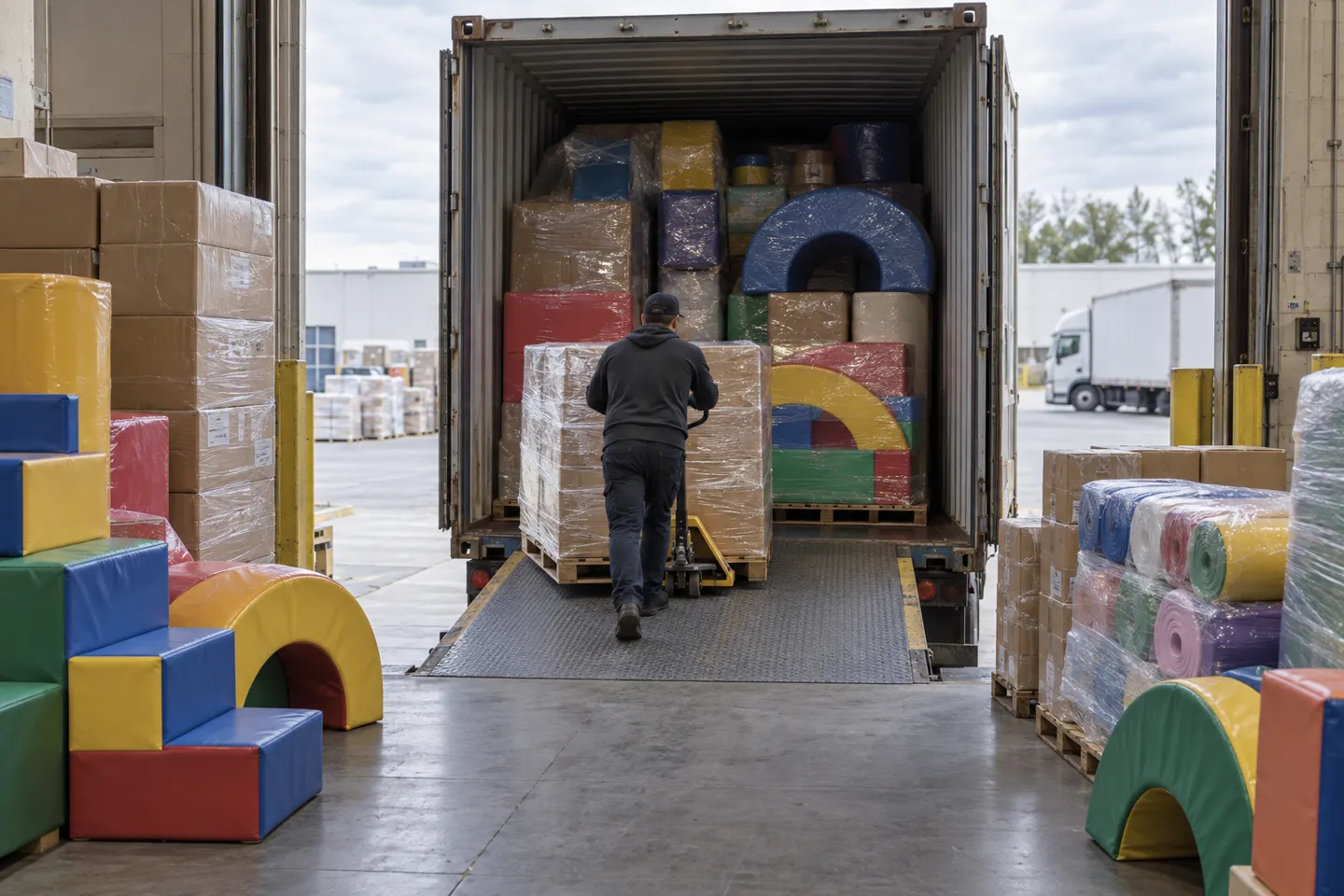
The number on the quote is the beginning of the cost, not the end. Total landed cost stacks at least six items: equipment price, ocean freight, import duties, customs handling, installation, and the ongoing cost of spare parts and warranty response. Soft play equipment is volume-heavy. A container fills by cubic meters long before it fills by weight, so freight takes a real bite out of any factory-price advantage.
Run the comparison over three years, not one shipment. A low factory price attached to slow spare-part response is regularly the most expensive option in the ledger. Every week of downtime at a commercial venue costs admission revenue and reputation. The buyer who costs the whole journey makes a different supplier decision than the buyer who compares sticker prices. That buyer also keeps more of the price gap as profit, instead of losing it to surprises.
Before any money moves, this list is the minimum:
Pre-order verification checklist
- Certificates name the correct standard and version for your product type and market.
- Certificate numbers verify against the issuing body’s public records.
- The tested entity on reports matches the supplier’s legal name.
- Factory confirmed by video walkthrough or third-party audit.
- Trial order completed — quality, packing and documents all pass.
- Payment terms: deposit plus balance-after-inspection, not full prepayment.
- Landed cost modeled: freight, duties, customs, installation, spare parts, warranty response.
Matching the Source to the Buyer
Collapse the guide into one line per buyer. A family furnishing a playroom should shop retail and specialty stores, check that items meet home-use standards, and stop there. The commercial channels would charge for robustness a living room will never need. A play café founder with a few hundred square feet belongs with commercial dealers or soft play specialists. A $15,000–$20,000 equipment budget builds a serious soft-play core there, though not a full multi-level structure. A venue founder planning at FEC scale should collect full-project quotes covering design, production, and installation, then run the vetting sequence on every bidder. A school or church should restrict itself to dealers who supply insurance certificates and procurement-compliant documentation. And a distributor or wholesaler has one lane that makes sense: direct import, negotiated on MOQ, container loads, OEM terms, and spare-part clauses.
That last line deserves its own sentence. Startinal’s soft play & indoor line covers the foam-layer equipment most play spaces start with. We run OEM/ODM programs on color, logo, packaging, and accessories, with in-house designers and product managers behind them. Stock items leave in 1–7 days, samples in 3–5, light custom in 15–25, and bulk production in 3–4 weeks. Trial orders are how most of our partners started. One German early-learning distributor began with a 200-piece trial and reordered four times within a year. And every certificate behind these products is published on the category pages, so the checklist above starts half-finished in your favor.
Your lane at a glance
Home buyer
Retail and specialty stores; confirm home-grade standards and stop there.
Play café founder
Commercial dealers or soft play specialists; $15,000–$20,000 builds a serious soft-play core.
FEC-scale founder
Collect full-project quotes, then run the vetting sequence on every bidder.
School or church
Dealers who supply insurance certificates and procurement-compliant documentation.
Distributor or wholesaler
Direct import, negotiated on MOQ, container loads, OEM terms, and spare-part clauses.
The Business Math: What the Price Gap Means for Trade Buyers
For distributors and wholesalers, the 2–5× spread documented above is not a curiosity; it is the entire business case. Retail-layer goods are commoditized: prices are comparable, and product differences are hard to explain to a shopper. The durable margin in this category lives in the layers where a catalog price cannot follow: certified play structures, project supply, and the service wrapped around them.
Three parts of that margin deserve protection, in a specific order. First, document verifiability. A certificate that fails at customs, or at a marketplace listing, converts the price gap directly into a loss. The temptation to fake documents grows with the size of the discount, so the verification duty grows with it. Second, spare parts and after-sales response: a dealer whose supplier answers in days keeps its venue customers for years, and that retention is worth more than any unit-price saving. Third, consolidation and OEM flexibility: mixed containers, private-label runs, and small repeat orders turn working capital faster than a single large gamble.
So the sourcing scorecard for a trade buyer writes itself, and the order matters: document verifiability first, spare-parts response second, consolidation and OEM flexibility third, unit price last. The price-gap logic only holds when verification holds. When verification fails, the gap does not disappear — it just changes sides of your ledger.
If you are building a supplier shortlist, Startinal’s catalog, with CE and CPC certificates published for open verification, is a reasonable line to include.
Start Your Soft Play Sourcing Shortlist
CE and CPC certificates are published on every category page. Bring your trial-order list, verify before you wire, and quote OEM terms directly.
Get a direct quoteReferences
- U.S. Consumer Product Safety Commission. “Toy Safety Business Guidance.” Accessed 2026. cpsc.gov
- U.S. Consumer Product Safety Commission. “Playground Equipment Business Guidance.” Accessed 2026. cpsc.gov
- iTeh Standards. “EN 1176-10:2023: Playground Equipment and Surfacing—Part 10: Fully Enclosed Play Equipment.” 2023. standards.iteh.ai